

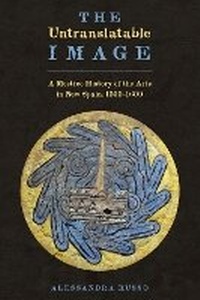
The Untranslatable Image
A Mestizo History of the Arts in New Spain, 1500-1600
Published on 10. January 2023
Book
Paperback/Softback
376 pages
978-0-292-75414-0 (ISBN)
Description
Moving beyond the dominant model of syncretism, this extensively illustrated volume proposes a completely different approach to the field known as Latin American "colonial art," positioning it as a constitutive part of Renaissance and early modern art history.
From the first contacts between European conquerors and the peoples of the Americas, objects were exchanged and treasures pillaged, as if each side were seeking to appropriate tangible fragments of the "world" of the other. Soon, too, the collision between the arts of Renaissance Europe and pre-Hispanic America produced new objects and new images with the most diverse usages and forms. Scholars have used terms such as syncretism, fusion, juxtaposition, and hybridity in describing these new works of art, but none of them, asserts Alessandra Russo, adequately conveys the impact that the European artistic world had on the Mesoamerican artistic world or treats the ways in which pre-Hispanic traditions, expertise, and techniques-as well as the creation of post-Conquest images-transformed the course of Western art.
This innovative study focuses on three sets of paradigmatic images created in New Spain between the sixteenth and seventeenth centuries-feather mosaics, geographical maps, and graffiti-to propose that the singularity of these creations arises not from a syncretic impulse, but rather from a complex process of "untranslatability." Foregrounding the distances and differences between incomparable theories and practices of images, Russo demonstrates how the constant effort to understand, translate, adapt, decode, transform, actualize, and condense Mesoamerican and European aesthetics, traditions, knowledge, techniques, and concepts constituted an exceptional engine of unprecedented visual and verbal creativity in the early modern transatlantic world.
From the first contacts between European conquerors and the peoples of the Americas, objects were exchanged and treasures pillaged, as if each side were seeking to appropriate tangible fragments of the "world" of the other. Soon, too, the collision between the arts of Renaissance Europe and pre-Hispanic America produced new objects and new images with the most diverse usages and forms. Scholars have used terms such as syncretism, fusion, juxtaposition, and hybridity in describing these new works of art, but none of them, asserts Alessandra Russo, adequately conveys the impact that the European artistic world had on the Mesoamerican artistic world or treats the ways in which pre-Hispanic traditions, expertise, and techniques-as well as the creation of post-Conquest images-transformed the course of Western art.
This innovative study focuses on three sets of paradigmatic images created in New Spain between the sixteenth and seventeenth centuries-feather mosaics, geographical maps, and graffiti-to propose that the singularity of these creations arises not from a syncretic impulse, but rather from a complex process of "untranslatability." Foregrounding the distances and differences between incomparable theories and practices of images, Russo demonstrates how the constant effort to understand, translate, adapt, decode, transform, actualize, and condense Mesoamerican and European aesthetics, traditions, knowledge, techniques, and concepts constituted an exceptional engine of unprecedented visual and verbal creativity in the early modern transatlantic world.
Reviews / Votes
Learned, insightful, and challenging, The Untranslatable Image has much to offer not only to Latin American colonial studies but also to the fields of Iberian, Renaissance, and early modern art, culture, and history, as well as to those who are more broadly intrigued by untranslatable images and words, culture contact, and global encounters. (CAA.reviews) A work whose signal achievement is to show how an art history of the New World can free itself from limiting metaphors, like "syncretic," and categorically based methodologies, such as the dutiful parsing of an artwork's "indigenous" or "European" elements. Russo's work in opening pathways of interpretation into cultural agents during a period of dramatic cultural change offers a model to fields beyond art history. (The Americas) The beauty of this book is that it deals with images in a qualitative manner that quantitative shcolars would think of an n-dimensional space. Literally and figuratively imaginative. (SMRC Revista)More details
Language
English
Place of publication
Austin, TX
United States
Target group
Professional and scholarly
Illustrations
150 B&W in text, 35 color in one 32-page section
Dimensions
Height: 229 mm
Width: 152 mm
Thickness: 30 mm
Weight
680 gr
ISBN-13
978-0-292-75414-0 (9780292754140)
Copyright in bibliographic data and cover images is held by Nielsen Book Services Limited or by the publishers or by their respective licensors: all rights reserved.
Schweitzer Classification
Persons
Alessandra Russo is an art historian studying and teaching the early modern worlds in the Department of Latin American and Iberian Cultures at Columbia University in New York City. She is the author of El Realismo Circular: Tierras, espacios y paisajes de la cartografIa novohispana and the coeditor of Images Take Flight: Feather Art in Mexico and Europe. She has participated in the curatorship of the international exhibitions El vuelo de las imAgenes and PlanEte MEtisse and has been the recipient of several international grants, including the Getty Collaborative Research Grant and the Wissenschaftskolleg zu Berlin's fellowship.
Content
Note on Translations
Acknowledgments
Prologue: From One Triptych to Another
Introduction: At the Frontiers of Art Histories
Part One: A Triptych from New Spain
Chapter 1. Treasures
Chapter 2. Figures
Chapter 3. Malicias
Part Two: Images between Words
Chapter 4. Mosaics
Chapter 5. Landscape
Chapter 6. Scratching
Part Three: The Creation of Unexpected Languages
Chapter 7. Relics of Ixiptla
Chapter 8. Circular Realism
Chapter 9. Figurative Condensation
Conclusion: Untranslatable Images?
Notes
Bibliography
Photographic Credits
Index
Acknowledgments
Prologue: From One Triptych to Another
Introduction: At the Frontiers of Art Histories
Part One: A Triptych from New Spain
Chapter 1. Treasures
Chapter 2. Figures
Chapter 3. Malicias
Part Two: Images between Words
Chapter 4. Mosaics
Chapter 5. Landscape
Chapter 6. Scratching
Part Three: The Creation of Unexpected Languages
Chapter 7. Relics of Ixiptla
Chapter 8. Circular Realism
Chapter 9. Figurative Condensation
Conclusion: Untranslatable Images?
Notes
Bibliography
Photographic Credits
Index