

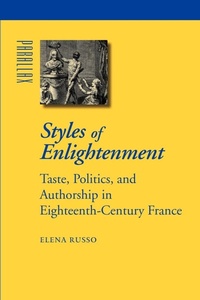
Styles of Enlightenment
Taste, Politics, and Authorship in Eighteenth-Century France
Published on 15. February 2010
Book
Paperback/Softback
366 pages
978-0-8018-9411-4 (ISBN)
Description
Styles of Enlightenment argues that alongside its democratic ideals and its efforts to create a unified public sphere, the Enlightenment also displayed a tendency to erect rigid barriers when it came to matters of style and artistic expression. The French philosophes tackled the issue of the hierarchy of genres with surprising inflexibility, and they looked down on those forms of art that they saw as commercial, popular, and merely entertaining. They were convinced that the standard of taste was too important a matter to be left to the whims of the public and the vagaries of the marketplace: aesthetic judgment ought to belong to a few, enlightened minds who would then pass it on to the masses. Through readings of fictions, essays, memoirs, eulogies, and theatrical works by Fenelon, Bouhours, Marivaux, Montesquieu, Voltaire, Diderot, Rousseau, Mercier, Thomas, and others, Styles of Enlightenment traces the stages of a confrontation between the virile philosophe and the effeminate worldly writer, "good" and "bad" taste, high art and frivolous entertainment, state patronage and the privately sponsored marketplace, the academic eulogy and worldly conversation.
It teases out the finer points of division on the public battlefields of literature and politics and the new world of contesting sexual economies.
It teases out the finer points of division on the public battlefields of literature and politics and the new world of contesting sexual economies.
Reviews / Votes
Clear, well-documented book... Highly recommended. Choice Illuminating and original, Styles of Enlightenment is a welcome addition to eighteenth-century studies. -- Julia Douthwaite Clio This absorbing, well-written study will be of tremendous interest to a wide range of readers. -- Geoffrey Turnovsky H-France The success of the book lies in Russo's ability to stitch together eighteenth-century literary and ethical theory with Augustinian theology and sociology. -- N.B. Leddy Modern Language Review What makes her contribution to eighteenth-century scholarship particularly noteworthy, even groundbreaking, is the new light it sheds on the entire movement of ideas known as the Enlightenment. -- Karlis Racevskis Substance Drawing on recent scholarship by Jay Caplan, Gregory Brown, and Joan DeJean, as well as on an abundance of lively quotations from the literature and art criticism of this period, Russo demonstrates that the philosophes' lofty condemnation of modern taste did not prevent them from succumbing to its appeal. -- Giulia Pacini Eighteenth-Century Life Russo offers a new and critical perspective on the Enlightenment. -- Rori Bloom South Atlantic Review Styles of Enlightenment: Taste, Politics, and Authorship in Eighteenth-Century France rewrites the history of a style that has all too often been dismissed as a marginal by-product of a decadent Regency. -- Giulia Paccini Eighteenth-Century LifeMore details
Series
Language
English
Place of publication
Baltimore, MD
United States
Target group
Professional and scholarly
Product notice
Paperback (trade)
Dimensions
Height: 229 mm
Width: 152 mm
Thickness: 21 mm
Weight
587 gr
ISBN-13
978-0-8018-9411-4 (9780801894114)
DOI
10.1353/book.3383
Copyright in bibliographic data and cover images is held by Nielsen Book Services Limited or by the publishers or by their respective licensors: all rights reserved.
Schweitzer Classification
Other editions
Additional editions
Book
03/2007
Johns Hopkins University Press
€61.00
Article not available for order
E-Book
03/2007
Johns Hopkins University Press
€28.49
Available for download
Person
Elena Russo is a professor of 17th- and 18th-century French literature at the Johns Hopkins University. She is the author of several books, including La Cour et la ville de la litterature classique aux Lumieres and S keptical Selves: Empiricism and Modernity in the French Novel.
Content
Acknowledgments
Introduction
Prologue: Boudoir and Tribune
1. A Faded Coquette: Marivaux and the Philosophes
2. Fakes, Impostors, and Beaux Esprits: Conversation's Backstage
3. The Sly and the Coy Mistress: Style and Manner from Fenelon to Diderot
4. Capturing Fireside Conversation: Diderot and Marivaux's Stylistic Challenge
5. Grace and the Epistemology of Confused Perception
6. Between Paris and Rome: Montesquieu's Poetry of History
7. Montesquieu for the Masses, or Implanting False Memory
8. Everlasting Theatricality: Arlequin and the Untamed Parterre
Epilogue: The Costume of Modernity
Notes
Index
Introduction
Prologue: Boudoir and Tribune
1. A Faded Coquette: Marivaux and the Philosophes
2. Fakes, Impostors, and Beaux Esprits: Conversation's Backstage
3. The Sly and the Coy Mistress: Style and Manner from Fenelon to Diderot
4. Capturing Fireside Conversation: Diderot and Marivaux's Stylistic Challenge
5. Grace and the Epistemology of Confused Perception
6. Between Paris and Rome: Montesquieu's Poetry of History
7. Montesquieu for the Masses, or Implanting False Memory
8. Everlasting Theatricality: Arlequin and the Untamed Parterre
Epilogue: The Costume of Modernity
Notes
Index