

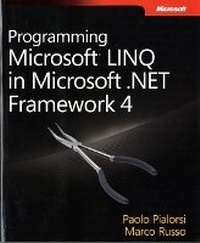
Programming Microsoft LINQ in .NET Framework 4
Published on 23. November 2010
Book
Paperback/Softback
650 pages
978-0-7356-4057-3 (ISBN)
Description
Dig into LINQ -- and transform the way you work with data.
With LINQ, you can query data from a variety of sources -- including databases, objects, and XML files -- directly from Microsoft Visual Basic or C#. Guided by data-access experts who've worked in depth with LINQ and the Microsoft development teams, you'll learn how .NET Framework 4 implements LINQ, and how to exploit it. Clear examples show you how to deliver your own data-access solutions faster and with leaner code.
Discover how to:
Use LINQ to query databases, object collections, arrays, XML, Microsoft Excel files, and other sources
Apply LINQ best practices to build data-enabled .NET applications and services
Manipulate data in a relational database with ADO.NET Entity Framework or LINQ to SQL
Read, write, and manage XML content more efficiently with LINQ to XML
Extend LINQ to support additional data sources by creating custom operators and providers
Examine other implementations, such as LINQ to SharePoint
Use LINQ within the data, business, and service layers of a distributed application
Get code samples on the Web
With LINQ, you can query data from a variety of sources -- including databases, objects, and XML files -- directly from Microsoft Visual Basic or C#. Guided by data-access experts who've worked in depth with LINQ and the Microsoft development teams, you'll learn how .NET Framework 4 implements LINQ, and how to exploit it. Clear examples show you how to deliver your own data-access solutions faster and with leaner code.
Discover how to:
Use LINQ to query databases, object collections, arrays, XML, Microsoft Excel files, and other sources
Apply LINQ best practices to build data-enabled .NET applications and services
Manipulate data in a relational database with ADO.NET Entity Framework or LINQ to SQL
Read, write, and manage XML content more efficiently with LINQ to XML
Extend LINQ to support additional data sources by creating custom operators and providers
Examine other implementations, such as LINQ to SharePoint
Use LINQ within the data, business, and service layers of a distributed application
Get code samples on the Web
More details
Other editions
Additional editions
Marco Russo | Paolo Pialorsi
Programming Microsoft LINQ in .NET Framework 4
E-Book
11/2010
1st Edition
Microsoft Press
€32.29
Available for download
Persons
Paolo Pialorsi is a consultant, trainer, and author who specializes in developing distributed applications architectures and Microsoft SharePoint enterprise solutions. He is a founder of DevLeap, a company focused on providing content and consulting to professional developers. Paolo wrote "Programming Microsoft LINQ" and "Introducing Microsoft LINQ" both published by Microsoft Press, and is the author of three books in Italian language about XML and Web Services. He is also a regular speaker at industry conferences.
Marco Russo is a founder of DevLeap. He is a regular contributor to developer user communities and is an avid blogger on Microsoft SQL Server Business Intelligence and other Microsoft technologies. Marco provides consulting and training to professional developers on the Microsoft .NET Framework and Microsoft SQL Server. He wrote "Programming Microsoft LINQ" and "Introducing Microsoft LINQ" with Paolo Pialorsi, "Expert Cube Development with Microsoft SQL Server 2008 Analysis Services" with Alberto Ferrari and Chris Webb, and is the author of two books in Italian about C# and the common language runtime.
Marco Russo is a founder of DevLeap. He is a regular contributor to developer user communities and is an avid blogger on Microsoft SQL Server Business Intelligence and other Microsoft technologies. Marco provides consulting and training to professional developers on the Microsoft .NET Framework and Microsoft SQL Server. He wrote "Programming Microsoft LINQ" and "Introducing Microsoft LINQ" with Paolo Pialorsi, "Expert Cube Development with Microsoft SQL Server 2008 Analysis Services" with Alberto Ferrari and Chris Webb, and is the author of two books in Italian about C# and the common language runtime.
Content
Preface
Acknowledgments
Introduction
Part I: LINQ Foundations
Chapter 1: LINQ Introduction
Chapter 2: LINQ Syntax Fundamentals
Chapter 3: Linq to Objects
Part II: LINQ to Relational
Chapter 4: Choosing Between LINQ to SQL and LINQ to Entities
Chapter 5: LINQ to SQL: Querying Data
Chapter 6: LINQ to SQL: Managing Data
Chapter 7: LINQ to SQL: Modeling Data and Tools
Chapter 8: LINQ to Entities: Modeling Data with Entity Framework
Chapter 9: LINQ to Entities: Querying Data
Chapter 10: LINQ to Entities: Managing Data
Chapter 11: LINQ to DataSet
Part III: LINQ to XML
Chapter 12: LINQ to XML: Managing the XML Infoset
Chapter 13: LINQ to XML: Querying Nodes
Part IV: Advanced LINQ
Chapter 14: Inside Expression Trees
Chapter 15: Extending LINQ
Chapter 16: Parallelism and Asynchronous Processing
Chapter 17: Other LINQ Implementations
Part V: Applied LINQ
Chapter 18: LINQ in a Multitier Solution
Chapter 19: LINQ Data Binding
Acknowledgments
Introduction
Part I: LINQ Foundations
Chapter 1: LINQ Introduction
Chapter 2: LINQ Syntax Fundamentals
Chapter 3: Linq to Objects
Part II: LINQ to Relational
Chapter 4: Choosing Between LINQ to SQL and LINQ to Entities
Chapter 5: LINQ to SQL: Querying Data
Chapter 6: LINQ to SQL: Managing Data
Chapter 7: LINQ to SQL: Modeling Data and Tools
Chapter 8: LINQ to Entities: Modeling Data with Entity Framework
Chapter 9: LINQ to Entities: Querying Data
Chapter 10: LINQ to Entities: Managing Data
Chapter 11: LINQ to DataSet
Part III: LINQ to XML
Chapter 12: LINQ to XML: Managing the XML Infoset
Chapter 13: LINQ to XML: Querying Nodes
Part IV: Advanced LINQ
Chapter 14: Inside Expression Trees
Chapter 15: Extending LINQ
Chapter 16: Parallelism and Asynchronous Processing
Chapter 17: Other LINQ Implementations
Part V: Applied LINQ
Chapter 18: LINQ in a Multitier Solution
Chapter 19: LINQ Data Binding