

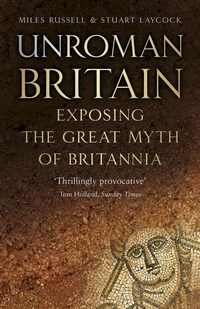
UnRoman Britain
Exposing the Great Myth of Britannia
3rd Edition
Published on 30. September 2019
Book
Paperback/Softback
352 pages
978-0-7509-9081-3 (ISBN)
Description
Roman Britain is usually thought of as a land full of togas, towns and baths with Britons happily going about their Roman lives under the benign gaze of Rome. This is, to a great extent, a myth that developed after Roman control of Britain came to an end, in particular when the British Empire was at its height in the late nineteenth and early twentieth centuries.
In fact, Britain was one of the least enthusiastic elements of the Roman Empire. The northern part of Britain was never conquered at all despite repeated attempts. Some Britons adopted Roman ways in order to advance themselves and become part of the new order, or just because they liked the new range of products available. However, many failed to acknowledge the Roman lifestyle at all, while many others were only outwardly Romanised, clinging to their own identities under the occupation. Britain never fully embraced the Empire and was itself never fully accepted by the rest of the Roman world. Even the Roman army inBritain became chronically rebellious and a source of instability that ultimately affected the whole Empire. As Roman power weakened, the Britons abandoned both Rome and almost all Roman culture, and the island became a land of warring kingdoms, as it had been before.
In fact, Britain was one of the least enthusiastic elements of the Roman Empire. The northern part of Britain was never conquered at all despite repeated attempts. Some Britons adopted Roman ways in order to advance themselves and become part of the new order, or just because they liked the new range of products available. However, many failed to acknowledge the Roman lifestyle at all, while many others were only outwardly Romanised, clinging to their own identities under the occupation. Britain never fully embraced the Empire and was itself never fully accepted by the rest of the Roman world. Even the Roman army inBritain became chronically rebellious and a source of instability that ultimately affected the whole Empire. As Roman power weakened, the Britons abandoned both Rome and almost all Roman culture, and the island became a land of warring kingdoms, as it had been before.
More details
Edition
3rd edition
Language
English
Place of publication
Stroud
United Kingdom
Product notice
Paperback (trade)
Unsewn / adhesive bound
Illustrations
70 Illustrations, black and white
Dimensions
Height: 196 mm
Width: 130 mm
Thickness: 28 mm
Weight
408 gr
ISBN-13
978-0-7509-9081-3 (9780750990813)
Copyright in bibliographic data and cover images is held by Nielsen Book Services Limited or by the publishers or by their respective licensors: all rights reserved.
Schweitzer Classification
Other editions
Previous edition
Book
09/2011
The History Press Ltd
€39.80
Article exhausted; check for reprint
Persons
Dr MILES RUSSELL is a Senior Lecturer in Prehistoric and Roman Archaeology in the School of Conservation Sciences at Bournemouth University and regularly appears on Channel 4's Time Team. He has been involved in Sussex archaeology for over 25 years and is currently examining a number of early Roman sites in the county. His previous books with The History Press include Prehistoric Sussex, Piltdown Man: the secret life of Charles Dawson and Monuments of the British Neolithic.
STUART LAYCOCK studied Classics at Cambridge, before working as a writer in advertising. He is now a historian and writer, and has written a number of history books, including Britannia: The Failed State (nominated for Current Archaeology Book of the Year) and the bestselling All the Countries We've Ever Invaded.
STUART LAYCOCK studied Classics at Cambridge, before working as a writer in advertising. He is now a historian and writer, and has written a number of history books, including Britannia: The Failed State (nominated for Current Archaeology Book of the Year) and the bestselling All the Countries We've Ever Invaded.