

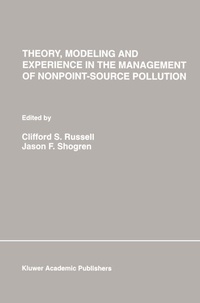
Theory, Modeling and Experience in the Management of Nonpoint-Source Pollution
Published on 10. October 2012
Book
Paperback/Softback
XVII, 345 pages
978-1-4613-6382-8 (ISBN)
Description
Nonpoint-source pollution (NPSP) poses a special challenge to society's ability to manage its collective environmental good - especially surface and groundwater quality. Since there is no `point', such as an outfall pipe, from which the pollution is being discharged and can be measured, pollution can reach the ambient environment without being monitored. Since management of air and water polution requires the definition and enforcement of limits on discharges or the imposition of fees on those discharges, inability to measure limits our ability to manage this environmental problem. This book presents a state-of-the-art review and discussion of economists' efforts to resolve this major problem and attempts to provide a way of working around it. The book sets forth the theoretical issues, modeling, and the actual programs set up to confront this issue.
More details
Series
Edition
Softcover reprint of the original 1st ed. 1993
Language
English
Place of publication
New York
United States
Target group
Professional and scholarly
Research
Illustrations
XVII, 345 p.
Dimensions
Height: 235 mm
Width: 155 mm
Thickness: 20 mm
Weight
557 gr
ISBN-13
978-1-4613-6382-8 (9781461363828)
DOI
10.1007/978-1-4615-3156-2
Schweitzer Classification
Other editions
Additional editions
Clifford S. Russell | Jason F. Shogren
Theory, Modeling and Experience in the Management of Nonpoint-Source Pollution
Book
01/1993
Kluwer Academic Publishers
€213.99
Shipment within 15-20 days
Content
1. Information Problems in the Design of Nonpoint-Source Pollution Policy.- 2. Differences in the Transaction Costs of Strategies to ControlAgricultural Offsite and Undersite Damages.- 3. Regulatory/Economic Instruments for Agricultural Pollution: Accounting for Input Substitution.- 4. Nonpoint-Source Pollution Control, Information Asymmetry,and the Choice of Time Profile for Environmental Fees.- 5. Point/Nonpoint Source Trading for Controlling Pollutant Loadings to Coastal Waters: A Feasibility Study.- 6. Integrating Economic & Physical Models for AnalyzingEnvironmental Effects of Agricultural Policy on NonpointSource Pollution.- 7. Data Requirements for Modeling and Evaluation of National Policies Aimed at Controlling Agricultural Sources ofNonpoint Water Pollution.- 8. Analysis of Policy Options for the Control of AgriculturalPollution in California's San Joaquin River Basin.- 9. Regional Modeling and Economic Incentives to ControlDrainage Pollution.- 10. Florida's Experience with Managing Nonpoint-Source Phosphorus Runoff into Lake Okeechobee.- 11. Subsidizing Agricultural Nonpoint-Source Pollution Control: Targetting Cost Sharing & Technical Assistance.- 12. Reforming Nonpoint Pollution Policy.