

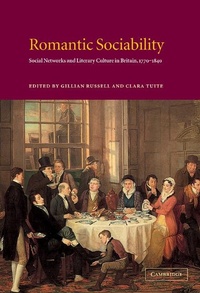
Romantic Sociability
Social Networks and Literary Culture in Britain, 1770-1840
Published on 2. May 2002
Book
Hardback
280 pages
978-0-521-77068-2 (ISBN)
Description
Challenging the assumptions which underlie an understanding of the 'Romantics' as solitary and anti-sociable, and Romanticism as representing the rejection of Enlightenment sociability, this 2002 volume introduces sociability to the field of Romantic literary and cultural studies. The volume engages with Jurgen Habermas' model of the 'public sphere' which emphasizes the coffee-house and club as models of an older, masculine eighteenth-century sociability, and focuses on the changing nature of sociability in British radical culture of the 1790s and on the gendered nature of sociability. In a range of essays which examine modes of sociability as diverse as circles of sedition, international republicanism, Dissenting culture, Romantic lecturing, theatre, and shopping, the volume transforms our understanding of Romanticism by exploring the social networks of such central Romantic figures as Anna Barbauld, Frances Burney, Samuel Taylor Coleridge, William Godwin, William Hazlitt, Anne Lister, Robert Merry, Joseph Priestley, John Thelwall and Mary Wollstonecraft.
Reviews / Votes
'[a] rich collection of essays ...'. British Association of Romantic Studies BulletinMore details
Language
English
Place of publication
Cambridge
United Kingdom
Target group
Professional and scholarly
Illustrations
4 Halftones, unspecified
Dimensions
Height: 235 mm
Width: 157 mm
Thickness: 21 mm
Weight
609 gr
ISBN-13
978-0-521-77068-2 (9780521770682)
Copyright in bibliographic data and cover images is held by Nielsen Book Services Limited or by the publishers or by their respective licensors: all rights reserved.
Schweitzer Classification
Persons
Gillian Russell is Senior Lecturer in English at the Australian National University. She is author of The Theatres of War: Performance, Politics and Society, 1793-1815 (1995) and an associate editor of The Oxford Companion to the Romantic Age: British Culture 1776-1832 ed. Iain McCalman (1999). Her articles have appeared in Eighteenth-Century Life, British Journal for Eighteenth-Century Studies, Eighteenth-Century Studies and The Eighteenth Century: Theory and Interpretation. Clara Tuite is Lecturer in English at the University of Melbourne. She is the author of Romantic Austen (Cambridge University Press, 2002) and an associate editor of The Oxford Companion to the Romantic Age: British Culture 1776-1832 ed. Iain McCalman (1999).
Content
Acknowledgements; 1. Introducing Romantic sociability Gillian Russell and Clara Tuite; 2. Sociability and the international republican conversation Margaret C. Jacob; 3. 'Equality and no king': sociability and sedition; the case of John Frost James Epstein; 4. Amiable and radical sociability: Anna Barbauld's 'free familiar conversation' Anne Janowitz; 5. Firebrands, letters and flowers: Mrs. Barbauld and the Priestleys Deirdre Coleman; 6. 'Reciprocal expressions of kindness': Robert Merry, the Della Cruscans, and the limits of Romantic sociability Jon Mee; 7. Spouters of washerwomen: the sociability of Romantic lecturing Gillian Russell; 8. Hazlitt and the sociability of theatre Julie A. Carlson; 9. 'Obliged to make this sort of deposit of our minds': William Godwin and the sociable contract of writing Judith Barbour; 10. The Byronic woman: Anne Lister's style, sociability and sexuality Clara Tuite; 11. Counter publics: shopping and women's sociability Deidre Shauna Lynch; Bibliography; Index.