

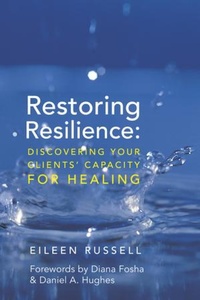
Restoring Resilience
Discovering Your Clients' Capacity for Healing
Published on 12. June 2015
Book
Hardback
384 pages
978-0-393-70571-3 (ISBN)
Description
Eileen Russell offers therapists a model for drawing on their clients' innate strengths to get the most out of therapy. Without minimising pathology, she explains what is meant by resilience in a clinical context, how to work with it, how to cultivate it and why using it is an effective approach to healing.
Reviews / Votes
"Restoring Resilience provides an innovative and convincing roadmap to optimize clients' resilience through the clinical interaction. Embedded in Russell's model is an understanding that resilience is a core component of the healthy individual that, as a construct, mirrors the physiological construct of homeostasis. Similar to homeostasis, the self has a natural range around a set point that optimizes reactions to challenges. The expanded range around a set point is Russell's definition of resilience and the goal of psychotherapy. Russell's intellectual agility shines through as she deconstructs clinical vignettes from emotional, historical, interpersonal, and neuroscience perspectives." -- Stephen Porges, PhD, Professor, Department of Psychiatry, University of North Carolina, Chapel Hill; author of The Polyvagal Theory "In this wonderfully rich synthesis of theory, science, and clinical application, Eileen Russell takes us on an insightful and inspiring exploration of how the process of therapy can be deepened and enhanced when resilience, rather than psychopathology, becomes our focus. It is a must read for any clinician interested in more readily and reliably recognizing and making optimal use of our clients' innate capacity for healing and transformation. I highly recommend it." -- Ronald J. Frederick, PhD, psychologist; author of Living Like You Mean It "As someone who has researched the positive effects of learning AEDP on the person of the therapist, I welcome Russell's book. Through ample case examples, annotated transcripts, and eloquent disquisition, Russell enables the reader to understand and experience how resilience-oriented work enlivens stuck clients and stuck therapists. Whether AEDP is your home theory or not, you will find clinical wisdom and, I dare say, inspiration within its pages." -- Hanna Levenson, PhD, Professor, Wright Institute; author of Brief Dynamic Therapy: An Attachment-based, Experiential ApproachMore details
Language
English
Place of publication
New York
United States
Target group
Professional and scholarly
Dimensions
Height: 241 mm
Width: 161 mm
Thickness: 38 mm
Weight
750 gr
ISBN-13
978-0-393-70571-3 (9780393705713)
Copyright in bibliographic data and cover images is held by Nielsen Book Services Limited or by the publishers or by their respective licensors: all rights reserved.
Schweitzer Classification
Other editions
Additional editions
E-Book
06/2015
W. W. Norton & Company
€27.99
Available for download
Persons
Eileen Russell, PhD, is a clinical psychologist in private practice in New York City and Montclair, NJ. She is a senior faculty and founding member of the AEDP Institute and has taught and supervised people in AEDP nationally and internationally for many years. She is also an adjunct clinical instructor at NYU/Bellevue Hospital Center where she was formerly a Senior Psychologist working with dually diagnosed individuals. Her other research and writing interests include AEDP theory and practice, the integration of psychodynamic understanding with experiential methods, the role of spirituality in psychotherapy and healing, and the "human beingness" of existence and experience. Diana Fosha, PhD, is the developer of AEDP (R), a healing-based, radically relational, transformation-oriented experiential psychotherapy, and Founder and Director of the AEDP (R) Institute. She is the editor of Undoing Aloneness and the Transformation of Suffering into Flourishing: AEDP 2.0 (APA, 2021); co-editor with Natasha Prenn of Supervision Essentials for Accelerated Experiential Dynamic Psychotherapy (APA, 2016); co-editor with Dan Siegel and Marion Solomon of The Healing Power of Emotion: Affective Neuroscience, Development & Clinical Practice (Norton, 2009); and author of The Transforming Power of Affect: A Model for Accelerated Change (Basic Books, 2000). Based in New York City, where she lives and practices, Fosha has been on the faculties of the Departments of Psychiatry and Psychology of NYU and St. Luke's/Roosevelt Medical Centers (now Mount Sinai) in NYC, and of the doctoral programs in Clinical Psychology at the Derner Institute for Advanced Psychological Studies at Adelphi University and at The City University of New York. Daniel Hughes, PhD, is a clinical psychologist and author who developed Dyadic Developmental Psychotherapy. He lives in Annville, Pennsylvania.