

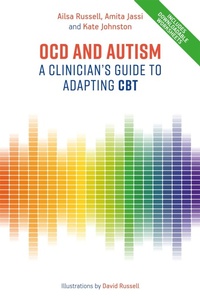
OCD and Autism
A Clinician's Guide to Adapting CBT
Published on 21. January 2019
Book
Paperback/Softback
144 pages
978-1-78592-379-1 (ISBN)
Description
This step-by-step manual explains how to adapt CBT (Cognitive Behaviour Therapy) approaches to OCD (Obsessive Compulsive Disorder) for autistic children and adults. It outlines why there is the need to adapt treatment for the autistic population, and includes detailed guidance on each phase of the approach.
It explains assessment of OCD in autism, the links between the two conditions and difficulties in identifying aspects of OCD in autistic people. The book offers advice on dealing with difficult issues and on the next steps after treatment is complete. Accompanying worksheets and handouts are available to download.
It explains assessment of OCD in autism, the links between the two conditions and difficulties in identifying aspects of OCD in autistic people. The book offers advice on dealing with difficult issues and on the next steps after treatment is complete. Accompanying worksheets and handouts are available to download.
Reviews / Votes
Drs. Russell, Jassi, and Johnston should be congratulated for filling a critical gap in the literature by crafting an evidence-based adaptation of cognitive-behavioral therapy for supporting individuals with autism and co-occurring OCD. The text is clear, informed by the latest scientific findings, and will successfully disseminate established interventional approaches to practicing clinicians. -- Eric Storch, Ph.D., McIngvale Presidential Endowed Chair & Professor, Vice Chair & Head of Psychology, Menninger Department of Psychiatry & Behavioral Sciences, Baylor College of Medicine The authors provide a clear, concise guide to the puzzle of OCD and ASD. There is clear advice on how to adapt CBT for OCD including key aspects such as the differences between compulsions and repetitive behaviours and obsessions and special interests. This volume is invaluable to those who are already familiar with OCD but less experienced in ASD. The authors speak with confidence and experience about how to adapt treatment to make the most of the powerful aspects of ERP whilst remaining sensitive to the particular needs of people with ASD. This is reassuring to novice practitioners to be aware of certain "do's and don'ts" and enlightening for both novice and experienced therapists when considering the nuance and detail of effective CBT. -- Dr Victoria Bream, Clinical Psychologist, Centre for Anxiety Disorders and Trauma, South London and Maudsley NHS Foundation Trust.More details
Language
English
Place of publication
London
United Kingdom
Target group
College/higher education
Professional and scholarly
Product notice
Paperback (UK-trade)
Illustrations
15 black and white line drawings
Dimensions
Height: 228 mm
Width: 154 mm
Thickness: 12 mm
Weight
207 gr
ISBN-13
978-1-78592-379-1 (9781785923791)
Copyright in bibliographic data and cover images is held by Nielsen Book Services Limited or by the publishers or by their respective licensors: all rights reserved.
Schweitzer Classification
Other editions
Additional editions
E-Book
01/2019
Jessica Kingsley Publishers
€28.99
Available for download
Persons
Dr Amita Jassi is a Consultant Clinical Psychologist at the National and Specialist OCD, BDD and Related Disorder Service for Children and Young People (South London and Maudsley NHS Trust). She lives in London, UK. David Russell is currently the Chief Executive Officer at Parent to Parent and has extensive experience specialising in work with children and young people with harmful sexual behaviour and / or who have experienced sexual abuse or exploitation. He currently sits on the NOTA (National Organisation for the Treatment of Abuse) Scotland Executive Committee, supporting professionals responding to sexual harm.
Content
1. Introduction to Autism and Adaptations to Cognitive Behaviour Therapy. 2. Assessment of Obsessive Compulsive Disorder (OCD) in Autism. 3. CBT Phase 1: Building Blocks for Treatment. 4. CBT Phase 2: Understanding and Rating Anxiety. 5. CBT Phase 3: Exposure with Response Prevention. 6. CBT Phase 4: Relapse Prevention. 7. Useful Resources and Organisations.