

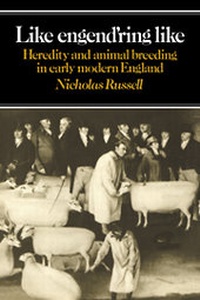
Like Engend'ring Like
Heredity and Animal Breeding in Early Modern England
Published on 3. July 1986
Book
Hardback
280 pages
978-0-521-30657-7 (ISBN)
Description
Robert Bakewell of Dishley Grange in Leicestershire is usually regarded as the founding father of modern farm livestock breeding, and is thought of as one of the legendary pioneers of the agricultural revolution in late eighteenth-century Britain. However, Bakewell was by no means the first English breeder to practise deliberate selection of desirable qualities in his livestock. This book sets out to examine the ideas and techniques of earlier generations of agricultural and sporting improvers in the seventeenth and eighteenth centuries, and to demonstrate the earlier sources of many of Bakewell's opinions and procedures. It reviews the relationships which may have existed between the ideas of practical animal breeders and those of philosophical naturalists with theoretical ideas about heredity. It also touches on the question of whether the stimulus for the development of new stock was provided by demand for different products or by a desire to obtain knowledge about the heredity of domestic animals.
More details
Language
English
Place of publication
Cambridge
United Kingdom
Target group
Professional and scholarly
Dimensions
Height: 228 mm
Width: 152 mm
Thickness: 21 mm
Weight
515 gr
ISBN-13
978-0-521-30657-7 (9780521306577)
Copyright in bibliographic data and cover images is held by Nielsen Book Services Limited or by the publishers or by their respective licensors: all rights reserved.
Schweitzer Classification
Other editions
New editions
Book
03/2007
Cambridge University Press
€61.40
Shipment within 15-20 days
Additional editions
Book
03/2007
Cambridge University Press
€61.40
Shipment within 15-20 days
Content
List of charts, tables and plates; Preface; Introduction; 1. Breeding strategies; 2. The classical tradition: theories of heredity and breeding practice in Greece and Rome; 3. Generation and the market: the background to animal breeding in the seventeenth and eighteenth centuries; 4. The horse: breeding for war, sport and fashion; 5. Horse breeding in the eighteenth century: blood, speed and carriages; 6. Cattle breeding: dairymen, graziers and the techniques of their 'fancy'; 7. Breeding sheep: mutton displaces wool; 8. Summary and conclusion; Notes; Bibliography; Index.