

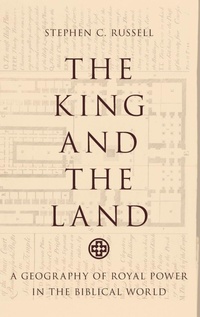
The King and the Land
A Geography of Royal Power in the Biblical World
Published on 8. December 2016
Book
Hardback
302 pages
978-0-19-936188-5 (ISBN)
Description
This is an open access title available under the terms of a CC BY-NC-ND 4.0 International license. It is free to read at Oxford Scholarship Online and offered as a free PDF download from OUP and selected open access locations.
In The King and the Land, Stephen C. Russell offers a history of space and power in the biblical world by demonstrating how the monarchies in ancient Israel and Judah asserted their power over strategically important spaces such as privately-held lands, religious buildings, collectively-governed towns, and urban water systems. Case studies in the book treat Solomon's use of foreign architecture (1 Kings 5-8), David's dedication of land to Yahweh (2 Samuel 24), Jehu's decommissioning of Baal's temple (2 Kings 10), Absalom's navigation of the collective politics of Levantine towns (2 Samuel 15), and Hezekiah's reshaping of the tunnels that supplied Jerusalem with water (2 Kings 20; 2 Chronicles 32).
Steeped in archaeological and textual evidence, this book contextualizes Israelite and Judahite royal and tribal politics within broader patterns of ancient Near Eastern spatial power. By providing a historical investigation into the nature of power and physical space in the Iron Age Levant, this book also offers fresh literary readings of the biblical texts that anchor its theses.
In The King and the Land, Stephen C. Russell offers a history of space and power in the biblical world by demonstrating how the monarchies in ancient Israel and Judah asserted their power over strategically important spaces such as privately-held lands, religious buildings, collectively-governed towns, and urban water systems. Case studies in the book treat Solomon's use of foreign architecture (1 Kings 5-8), David's dedication of land to Yahweh (2 Samuel 24), Jehu's decommissioning of Baal's temple (2 Kings 10), Absalom's navigation of the collective politics of Levantine towns (2 Samuel 15), and Hezekiah's reshaping of the tunnels that supplied Jerusalem with water (2 Kings 20; 2 Chronicles 32).
Steeped in archaeological and textual evidence, this book contextualizes Israelite and Judahite royal and tribal politics within broader patterns of ancient Near Eastern spatial power. By providing a historical investigation into the nature of power and physical space in the Iron Age Levant, this book also offers fresh literary readings of the biblical texts that anchor its theses.
Reviews / Votes
This volume is packed with many fruitful insights and intriguing interpretations that make this work a must read for anyone interested in the dynamics of power in ancient Israel and in text-critical issues in the Hebrew Bible. * Kyle H. Keimer, Macquarie University * Readers who are looking for a well-researched, critical study of royal power and space in the biblical world would benefit from reading this book. It is very readable for a general audience, and the extensive notes and bibliography, which make up more than half of the book, are useful to a scholarly audience. * Jaime L. Waters, Biblical Theology Bulletin05/11/2018 * The gains of the book...are considerable for those who read with sufficient patience. They will read more knowingly about royal power in the Bible. And beyond the scope of the book itself, the tension between centralized economic-political leverage and a community-based social realty is immediately pertinent to our interpretive situation in the United States. The book will help us read more knowingly the Bible as an arena in which social power is intensely contested and our own circumstance of public power that faces acute crisis. * Walter Brueggemann, Interpretation: A Journal of Bible and Theology *More details
Language
English
Place of publication
New York
United States
Target group
College/higher education
Professional and scholarly
Dimensions
Height: 240 mm
Width: 161 mm
Thickness: 21 mm
Weight
619 gr
ISBN-13
978-0-19-936188-5 (9780199361885)
Copyright in bibliographic data and cover images is held by Nielsen Book Services Limited or by the publishers or by their respective licensors: all rights reserved.
Schweitzer Classification
Other editions
Additional editions
E-Book
10/2016
1st Edition
OUP eBook
€0.00
Available for download
E-Book
10/2016
1st Edition
OUP eBook
€38.49
Available for download
Person
Stephen C. Russell is Assistant Professor of Ancient History at John Jay College, CUNY.
Content
Acknowledgments
1. Solomon's Temple: On Space, Power, and Ancient Evidence
2. David's Threshing Floor: On Royal Dedication of Land to the Gods
3. Jehu's Dung Heap: On Royal Decommissioning of Religious Space
4. Absalom's Gate: On Royal Navigation of Collective Urban Politics
5. Hezekiah's Tunnel: On Royal Shaping of the Water Supply
6. Summary
Notes
Bibliography
Index of Ancient Sources
Index of Authors
Index of Subjects
1. Solomon's Temple: On Space, Power, and Ancient Evidence
2. David's Threshing Floor: On Royal Dedication of Land to the Gods
3. Jehu's Dung Heap: On Royal Decommissioning of Religious Space
4. Absalom's Gate: On Royal Navigation of Collective Urban Politics
5. Hezekiah's Tunnel: On Royal Shaping of the Water Supply
6. Summary
Notes
Bibliography
Index of Ancient Sources
Index of Authors
Index of Subjects