

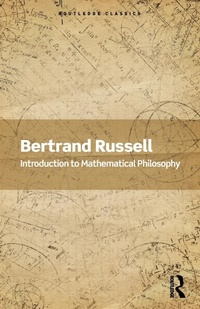
Introduction to Mathematical Philosophy
1st Edition
Published on 15. September 2022
Book
Paperback/Softback
226 pages
978-1-032-31227-9 (ISBN)
Description
"The philosophy of mathematics will naturally be expected to deal with questions at the frontier of knowledge, as to which comparative certainty is not yet attained. But separation of such questions is hardly likely to be fruitful unless the more scientific parts of mathematics are known. A book dealing with those parts may, therefore, claim to be an introduction to mathematical philosophy..." - Bertrand Russell, from the Preface
First published in 1919, Introduction to Mathematical Philosophy shows Russell drawing on his formidable knowledge of philosophy and mathematics to write a brilliant introduction to the subject. Russell explains that mathematics can be approached in two distinct directions: one that is driven by a mechanical kind of simplicity and builds towards complexity, from integers to fractions and real numbers to complex ones; and one that searches for abstractness and logical simplicity by asking what general principles underlie mathematics.
From here Russell introduces and explains, in his customary pellucid prose, the definition of numbers, finitude, correlation and relation, mathematical limits, infinity, propositional descriptions and classes. Russell concludes with a fascinating summary of the relationship between mathematics and logic, of which he states "logic is the youth of mathematics."
This Routledge Classics edition includes a new Foreword by Michael Potter.
First published in 1919, Introduction to Mathematical Philosophy shows Russell drawing on his formidable knowledge of philosophy and mathematics to write a brilliant introduction to the subject. Russell explains that mathematics can be approached in two distinct directions: one that is driven by a mechanical kind of simplicity and builds towards complexity, from integers to fractions and real numbers to complex ones; and one that searches for abstractness and logical simplicity by asking what general principles underlie mathematics.
From here Russell introduces and explains, in his customary pellucid prose, the definition of numbers, finitude, correlation and relation, mathematical limits, infinity, propositional descriptions and classes. Russell concludes with a fascinating summary of the relationship between mathematics and logic, of which he states "logic is the youth of mathematics."
This Routledge Classics edition includes a new Foreword by Michael Potter.
More details
Series
Language
English
Place of publication
London
United Kingdom
Publishing group
Taylor & Francis Ltd
Target group
College/higher education
General, Postgraduate, and Undergraduate Core
Dimensions
Height: 216 mm
Width: 140 mm
Thickness: 13 mm
Weight
293 gr
ISBN-13
978-1-032-31227-9 (9781032312279)
Copyright in bibliographic data and cover images is held by Nielsen Book Services Limited or by the publishers or by their respective licensors: all rights reserved.
Schweitzer Classification
Other editions
Additional editions
Bertrand Russell
Introduction to Mathematical Philosophy
E-Book
09/2022
1st Edition
Routledge
€25.99
Available for download
Bertrand Russell
Introduction to Mathematical Philosophy
E-Book
09/2022
1st Edition
Routledge
€25.99
Available for download
Bertrand Russell
Introduction to Mathematical Philosophy
Book
09/2022
1st Edition
Routledge
€178.80
Shipment within 10-20 days
Person
Bertrand Russell (1872-1970). A celebrated mathematician and logician, Russell was and remains one of the most genuinely widely read and popular philosophers of modern times.
Content
Foreword to the Routledge Classics Edition Michael Potter Preface 1. The Series of Natural Numbers 2. Definition of Number 3. Finitude and Mathematical Induction 4. The Definition of Order 5. Kinds of Relations 6. Similarity of Relations 7. Rational, Real, and Complex Numbers 8. Infinite Cardinal Numbers 9. Infinite Series and Ordinals 10. Limits and Continuity 11. Limits and Continuity of Functions 12. Selections and the Multiplicative Axiom 13. The Axiom of Infinity and Logical Types 14. Incompatibility and the Theory of Deduction 15. Propositional Functions 16. Descriptions 17. Classes 18. Mathematics and Logic. Index