

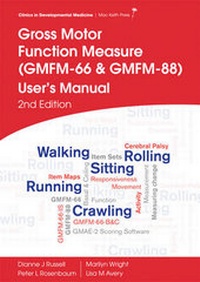
Gross Motor Function Measure (GMFM-66 and GMFM-88) User's Manual
2nd Edition
Published on 8. November 2013
Book
Spiral bound
304 pages
978-1-908316-88-2 (ISBN)
Description
The Gross Motor Function Measure (GMFM) has become the best evaluative measure of motor function designed for quantifying change in the gross motor abilities of children with cerebral palsy. The new version of the scoring programme has now been released, and includes two abbreviated methods of estimating GMFM-66 scores using the GMFM-66-Item sets and the GMFM-66-Basal & Ceiling.
The measure is very widely used internationally, and is now the standard outcome assessment tool. This new edition builds on the wide success of the first edition and:
Is now based on an updated version of the GMFM scoring program (GMAE-2)
Includes an update on the psychometric properties of the GMFM-88 and GMFM-66
Covers development and validation of two abbreviated methods of estimating GMFM-66 scores using the GMFM-66 Item sets (GMFM-66-IS) and the GMFM-66-B&C (Basal and Ceiling)
Includes a new longitudinal case illustration of the development, application and interpretation of the measure
Presents a forward look to an upward extension of the GMFM to assess skill development in highly functional young people with cerebral palsy
Presents a forward look to ?Quality Function Measure? to quantify changes in quality of gross motor function
Readership
Physical Therapists and other health professionals working with children, youth and adults with cerebral palsy
Clinical and health services researchers as an outcome measure to assess the impact of numerous interventions that are proposed as methods of enhancing gross motor function in this population
Any clinician who is assessing and describing current gross motor function and evaluating its change over time
It serves the needs of clinical and health services researchers as an outcome measure to assess the impact of any of a host of interventions that are proposed as methods of enhancing gross motor function in this population.
The measure is very widely used internationally, and is now the standard outcome assessment tool. This new edition builds on the wide success of the first edition and:
Is now based on an updated version of the GMFM scoring program (GMAE-2)
Includes an update on the psychometric properties of the GMFM-88 and GMFM-66
Covers development and validation of two abbreviated methods of estimating GMFM-66 scores using the GMFM-66 Item sets (GMFM-66-IS) and the GMFM-66-B&C (Basal and Ceiling)
Includes a new longitudinal case illustration of the development, application and interpretation of the measure
Presents a forward look to an upward extension of the GMFM to assess skill development in highly functional young people with cerebral palsy
Presents a forward look to ?Quality Function Measure? to quantify changes in quality of gross motor function
Readership
Physical Therapists and other health professionals working with children, youth and adults with cerebral palsy
Clinical and health services researchers as an outcome measure to assess the impact of numerous interventions that are proposed as methods of enhancing gross motor function in this population
Any clinician who is assessing and describing current gross motor function and evaluating its change over time
It serves the needs of clinical and health services researchers as an outcome measure to assess the impact of any of a host of interventions that are proposed as methods of enhancing gross motor function in this population.
More details
Series
Edition
2nd edition
Language
English
Place of publication
Cambridge
United Kingdom
Target group
Professional and scholarly
Dimensions
Height: 239 mm
Width: 183 mm
Thickness: 18 mm
Weight
612 gr
ISBN-13
978-1-908316-88-2 (9781908316882)
Copyright in bibliographic data and cover images is held by Nielsen Book Services Limited or by the publishers or by their respective licensors: all rights reserved.
Schweitzer Classification
Other editions
New editions
Dianne J. Russell | Marilyn Wright | Peter L. Rosenbaum
Gross Motor Function Measure (GMFM-66 & GMFM-88) User's Manual
Book
08/2021
Mac Keith Press
€97.90
Article exhausted; check for reprint
Additional editions
Dianne Russell | Peter L. Rosenbaum | Marilyn Wright
GMFM (GMFM-66 & GMFM-88) User's Manual, 2nd edition
2nd Edition
E-Book
10/2013
1st Edition
Mac Keith Press
€116.69
Available for download
Dianne Russell | Peter L. Rosenbaum | Marilyn Wright
GMFM (GMFM-66 & GMFM-88) User's Manual, 2nd edition
E-Book
10/2013
2nd Edition
Mac Keith Press
€105.99
Available for download
Previous edition

Dianne J. Russell | Peter L. Rosenbaum | Lisa M. Avery
Gross Motor Function Measure (GMFM-66 and GMFM-88) User's Manual
Book
11/2002
Mac Keith Press
Unfortunately, price unknown
No shipping information available
Persons
Dianne J. Russell is Research and Knowledge Exchange Specialist with CanChild Centre for Childhood Disability Research. She has been a health services researcher for over 20 years and a key individual in the development, evaluation and dissemination of clinical outcome measures such as the Gross Motor Function Measure (GMFM). Her current focus is on facilitating the use of research evidence in practice by engaging with research users throughout the research process and by making research results easily accessible in multiple formats to families, service providers, and policy decision-makers.
Peter L. Rosenbaum is a Developmental Paediatrician, health services research, teacher, writer and editor. His career has been devoted to childhood disability, and all his roles have involved work with, or about, children with impairments and their families. He has held over 75 research grants and has contributed to almost 300 peer-reviewed papers, book chapters, editorials and invited commentaries in his field.
Marilyn Wright is a pediatric physiotherapist. She has worked with children with physical disabilities or cancer in acute, rehabilitation, and community settings. In addition to clinical work, she has been involved in research, teaching, administrative, and policy roles. Work in these areas has contributed to inter-professional and multi-site best practice initiatives. Current interests include physical activity promotion, lifespan services, and motion analysis.
Lisa M. Avery is an independent statistician and founder of Avery Information Services. She provides statistical consulting and analysis services to various academic institutions and is primarily involved in pediatric disability research. Her primary interests are outcome measurement and causation modeling.
Peter L. Rosenbaum is a Developmental Paediatrician, health services research, teacher, writer and editor. His career has been devoted to childhood disability, and all his roles have involved work with, or about, children with impairments and their families. He has held over 75 research grants and has contributed to almost 300 peer-reviewed papers, book chapters, editorials and invited commentaries in his field.
Marilyn Wright is a pediatric physiotherapist. She has worked with children with physical disabilities or cancer in acute, rehabilitation, and community settings. In addition to clinical work, she has been involved in research, teaching, administrative, and policy roles. Work in these areas has contributed to inter-professional and multi-site best practice initiatives. Current interests include physical activity promotion, lifespan services, and motion analysis.
Lisa M. Avery is an independent statistician and founder of Avery Information Services. She provides statistical consulting and analysis services to various academic institutions and is primarily involved in pediatric disability research. Her primary interests are outcome measurement and causation modeling.
Content
1. Overview of the Gross Motor Function Measure (GMFM)
2. Conceptual Background
3. Development and Validation of the GMFM-88
4. Development and Validation of the GMFM-66
5. GMFM-66: Two Short Forms of Administration
6. Administration and Scoring Guidelines for the GMFM-88 and GMFM-66
7. Interpretation and Uses of the GMFM-88 and GMFM-66
8. Applications of the GMFM: What Have We Learned and Where Can We Go Next?
2. Conceptual Background
3. Development and Validation of the GMFM-88
4. Development and Validation of the GMFM-66
5. GMFM-66: Two Short Forms of Administration
6. Administration and Scoring Guidelines for the GMFM-88 and GMFM-66
7. Interpretation and Uses of the GMFM-88 and GMFM-66
8. Applications of the GMFM: What Have We Learned and Where Can We Go Next?