

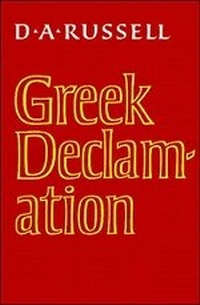
Greek Declamation
Published on 22. December 1983
Book
Hardback
160 pages
978-0-521-25780-0 (ISBN)
Description
Declamation was 'a toy model of oratory' in which students composed and delivered deliberative and forensic practice speeches in character. It was not confined to the schools: the professionals gave public performances to large and critical audiences. Greco-Roman education was more or less dominated by rhetoric; from the fourth century BC down to and beyond the end of classical antiquity declamation was an art within the larger art, inhabiting almost a distinct world, with its own laws, customs and mores. Latin declamation has been well studied but its Greek counterpart is less well known. This book sets the practice of declamation in its historical context, describes the conventional, though often bizarre, themes of the speeches and discusses the declaimers' public performances, rhetorical theory and knowledge and use of classical literature and history. This book will be of interest both to students of classical literature and to historians of ancient society and education. The main text is written so as to be wholly intelligible to those with no knowledge of Greek.
More details
Language
English
Place of publication
Cambridge
United Kingdom
Target group
Professional and scholarly
Dimensions
Height: 216 mm
Width: 138 mm
Thickness: 19 mm
Weight
335 gr
ISBN-13
978-0-521-25780-0 (9780521257800)
Copyright in bibliographic data and cover images is held by Nielsen Book Services Limited or by the publishers or by their respective licensors: all rights reserved.
Schweitzer Classification
Other editions
New editions
D. A. Russell
Greek Declamation
Book
09/2009
Cambridge University Press
€47.90
Shipment within 15-20 days
Additional editions
D. A. Russell
Greek Declamation
Book
09/2009
Cambridge University Press
€47.90
Shipment within 15-20 days
Content
Preface; 1. Evidence, definitions, origins; 2. Sophistopolis, or the world of the Aristeus; 3. Teachers and theories; 4. Performers and occasions; 5. Character and characters; 6. Declamation and history; Bibliography; Indexes.