

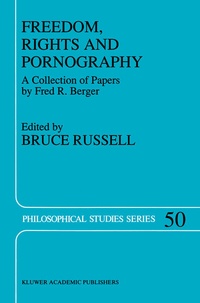
Freedom, Rights And Pornography
A Collection of Papers by Fred R. Berger
Published on 31. December 1990
Book
Hardback
XXII, 222 pages
978-0-7923-1034-1 (ISBN)
Description
In the essays that follow, Fred Berger argues for freedom of expression, civil disobedience, affirmative action and what he calls liberal judicial activism and against sex-role stereotyping, paternalism and the censorship of pornography. Underlying his liberalism is a unified theory. That theory consists of a conception of rights, a theory of value and a theory of government. The conception of a right that Berger defends derives from J ohn Stuart Mill and is captured by what he calls "the rights formula": to have a right is to have important interests that society ought to protect as a matter of general rule (pp. 2, 7, 17-18, 19, 95). Since rights are to be protected by general rule, case-by-case consideration of consequences is ruled out (pp. 3, 18, 96) and neither modest increases in the general welfare, nor majority opinion, can justify the violation of a right (pp. 14-15; 17-18). Berger combines this view of the nature of a right with an objective theory of value according to which the important interests that ought to be protected are ones that people have "whether they know them or not, whether they desire that in which they have an interest or not" (p.
More details
Series
Edition
1991 ed.
Language
English
Place of publication
Dordrecht
Netherlands
Target group
Professional and scholarly
Research
Illustrations
XXII, 222 p.
Dimensions
Height: 241 mm
Width: 160 mm
Thickness: 19 mm
Weight
541 gr
ISBN-13
978-0-7923-1034-1 (9780792310341)
DOI
10.1007/978-94-011-3334-0
Schweitzer Classification
Other editions
Additional editions
Book
09/2012
Springer
€164.50
Shipment within 15-20 days
Content
1: Mill And The Right Of Free Expression.- I. Mill's Concept Of A Right.- II. The Basic Elements Of Mill's Moral Theory.- III. The Right Of Free Expression.- 2: The Right Of Free Expression.- I. Features Of A Basic Constitutional Right.- II. Philosophical Justifications For Freedom of Expression.- III. The Right Of Free Expression-A New Perspective.- IV. Censorship and Regulation-Crucial Tools of Analysis 23 V. Conclusion.- 3: Symbolic Conduct And Freedom Of Speech.- I. The Nature Of Symbolic Conduct.- II. The Argument For Protection.- III. Objections And Replies.- IV. Legal Doctrines Needed.- 4: Judicial Review, Constitutionally Protected Rights, And Democracy.- I. Principles Used In Deciding Constitutional Questions.- II. The Role Of The Constitution In Protecting 51 Basic.- 5: Some Aspects Of Legal Reasoning Concerning Constitutionally Protected Rights.- I. Constitutionally Protected Rights And Values Esssential To A Democracy.- II. The Courts Protection Of Fundamental Rights.- 6: 'Law And Order' And Civil DISOBEDIENCE.- I. Law, Regularity And Security.- II. Disorder.- III. Replies To Objections.- 7: Paternalism And Autonomy.- I. Mill's Concept of Happiness.- II. Mill's Conception of Justice and Rights.- III. Further Development of Mill's Theory.- IV. Paternalism and Autonomy.- 8: Sex Role Change And Autonomy.- 9: Racial And Sex-Role Stereotyping In The Media: An Analysis.- 10: The Differences In The Cases For And Against Preferential Treatment Based On Sex And Those Based On Race.- 11: Pornography, Sex, And Censorship.- I. Objections To Pornography: Conflicting Views On Sex.- II. The Response To Conservative Objections.- 12: Pornography, Feminism, And Censorship.- I. The Feminist Objections To Pornography.- II. Response To The Arguments.- III. Conclusions.- 13: Gratitude.- I. The Duty To Show Gratitude.- II. What Does Gratitude Express.- III. The Significance Of Gratitude For Moral Philosophy.- 14: Love, Friendship, And Utility: On Practical Reason And Reductionism.- I. Love and Friendship.- II. Utilitarianism.- III. Practical Reasoning and Reductivist Explanation.- Bibliography Of Fred Berger's Work.- Index Of Names.- Index Of Subjects.