

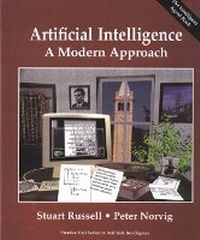
Artificial Intelligence
A Modern Approach: United States Edition
Published on 2. February 1995
Book
Hardback
912 pages
978-0-13-103805-9 (ISBN)
Description
This is an introduction to the theory and practice of artificial intelligence. It uses an intelligent agent as the unifying theme throughout, and covers areas that are sometimes underemphasized elsewhere. These include reasoning under uncertainty, learning, natural language, vision and robotics. The book also explains in detail some of the more recent ideas in the field, including simulated annealing, memory-bounded search, global ontologies, dynamic belief networks, neural nets, inductive logic programming, computational learning theory, and reinforcement learning.
More details
Language
English
Place of publication
United States
Publishing group
Pearson Education (US)
Target group
College/higher education
Dimensions
Height: 243 mm
Width: 198 mm
Thickness: 39 mm
Weight
1634 gr
ISBN-13
978-0-13-103805-9 (9780131038059)
Copyright in bibliographic data and cover images is held by Nielsen Book Services Limited or by the publishers or by their respective licensors: all rights reserved.
Schweitzer Classification
Other editions
New editions
Book
01/2003
2nd Edition
Pearson
€66.84
Article exhausted; check for reprint
Content
I. ARTIFICIAL INTELLIGENCE.
1. Introduction.
2. Intelligent Agents.
II. PROBLEM-SOLVING.
3. Solving Problems by Searching.
4. Informed Search Methods.
5. Game Playing.
III. KNOWLEDGE AND REASONING.
6. Agents that Reason Logically.
7. First-order Logic.
8. Building a Knowledge Base.
9. Inference in First-Order Logic.
10. Logical Reasoning Systems.
IV. ACTING LOGICALLY.
11. Planning.
12. Practical Planning.
13. Planning and Acting.
V. UNCERTAIN KNOWLEDGE AND REASONING.
14. Uncertainty.
15. Probabilistic Reasoning Systems.
16. Making Simple Decisions.
17. Making Complex Decisions.
VI. LEARNING.
18. Learning from Observations.
19. Learning with Neural Networks.
20. Reinforcement Learning.
21. Knowledge in Learning.
VII. COMMUNICATING, PERCEIVING, AND ACTING.
22. Agents that Communicate.
23. Practical Communication in English.
24. Perception.
25. Robotics.
VIII. CONCLUSIONS.
26. Philosophical Foundations.
27. AI: Present and Future.
1. Introduction.
2. Intelligent Agents.
II. PROBLEM-SOLVING.
3. Solving Problems by Searching.
4. Informed Search Methods.
5. Game Playing.
III. KNOWLEDGE AND REASONING.
6. Agents that Reason Logically.
7. First-order Logic.
8. Building a Knowledge Base.
9. Inference in First-Order Logic.
10. Logical Reasoning Systems.
IV. ACTING LOGICALLY.
11. Planning.
12. Practical Planning.
13. Planning and Acting.
V. UNCERTAIN KNOWLEDGE AND REASONING.
14. Uncertainty.
15. Probabilistic Reasoning Systems.
16. Making Simple Decisions.
17. Making Complex Decisions.
VI. LEARNING.
18. Learning from Observations.
19. Learning with Neural Networks.
20. Reinforcement Learning.
21. Knowledge in Learning.
VII. COMMUNICATING, PERCEIVING, AND ACTING.
22. Agents that Communicate.
23. Practical Communication in English.
24. Perception.
25. Robotics.
VIII. CONCLUSIONS.
26. Philosophical Foundations.
27. AI: Present and Future.