

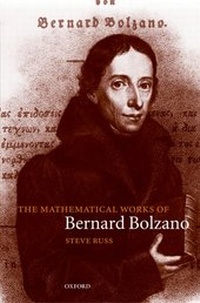
The Mathematical Works of Bernard Bolzano
Published on 9. December 2004
Book
Hardback
732 pages
978-0-19-853930-8 (ISBN)
Description
Bernard Bolzano (1781-1848, Prague) was a remarkable thinker and reformer far ahead of his time in many areas, including philosophy, theology, ethics, politics, logic, and mathematics.
Aimed at historians and philosophers of both mathematics and logic, and research students in those fields, this volume contains English translations, in most cases for the first time, of many of Bolzano's most significant mathematical writings.
These are the primary sources for many of his celebrated insights and anticipations, including: clear topological definitions of various geometric extensions; an effective statement and use of the Cauchy convergence criterion before it appears in Cauchy's work; proofs of the binomial theorem and the intermediate value theorem that are more general and rigorous than previous ones; an impressive theory of measurable numbers (a version of real numbers), a theory of functions including the construction of a continuous, non-differentiable function (around 1830); and his tantalising conceptual struggles over the possible relationships between infinite collections.
Bolzano identified an objective and semantic connection between truths, his so-called 'ground-consequence' relation that imposed a structure on mathematical theories and reflected careful conceptual analysis. This was part of his highly original philosophy of mathematics that appears to be inseparable from his extraordinarily fruitful practical development of mathematics in ways that remain far from being properly understood, and may still be of relevance today.
Aimed at historians and philosophers of both mathematics and logic, and research students in those fields, this volume contains English translations, in most cases for the first time, of many of Bolzano's most significant mathematical writings.
These are the primary sources for many of his celebrated insights and anticipations, including: clear topological definitions of various geometric extensions; an effective statement and use of the Cauchy convergence criterion before it appears in Cauchy's work; proofs of the binomial theorem and the intermediate value theorem that are more general and rigorous than previous ones; an impressive theory of measurable numbers (a version of real numbers), a theory of functions including the construction of a continuous, non-differentiable function (around 1830); and his tantalising conceptual struggles over the possible relationships between infinite collections.
Bolzano identified an objective and semantic connection between truths, his so-called 'ground-consequence' relation that imposed a structure on mathematical theories and reflected careful conceptual analysis. This was part of his highly original philosophy of mathematics that appears to be inseparable from his extraordinarily fruitful practical development of mathematics in ways that remain far from being properly understood, and may still be of relevance today.
Reviews / Votes
The book will be very interesting and helpful for historians of mathematics who are interested in the development of mathematics in the first half of the 19th century.More details
Language
English
Place of publication
Oxford
United Kingdom
Target group
Professional and scholarly
Illustrations
colour frontispiece
Dimensions
Height: 243 mm
Width: 162 mm
Thickness: 43 mm
Weight
1232 gr
ISBN-13
978-0-19-853930-8 (9780198539308)
Copyright in bibliographic data and cover images is held by Nielsen Book Services Limited or by the publishers or by their respective licensors: all rights reserved.
Schweitzer Classification
Person
Content
PART I: GEOMETRY AND FOUNDATIONS ; 1.1 Elementary Geometry (1804) ; 1.2 A Better-Grounded Presentation of Mathematics (1810) ; PART II: EARLY ANALYSIS ; 2.1 The Binomial Theorem (1816) ; 2.2 A Purely Analytic Proof (1817) ; 2.3 Three Problems of Rectification, Complanation and Cubature (1817) ; PART III: LATER ANALYSIS AND THE INFINITE ; 3.1 Infinite Quantity Concepts (1830s) ; 3.2 Theory of Functions (1830s) ; 3.3 Paradoxes of the Infinite (posthumous 1851)