

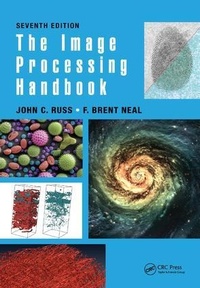
The Image Processing Handbook
7th Edition
Published on 2. August 2017
Book
Paperback/Softback
1056 pages
978-1-138-74749-4 (ISBN)
Description
Consistently rated as the best overall introduction to computer-based image processing, The Image Processing Handbook covers two-dimensional (2D) and three-dimensional (3D) imaging techniques, image printing and storage methods, image processing algorithms, image and feature measurement, quantitative image measurement analysis, and more.
Incorporating image processing and analysis examples at all scales, from nano- to astro-, this Seventh Edition:
Features a greater range of computationally intensive algorithms than previous versions
Provides better organization, more quantitative results, and new material on recent developments
Includes completely rewritten chapters on 3D imaging and a thoroughly revamped chapter on statistical analysis
Contains more than 1700 references to theory, methods, and applications in a wide variety of disciplines
Presents 500+ entirely new figures and images, with more than two-thirds appearing in color
The Image Processing Handbook, Seventh Edition delivers an accessible and up-to-date treatment of image processing, offering broad coverage and comparison of algorithms, approaches, and outcomes.
Incorporating image processing and analysis examples at all scales, from nano- to astro-, this Seventh Edition:
Features a greater range of computationally intensive algorithms than previous versions
Provides better organization, more quantitative results, and new material on recent developments
Includes completely rewritten chapters on 3D imaging and a thoroughly revamped chapter on statistical analysis
Contains more than 1700 references to theory, methods, and applications in a wide variety of disciplines
Presents 500+ entirely new figures and images, with more than two-thirds appearing in color
The Image Processing Handbook, Seventh Edition delivers an accessible and up-to-date treatment of image processing, offering broad coverage and comparison of algorithms, approaches, and outcomes.
Reviews / Votes
"With a new co-author (the same Brent Neal who has collaborated with him before in writing the excellent book Measuring Shape), John Russ has again produced a winner-a textbook and reference book that belongs on the shelf, and perhaps on the desk, of anyone involved in digital imaging. Even if you have a copy of one of the previous editions, this is a highly worthwhile addition."-Microscopy and Microanalysis, October 2016
More details
Edition
7th edition
Language
English
Place of publication
London
United Kingdom
Publishing group
Taylor & Francis Ltd
Target group
Professional and scholarly
Professional
Dimensions
Height: 251 mm
Width: 179 mm
Thickness: 50 mm
Weight
2414 gr
ISBN-13
978-1-138-74749-4 (9781138747494)
Copyright in bibliographic data and cover images is held by Nielsen Book Services Limited or by the publishers or by their respective licensors: all rights reserved.
Schweitzer Classification
Other editions
Additional editions
John C. Russ | F. Brent Neal
The Image Processing Handbook
E-Book
09/2018
7th Edition
CRC Press
€128.99
Available for download
John C. Russ | F. Brent Neal
The Image Processing Handbook
E-Book
09/2018
7th Edition
CRC Press
€128.99
Available for download
John C. Russ | F. Brent Neal
The Image Processing Handbook
Book
11/2015
7th Edition
CRC Press
€273.50
Shipment within 15-20 days
Persons
John C. Russ has used image processing and analysis as a principal tool for understanding and characterizing the structure and function of materials throughout his more than 50-year career as a scientist and educator. Much of Russ' research work has been concerned with the microstructure and surface topography of metals and ceramics. He has received funding for his research from government agencies and from industry. Teaching the principles and methods involved to several thousand students-in addition to consulting for many industrial clients-has further broadened Dr. Russ' experience and the scope of applications for image processing and analysis. He continues to write and consult for a variety of companies (and to provide expert testimony in criminal and civil cases). He also still teaches image processing and analysis workshops worldwide and reviews publications and funding proposals.
F. Brent Neal is a scientist and industrial researcher with Milliken Research Corporation, where he currently leads the central materials characterization and analytical chemistry facility. In this role, he leads efforts in technology and product development through deep understanding of materials performance. He has three patents issued or pending based on his work in polymer-matrix composites. Prior to his tenure at Milliken Research Corporation, he consulted and developed bespoke software for quantitative image analysis. He received his Ph.D in solid-state physics from Louisiana State University in 2002. Over the course of his career, he has measured and analyzed images from many different fields and his experience in materials characterization and measurement has been applied everywhere from the lab bench to manufacturing plants.
F. Brent Neal is a scientist and industrial researcher with Milliken Research Corporation, where he currently leads the central materials characterization and analytical chemistry facility. In this role, he leads efforts in technology and product development through deep understanding of materials performance. He has three patents issued or pending based on his work in polymer-matrix composites. Prior to his tenure at Milliken Research Corporation, he consulted and developed bespoke software for quantitative image analysis. He received his Ph.D in solid-state physics from Louisiana State University in 2002. Over the course of his career, he has measured and analyzed images from many different fields and his experience in materials characterization and measurement has been applied everywhere from the lab bench to manufacturing plants.
Content
Introduction. Acquiring Images. Printing and Storage. Human Vision. Correcting Imaging Defects. Image Enhancement in the Spatial Domain. Processing Images in Frequency Space. Segmentation and Thresholding. Processing Binary Images. Image Measurements. Feature Measurements. Characterizing Shape. Correlation, Classification, Identification, and Matching. 3D Imaging. 3D Processing and Measurement. Imaging Surfaces. References.