

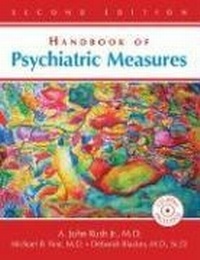
Handbook of Psychiatric Measures
2nd Edition
Will be published approx. on 5. February 2008
Book
Hardback
864 pages
978-1-58562-218-4 (ISBN)
Description
The Handbook of Psychiatric Measures offers a
concise summary of key evaluations that you can easily incorporate into your
daily practice. The measures will enhance the quality of patient care
assisting you, both in diagnosis and assessment of outcomes. Comprising a
wide range of methods available for assessing persons with mental health
problems, the Handbook contains more than 275 rating methods, from
the Abnormal Involuntary Movement Scale to the Zung Self-Rating Depression
Scale.
In this fully revised edition, more than 40 measures have been
added both to the book and to the accompanying CD-ROM. The Handbook features:
* Thoroughly examined and revised measures that provide the most
relevant and timely information for clinicians.
* New measures that
empirically provide better patient evaluation
* Updated costs,
translations, and contact information for each measure
This handy
compendium includes both diagnostic tools and measures of symptoms, function
and quality of life, medication side effects, and other clinically relevant
parameters. It focuses on measures that can be most readily used in either
clinical practice or research. Most of the measures are designed to improve
the reliability and validity of patient assessment over what might be
accomplished in a standard clinical interview. The measures also demonstrate
that the use of formal measures can improve the collection, synthesis, and
reporting of information as compared with the use of unstructured
examinations.
Seventeen disorder-specific chapters, organized in
DSM-IV-TR order, include measures for:
* Disorders of childhood and adolescence
* Cognitive
disorders
* Sexual dysfunction
* Eating disorders
* Sleep
disorders
* Aggression and much more.
The discussion of each
measure includes goals, description, practical issues, psychometric
properties, and clinical utility, followed by references and suggested
readings. This revised edition includes updated measure descriptions, new
measure variants and research, and newly selected measures particularly
appropriate to the domain of discussion. As a clinical tool, this book
* Describes how, when, and to what purpose measures are used
*
Points out practical issues to consider in choosing a measure for clinical
use
* Addresses limitations in the use of measures including ethnic,
cultural, and socioeconomic factors that influence their interpretation
Use of this special resource is further enhanced by a CD-ROM
containing the full text of more than 150 of these measures-an invaluable
aid for reference and clinical decision-making.
concise summary of key evaluations that you can easily incorporate into your
daily practice. The measures will enhance the quality of patient care
assisting you, both in diagnosis and assessment of outcomes. Comprising a
wide range of methods available for assessing persons with mental health
problems, the Handbook contains more than 275 rating methods, from
the Abnormal Involuntary Movement Scale to the Zung Self-Rating Depression
Scale.
In this fully revised edition, more than 40 measures have been
added both to the book and to the accompanying CD-ROM. The Handbook features:
* Thoroughly examined and revised measures that provide the most
relevant and timely information for clinicians.
* New measures that
empirically provide better patient evaluation
* Updated costs,
translations, and contact information for each measure
This handy
compendium includes both diagnostic tools and measures of symptoms, function
and quality of life, medication side effects, and other clinically relevant
parameters. It focuses on measures that can be most readily used in either
clinical practice or research. Most of the measures are designed to improve
the reliability and validity of patient assessment over what might be
accomplished in a standard clinical interview. The measures also demonstrate
that the use of formal measures can improve the collection, synthesis, and
reporting of information as compared with the use of unstructured
examinations.
Seventeen disorder-specific chapters, organized in
DSM-IV-TR order, include measures for:
* Disorders of childhood and adolescence
* Cognitive
disorders
* Sexual dysfunction
* Eating disorders
* Sleep
disorders
* Aggression and much more.
The discussion of each
measure includes goals, description, practical issues, psychometric
properties, and clinical utility, followed by references and suggested
readings. This revised edition includes updated measure descriptions, new
measure variants and research, and newly selected measures particularly
appropriate to the domain of discussion. As a clinical tool, this book
* Describes how, when, and to what purpose measures are used
*
Points out practical issues to consider in choosing a measure for clinical
use
* Addresses limitations in the use of measures including ethnic,
cultural, and socioeconomic factors that influence their interpretation
Use of this special resource is further enhanced by a CD-ROM
containing the full text of more than 150 of these measures-an invaluable
aid for reference and clinical decision-making.
Reviews / Votes
It is an impressive reference work. * The Journal of Nervous and Mental Disease *More details
Edition
Second Edition
Language
English
Place of publication
VA
United States
Target group
Professional and scholarly
US School Grade: College Graduate Student and over
Edition type
Revised edition
Product notice
Laminated cover
Illustrations
3 Line drawings, black and white
Dimensions
Height: 281 mm
Width: 221 mm
Thickness: 50 mm
Weight
2595 gr
ISBN-13
978-1-58562-218-4 (9781585622184)
Copyright in bibliographic data and cover images is held by Nielsen Book Services Limited or by the publishers or by their respective licensors: all rights reserved.
Schweitzer Classification
Other editions
Additional editions
Unknown | A. John Rush Jr. | Michael B. First
Handbook of Psychiatric Measures
E-Book
03/2009
1st Edition
American Psychiatric Publishing
€447.99
Available for download
Previous edition

American Psychiatric Association
Handbook of Psychiatric Measures
Book
06/2000
American Psychiatric Press Inc.
€136.67
Article exhausted; check for reprint
Persons
A. John Rush Jr., M.D., is Professor of Psychiatry
and Clinical Sciences at the University of Texas Southwestern Medical Center
at Dallas in Dallas, Texas.
Michael B. First, M.D., is
Professor of Clinical Psychiatry at Columbia University College of
Physicians and Surgeons, and Research Psychiatrist at New York State
Psychiatric Institute in New York, New York.
Deborah Blacker, M.D.,
Sc.D., is Assistant Vice Chair for Research and Director,
Gerontology Research Unit, Department of Psychiatry, Massachusetts General
Hospital; Associate Professor of Psychiatry at Harvard Medical School and
Associate Professor of Epidemiology at Harvard School of Public Health in
Boston, Massachusetts.
and Clinical Sciences at the University of Texas Southwestern Medical Center
at Dallas in Dallas, Texas.
Michael B. First, M.D., is
Professor of Clinical Psychiatry at Columbia University College of
Physicians and Surgeons, and Research Psychiatrist at New York State
Psychiatric Institute in New York, New York.
Deborah Blacker, M.D.,
Sc.D., is Assistant Vice Chair for Research and Director,
Gerontology Research Unit, Department of Psychiatry, Massachusetts General
Hospital; Associate Professor of Psychiatry at Harvard Medical School and
Associate Professor of Epidemiology at Harvard School of Public Health in
Boston, Massachusetts.
Content
Section I: Introduction to the Handbook.
Organization and use of the handbook. Psychometric properties: concepts
of reliability and validity. Considerations in choosing, using, and
interpreting a measure for a particular clinical context. Cultural factors
influencing the selection, use, and interpretation of psychiatric measures.
Section II: General Measures (Nondisorder Specific). Diagnostic
measures for adults. General psychiatric symptoms measures. Mental health
status, functioning, and disabilities measures. General health status,
functioning, and disabilities measures. Quality of life measures. Adverse
effects measures. Patient perceptions of care measures. Stress and life
events measures. Family and relational issues measures. Suicide risk
measures. Section III: Measures Related To DSM-IV Diagnostic Categories.
Child and adolescent measures for diagnosis and screening.
Symptom-specific measures for disorders usually first diagnosed in infancy,
childhood, or adolescence. Child and adolescent measures of functional
status. Measures for delirium and the behavioral symptoms of cognitive
disorders. Neuropsychiatric measures for cognitive disorders. Substance use
disorder measures. Psychotic disorders measures. Mood disorders measures.
Anxiety disorders measures. Somatoform and factitious disorders and
malingering measures. Dissociative disorders measures. Measures of sexual
dysfunction and disorders. Eating disorders measures. Sleep disorders
measures. Impulse-control disorders measures. Personality disorders,
personality traits, and defense mechanisms measures. Violence and aggression
measures. Appendix A: DSM-IV-TR classification. Appendix B: list of measures
included on the CD-ROM. Appendix C: index of measures. Appendix D: index of
abbreviations for measures. General index.
Organization and use of the handbook. Psychometric properties: concepts
of reliability and validity. Considerations in choosing, using, and
interpreting a measure for a particular clinical context. Cultural factors
influencing the selection, use, and interpretation of psychiatric measures.
Section II: General Measures (Nondisorder Specific). Diagnostic
measures for adults. General psychiatric symptoms measures. Mental health
status, functioning, and disabilities measures. General health status,
functioning, and disabilities measures. Quality of life measures. Adverse
effects measures. Patient perceptions of care measures. Stress and life
events measures. Family and relational issues measures. Suicide risk
measures. Section III: Measures Related To DSM-IV Diagnostic Categories.
Child and adolescent measures for diagnosis and screening.
Symptom-specific measures for disorders usually first diagnosed in infancy,
childhood, or adolescence. Child and adolescent measures of functional
status. Measures for delirium and the behavioral symptoms of cognitive
disorders. Neuropsychiatric measures for cognitive disorders. Substance use
disorder measures. Psychotic disorders measures. Mood disorders measures.
Anxiety disorders measures. Somatoform and factitious disorders and
malingering measures. Dissociative disorders measures. Measures of sexual
dysfunction and disorders. Eating disorders measures. Sleep disorders
measures. Impulse-control disorders measures. Personality disorders,
personality traits, and defense mechanisms measures. Violence and aggression
measures. Appendix A: DSM-IV-TR classification. Appendix B: list of measures
included on the CD-ROM. Appendix C: index of measures. Appendix D: index of
abbreviations for measures. General index.