

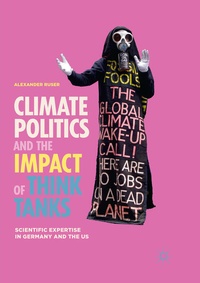
Climate Politics and the Impact of Think Tanks
Scientific Expertise in Germany and the US
Published on 15. January 2019
Book
Paperback/Softback
IX, 173 pages
978-3-030-09317-4 (ISBN)
Description
This book provides an innovative theoretical and analytical framework for studying the role and impact of specialized research organizations and consultancies on decision making in climate politics. It includes advanced empirical analysis of the case of Germany, compared with the situation in the USA. The book improves the understanding of the role and impact of 'scientific' advice in coping with the challenge of anthropogenic climate change.
More details
Edition
Softcover Reprint of the Original 1st 2018 ed.
Language
English
Place of publication
Cham
Switzerland
Publishing group
Springer International Publishing
Target group
Professional and scholarly
Illustrations
6 s/w Abbildungen
IX, 173 p. 6 illus.
Dimensions
Height: 210 mm
Width: 148 mm
Thickness: 11 mm
Weight
246 gr
ISBN-13
978-3-030-09317-4 (9783030093174)
DOI
10.1007/978-3-319-75750-6
Schweitzer Classification
Other editions
Additional editions
Alexander Ruser
Climate Politics and the Impact of Think Tanks
Scientific Expertise in Germany and the US
Book
05/2018
Palgrave Macmillan
€128.39
Article exhausted; check for reprint
Person
Alexander Ruser
is currently a temporary Professor of Sociology and Head of the Center for Political Communication at Zeppelin University, Germany. He was a Dahrendorf fellow at the Hertie School of Governance in Berlin and Visiting Fellow at the London School of Economic and Political Science and the Punjab University, Chandigarh, India.
Content
Introduction.- Chapter 1: Knowledge and Climate.- Chapter 2: What Think Tanks do - Towards a conceptual framework.- Chapter 3: Heated Debates and Cooler Heads - Think Tanks and Climate Politics in the United States.- Chapter 4: Members Only: Think tanks and climate politics in Germany.- Chapter 5: German and US Think Tanks in Comparison.- Chapter 6: Conclusion and Outlook.