

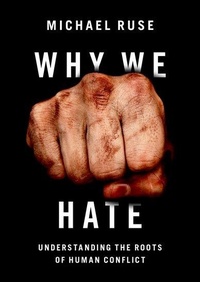
Why We Hate
Understanding the Roots of Human Conflict
Published on 14. November 2022
Book
Hardback
320 pages
978-0-19-762128-8 (ISBN)
Description
An insightful and probing exploration of the contradiction between humans' enormous capacity for hatred and their evolutionary development as a social species
Why We Hate tackles a pressing issue of both longstanding interest and fresh relevance: why a social species like Homo sapiens should nevertheless be so hateful to itself. We go to war and are prejudiced against our fellow human beings. We discriminate on the basis of nationality, class, race, sexual orientation, religion, and gender. Why are humans at once so social and so hateful to each other? In this book, prominent philosopher Michael Ruse looks at scientific understandings of human hatred, particularly Darwinian evolutionary theory. He finds the secret to this paradox in our tribal evolutionary past, when we moved ten thousand years ago from being hunter-gatherers to agriculturalists--a shift that paved the way for modern civilization. Simply put, as Ruse paraphrases, "our modern skulls house Stone Age minds."
Combining rigorous argument with an engaging and accessible style, Ruse makes frequent use of historical examples, examining the history of two World Wars, and the U.S. offensive against Iraq. He also gives many pertinent and up-to-date examples of prejudice, including the significance of Brexit and the systemic racism that lead to the Black Lives Matter movement. Ruse pays special attention to egregious cases of hatred, such as the treatment of Jews by the Third Reich, and to pressing contemporary issues, including the status of women. Ruse concludes with constructive suggestions for ways in which we might reconcile the contradictory aspects of our nature.
Why We Hate will be of interest and value to a wide range of readers interested in the role of human nature in current events, as well as to readers interested in philosophy, the life sciences, social sciences (especially anthropology and archaeology), and beyond.
Why We Hate tackles a pressing issue of both longstanding interest and fresh relevance: why a social species like Homo sapiens should nevertheless be so hateful to itself. We go to war and are prejudiced against our fellow human beings. We discriminate on the basis of nationality, class, race, sexual orientation, religion, and gender. Why are humans at once so social and so hateful to each other? In this book, prominent philosopher Michael Ruse looks at scientific understandings of human hatred, particularly Darwinian evolutionary theory. He finds the secret to this paradox in our tribal evolutionary past, when we moved ten thousand years ago from being hunter-gatherers to agriculturalists--a shift that paved the way for modern civilization. Simply put, as Ruse paraphrases, "our modern skulls house Stone Age minds."
Combining rigorous argument with an engaging and accessible style, Ruse makes frequent use of historical examples, examining the history of two World Wars, and the U.S. offensive against Iraq. He also gives many pertinent and up-to-date examples of prejudice, including the significance of Brexit and the systemic racism that lead to the Black Lives Matter movement. Ruse pays special attention to egregious cases of hatred, such as the treatment of Jews by the Third Reich, and to pressing contemporary issues, including the status of women. Ruse concludes with constructive suggestions for ways in which we might reconcile the contradictory aspects of our nature.
Why We Hate will be of interest and value to a wide range of readers interested in the role of human nature in current events, as well as to readers interested in philosophy, the life sciences, social sciences (especially anthropology and archaeology), and beyond.
Reviews / Votes
This book is a must read for anyone hoping to address instances of human hatred, because it also offers a hope of reducing hate-based conflicts. * R. E. Osborne, CHOICE * Ruse has written one of the most powerful books this reader has encountered in quite a while... [he] does a masterful job of uncovering those roots in a text that addresses the fundamentals of human conflict in a more comprehensive way than any other work on this reader's current course list. The work is both personal and professional, incorporating a blend of historical fact and firsthand observation that effectively reveals manifestations of the roots of human conflict. The text is both humbling and uplifting, offering a clear look at the past with an eye toward promoting resolution or avoidance of hate-based conflicts in the future. Ruse achieves this effect through a blended approach encompassing aspects of religion, sociology, social work, history, anthropology-and even a bit of psychology. This book is a must read for anyone hoping to address instances of human hatred, because it also offers a hope of reducing hate-based conflicts. * Choice * An illuminating interdisciplinary rumination on the causes of war and prejudice. Considering both nature and nurture, Ruse argues that hate is not an irradicably given aspect of human life. Squarely facing present day cultural conflicts over immigration, race, sex, and more, this heartfelt book provides hope that we may yet overcome ingroup/outgroup divisions and find a way forward together. * Robert T. Pennock, Michigan State University, and author of An Instinct for Truth * This is a lively, personal, and often provocative natural history of human hate, its origins in ingroup-outgroup discriminations, and all it brings: wars, individual aggression, prejudice, racism, class conflict, anti-Semitism, misogyny and more. In his unique and conversational style, Michael Ruse draws upon an impressive range of scholarship from evolutionary biology, philosophy, history, political science, anthropology, and literature, to understand human hate and its sources, in part to debunk the 'killer ape' hypothesis that humans are irremediably violent and hateful. We may be able to do something about human hate if we understand more about it; if so, then Why We Hate starts an essential conversation on a matter of crucial importance. * Richard A. Richards, University of Alabama *More details
Language
English
Place of publication
New York
United States
Target group
Professional and scholarly
Product notice
sewn/stitched
Cloth over boards
Dimensions
Height: 184 mm
Width: 134 mm
Thickness: 29 mm
Weight
417 gr
ISBN-13
978-0-19-762128-8 (9780197621288)
Copyright in bibliographic data and cover images is held by Nielsen Book Services Limited or by the publishers or by their respective licensors: all rights reserved.
Schweitzer Classification
Other editions
Additional editions
E-Book
05/2022
OUP eBook
€9.99
Available for download
E-Book
05/2022
OUP eBook
€9.99
Available for download
Person
Michael Ruse, born (in 1940) in England, taught philosophy for 35 years at the University of Guelph, in Ontario, Canada, and then for 20 years at Florida State University. He is an expert on the history and philosophy of evolutionary biology and has written or edited over sixty books. He is particularly interested in the relationship between science and religion, and was a witness for the ACLU in 1981 in its successful attempt to overturn a law mandating the compulsory teaching of Creationism in Arkansas. He has been awarded a Guggenheim fellowship (USA) and a Killam fellowship (Canada). A Fellow of the Royal Society of Canada, he has been a Gifford Lecturer and is the recipient of four honorary degrees. He was the founding editor of Biology and Philosophy and editor of several series of books, most recently and continuing the Cambridge University Press Elements series in the Philosophy of Biology.
Content
Preface
Acknowledgments
Illustrations
Introduction
1. The Biology of War
2. The Biology of Prejudice
3. The Culture of War
4. The Culture of Prejudice
5. Moving Forward
Epilogue
Bibliography
Index
Acknowledgments
Illustrations
Introduction
1. The Biology of War
2. The Biology of Prejudice
3. The Culture of War
4. The Culture of Prejudice
5. Moving Forward
Epilogue
Bibliography
Index