

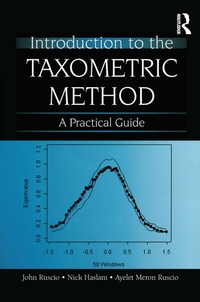
Introduction to the Taxometric Method
A Practical Guide
1st Edition
Published on 11. April 2006
Book
Hardback
362 pages
978-0-8058-4749-9 (ISBN)
Description
Introduction to the Taxometric Method is a user-friendly, practical guide to taxometric research. Drawing from both classic and contemporary research, it provides a comprehensive introduction to the method. With helpful tools and guidance, the book is intended to teach those new to the method, as well as those already familiar with it, tips on how to conduct and evaluate taxometric investigations. The book covers a broad range of analytic techniques, describing their logic and implementation as well as what is known about their performance from systematic study.
The book opens with the background material essential to understanding the research problems that the taxometric method addresses. The authors then explain the data requirements of taxometric analysis, the logic of each procedure, factors that can influence results and lead to misinterpretations, suggestions for choosing the best procedures, and methodological safeguards to prevent erroneous conclusions. Illustrative examples of each procedure and consistency test demonstrate how to perform analyses and interpret results using a variety of data sets. A checklist of conceptual and methodological issues that should be addressed in any investigation is included. The downloadable resources provide a variety of programs for performing taxometric analyses along with simulations and analyses of data sets.
Introduction to the Taxometric Method is ideal for researchers and students conducting or evaluating taxometric studies in the social and behavioral sciences, especially those in clinical and personality psychology, as well as those in the physical sciences, education, biology, and beyond. The book also serves as a text for courses on this method, or as a supplement in psychological assessment, statistics, or research methods courses.Familiarity with taxometrics is not assumed.
The book opens with the background material essential to understanding the research problems that the taxometric method addresses. The authors then explain the data requirements of taxometric analysis, the logic of each procedure, factors that can influence results and lead to misinterpretations, suggestions for choosing the best procedures, and methodological safeguards to prevent erroneous conclusions. Illustrative examples of each procedure and consistency test demonstrate how to perform analyses and interpret results using a variety of data sets. A checklist of conceptual and methodological issues that should be addressed in any investigation is included. The downloadable resources provide a variety of programs for performing taxometric analyses along with simulations and analyses of data sets.
Introduction to the Taxometric Method is ideal for researchers and students conducting or evaluating taxometric studies in the social and behavioral sciences, especially those in clinical and personality psychology, as well as those in the physical sciences, education, biology, and beyond. The book also serves as a text for courses on this method, or as a supplement in psychological assessment, statistics, or research methods courses.Familiarity with taxometrics is not assumed.
Reviews / Votes
"This is a very thorough overview of taxometric studies and methodology as well as relevant literature on categorization and statistics." - PsycCRITIQUES"...It will become the obvious text for anyone wishing to learn about taxometrics...the authors are three of the most productive contributors to this literature..." - David K. Marcus, Sam Houston State University, USA
"The Ruscios and Haslam are leaders in the field of applied taxometric research...an indispensible reference to investigators interested in conducting taxometric research." - Timothy A. Brown, Boston University, USA
"...A necessary guide to people doing taxometric research..." - David H. Gleaves, University of Canterbury, UK
More details
Language
English
Place of publication
New York
United States
Publishing group
Taylor & Francis Inc
Target group
College/higher education
Professional and scholarly
Professional
Dimensions
Height: 229 mm
Width: 152 mm
Weight
830 gr
ISBN-13
978-0-8058-4749-9 (9780805847499)
Copyright in bibliographic data and cover images is held by Nielsen Book Services Limited or by the publishers or by their respective licensors: all rights reserved.
Schweitzer Classification
Other editions
Additional editions
John Ruscio | Nick Haslam | Ayelet Meron Ruscio
Introduction to the Taxometric Method
A Practical Guide
E-Book
01/2013
Routledge
€78.99
Available for download
John Ruscio | Nick Haslam | Ayelet Meron Ruscio
Introduction to the Taxometric Method
A Practical Guide
E-Book
01/2013
Routledge
€78.99
Available for download
John Ruscio | Nick Haslam | Ayelet Meron Ruscio
Introduction to the Taxometric Method
A Practical Guide
Book
04/2006
1st Edition
Routledge
€90.55
Shipment within 10-20 days
Persons
John Ruscio - Elizabethtown College, Nick Haslam - University of Melbourne, Ayelet Meron Ruscio - Harvard Medical School
Content
Preface. Part 1. Introduction and Background. Introduction. Why Latent Structure Matters. The Classification Problem. Part 2. Taxometric Method. Data Requirements for Taxometrics. Taxometric Procedures I: MAXSLOPE, MAMBAC, and L-Mode. Taxometric Procedures II: MAXCOV and MAXEIG. Consistency Tests. Interpretational Issues. A Taxometric Checklist. Part 3. Applications and Future Directions. Applications of the Taxometric Method. The Future of Taxometrics. Appendix A: Simulating Taxonic and Dimensional Comparison Data. Appendix B: Estimating Latent Parameters and Classifying Cases Using MAXCOV. Appendix C: Estimating the Taxon Base Rate Using MAXEIG.