

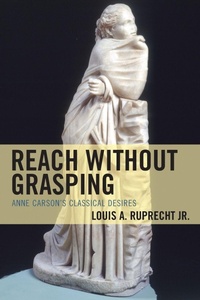
Reach without Grasping
Anne Carson's Classical Desires
Published on 22. August 2023
Book
Paperback/Softback
220 pages
978-1-7936-3768-0 (ISBN)
Description
Anne Carson (b. June 21, 1950, in Toronto, Canada) is one of the most versatile of contemporary classicists, poets, and translators in the English language. In Reach without Grasping, Louis A. Ruprecht Jr. explores the role played by generic transgressions on the one hand, and by embodied spirituality on the other, throughout Carson's ambitious literary career. Where others see classical dichotomies (soul versus body, classical versus Christian), Carson sees connection. Like Nietzsche before her, Carson decries the images of the Classics as merely bookish and of classicists as disembodied intellects. She has brought religious, bodily erotics back into the heart of the classical tradition.
Reviews / Votes
Ruprecht examines in impressive scholarly depth the classical influences on Anne Carson (b. 1950), anti-genre poet/ philosopher/dramatist/translator, who traded her early position as a classics professor for a position as writer/artist in residence.... Ruprecht convincingly insists that for Carson there is no separation between Christian and classical themes and that in all her work, reach is emphasized over grasp-desire over sex. She is transgressive just as Socrates and Jesus were transgressive-upending expectations and creating new genres. Highly recommended. Graduate students, researchers, faculty. * Choice Reviews * Nimbly straddling the fields of Classics, Philosophy, and Religious Studies, Louis Ruprecht takes on the multi-faceted, genre-bending work of Anne Carson. With an eye focused on her images and an ear attuned to her language, Ruprecht explores Carson's poetry, translations, and essays, demonstrating how her meditations on the classical world are relevant for us today. -- Gregory Jusdanis, The Ohio State University In the spirit of Carson's own genre-bending work, Ruprecht artfully threads the ancient and modern, the literary, philosophical, and religious, to introduce Carson and her work to a wide audience. A study in eros, Ruprecht's book paints a portrait of Carson as a philosopher, poet, and (perhaps) mystic, for whom embodied desire manifests most fully in the space between words and the worlds they create. -- Wesley N. Barker, Mercer UniversityMore details
Series
Language
English
Place of publication
United States
Publishing group
Bloomsbury Publishing Plc
Target group
Professional and scholarly
Dimensions
Height: 229 mm
Width: 152 mm
Thickness: 13 mm
Weight
365 gr
ISBN-13
978-1-7936-3768-0 (9781793637680)
Copyright in bibliographic data and cover images is held by Nielsen Book Services Limited or by the publishers or by their respective licensors: all rights reserved.
Schweitzer Classification
Other editions
Additional editions
E-Book
11/2021
1st Edition
Bloomsbury eBooks US
€33.49
Available for download
Person
Louis A. Ruprecht Jr. is the inaugural William M. Suttles Professor of Religious Studies in the Department of Anthropology and director of the Center for Hellenic Studies at Georgia State University.
Content
Preface
Acknowledgments
Introduction: The Quest for a Genre, or, Where Boundaries Touch Then Blur
Chapter 1. Eros the Bittersweet, or, The Poetics of Desire
Chapter 2. Translation as Criticism, Creation and Conjuring, or, The Musing Scholar
Chapter 3. Poetry, Madness and Markets, or, The Ancients and the Moderns
Chapter 4. Hybrid Genres Between Body and Spirit, or, Righting the Self and Writing God
Conclusion: Dreaming in the Night
Epilogue: Six Questions and an Afterword
Appendix: The Works of Anne Carson
Acknowledgments
Introduction: The Quest for a Genre, or, Where Boundaries Touch Then Blur
Chapter 1. Eros the Bittersweet, or, The Poetics of Desire
Chapter 2. Translation as Criticism, Creation and Conjuring, or, The Musing Scholar
Chapter 3. Poetry, Madness and Markets, or, The Ancients and the Moderns
Chapter 4. Hybrid Genres Between Body and Spirit, or, Righting the Self and Writing God
Conclusion: Dreaming in the Night
Epilogue: Six Questions and an Afterword
Appendix: The Works of Anne Carson