

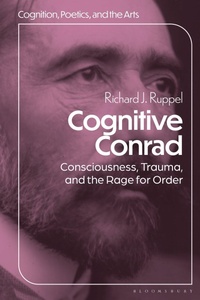
Cognitive Conrad
Consciousness, Trauma, and the Rage for Order
Will be published approx. on 1. October 2026
Book
Hardback
192 pages
979-8-216-39235-4 (ISBN)
Description
Uncovers how Joseph Conrad's narratives reflect the cognitive studies of his day but also anticipate our own contemporary understandings of consciousness, trauma, and the human need for order.
Cognitive Conrad demonstrates the interpretive power of cognitive literary studies and historicism in the most important works of Joseph Conrad. It highlights how Conrad's fiction reflects the complexities of human consciousness, trauma, and the relentless human drive to impose a coherent form on a world that, ultimately, lacks any dependable order independent of individual, human constructions.
Through a detailed examination of Conrad's characters and their psychological landscapes - in a wide range of fiction, such as Lord Jim, Under Western Eyes, and various short stories - Richard J. Ruppel reveals how the novelist anticipated modern cognitive theories and the science of trauma. He also discusses the profound connections between Conrad's fiction and the work of 19th-century scientists like Hermann Helmholtz, who influenced Conrad's portrayal of perception and consciousness.
Cognitive Conrad asserts the power of the arts and humanities to supplement and correct the sciences, which most often look to generalize and categorize. It argues that one key role of the arts - often articulated poignantly in Conrad's greatest work - is to highlight the anomalous, to champion the peculiar.
Cognitive Conrad demonstrates the interpretive power of cognitive literary studies and historicism in the most important works of Joseph Conrad. It highlights how Conrad's fiction reflects the complexities of human consciousness, trauma, and the relentless human drive to impose a coherent form on a world that, ultimately, lacks any dependable order independent of individual, human constructions.
Through a detailed examination of Conrad's characters and their psychological landscapes - in a wide range of fiction, such as Lord Jim, Under Western Eyes, and various short stories - Richard J. Ruppel reveals how the novelist anticipated modern cognitive theories and the science of trauma. He also discusses the profound connections between Conrad's fiction and the work of 19th-century scientists like Hermann Helmholtz, who influenced Conrad's portrayal of perception and consciousness.
Cognitive Conrad asserts the power of the arts and humanities to supplement and correct the sciences, which most often look to generalize and categorize. It argues that one key role of the arts - often articulated poignantly in Conrad's greatest work - is to highlight the anomalous, to champion the peculiar.
Reviews / Votes
An informative survey of Conrad's canon re-envisioned through the concepts of contemporary cognitive science. Ruppel uses neuroscientific theories lucidly and responsibly to explore the relation between Conrad's understanding of consciousness, his narrative techniques, and his metaphysical vision. * Paul B. Armstrong, Professor Emeritus of English, Brown University, USA, and author of Stories and the Brain: The Neuroscience of Narrative (2020) * Ruppel makes a compelling case that Conrad's major fiction embodies an intuitive understanding of consciousness, trauma, and identity, claiming that the author anticipates scientific concepts including PTSD, Bayesian integration, and autism spectrum disorder. This is a scholarly, rigorous, and revelatory contribution to both Conrad studies and the growing field of cognitive literary studies. * Kim Salmons, Associate Professor of Modern Literature, St Mary's University, UK *More details
Series
Language
English
Place of publication
New York
United States
Publishing group
Bloomsbury Publishing Plc
Target group
Professional and scholarly
College/higher education
Product notice
sewn/stitched
Cloth over boards
With dust jacket
Dimensions
Height: 229 mm
Width: 152 mm
Thickness: 25 mm
Weight
454 gr
ISBN-13
979-8-216-39235-4 (9798216392354)
Copyright in bibliographic data and cover images is held by Nielsen Book Services Limited or by the publishers or by their respective licensors: all rights reserved.
Schweitzer Classification
Person
Richard J. Ruppel is Professor of English and Peace and Justice Studies at Chapman University, USA. He is a past president of the Joseph Conrad Society and has published extensively on Conrad's work. His books include A Political Genealogy of Joseph Conrad (2014), Homosexuality in the Life and Work of Joseph Conrad (2008), and Imperial Desire: Dissident Sexualities and Colonial Literature (2003).
Content
Acknowledgements
Works by Joseph Conrad
1. Introduction
2. "The changes take place inside": Marlow in Wonderland
3. Lord Jim: Bovarysm, Narrative Identity, and Shame
4. History, Cognition, and Nostromo
5. Lombroso, Trauma, Mind Misreading, Mental Pathologies, and The Secret Agent
6. Under Western Eyes: "Words as is well known are the great foes of reality"
7. Conrad's Stories and Cognition
Epilogue
Works Cited
Index
Works by Joseph Conrad
1. Introduction
2. "The changes take place inside": Marlow in Wonderland
3. Lord Jim: Bovarysm, Narrative Identity, and Shame
4. History, Cognition, and Nostromo
5. Lombroso, Trauma, Mind Misreading, Mental Pathologies, and The Secret Agent
6. Under Western Eyes: "Words as is well known are the great foes of reality"
7. Conrad's Stories and Cognition
Epilogue
Works Cited
Index