

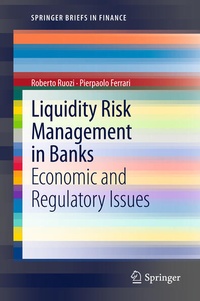
Liquidity Risk Management in Banks
Economic and Regulatory Issues
Published on 21. September 2012
Book
Paperback/Softback
V, 54 pages
978-3-642-29580-5 (ISBN)
Description
The recent turmoil on financial markets has made evident the importance of efficient liquidity risk management for the stability of banks. The measurement and management of liquidity risk must take into account economic factors such as the impact area, the timeframe of the analysis, the origin and the economic scenario in which the risk becomes manifest. Basel III, among other things, has introduced harmonized international minimum requirements and has developed global liquidity standards and supervisory monitoring procedures. The short book analyses the economic impact of the new regulation on profitability, on assets composition and business mix, on liabilities structure and replacement effects on banking and financial products.
More details
Series
Edition
2013 ed.
Language
English
Place of publication
Berlin
Germany
Publishing group
Springer Berlin
Target group
Professional and scholarly
Research
Illustrations
4 s/w Abbildungen
V, 54 p. 4 illus.
Dimensions
Height: 235 mm
Width: 155 mm
Thickness: 4 mm
Weight
108 gr
ISBN-13
978-3-642-29580-5 (9783642295805)
DOI
10.1007/978-3-642-29581-2
Schweitzer Classification
Other editions
Additional editions
E-Book
09/2012
1st Edition
Springer
€50.28
Available for download
Persons
Pierpaolo Ferrari is associate professor of financial markets and institutions at University of Brescia and SDA professor at Bocconi University, Milan, Italy, where he teaches Financial Markets. He holds a M.Sc. in business administration at Bocconi University and a Ph.D. in financial markets and institutions at University of Siena, Italy.
Roberto Ruozi is emeritus professor of financial markets and institutions at Bocconi University, Milan, Italy. He has been Rector of Bocconi from 1994 to 2000 and has taught at University of Siena, Ancona, Parma (Italy) and Sorbonne, Paris (France). He is a member of the board of banks, insurance companies and industrial companies.
Content
Introduction.- Liquidity Risk: Economic Issues.- Liquidity Risk: Regulatory Issues.- Economic Impacts of the New Regulation.- Conclusions.