

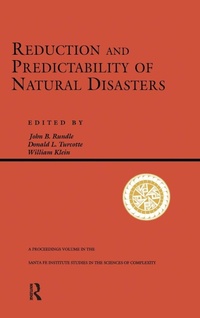
Reduction And Predictability Of Natural Disasters
1st Edition
Published on 12. July 2019
Book
Hardback
324 pages
978-0-367-32049-2 (ISBN)
Description
Within the past five years, the international community has recognized that it may be possible, through programs of systematic study, to devise means to reduce and mitigate the occurrence of a variety of devastating natural hazards. Among these disasters are earthquakes, volcanic eruptions, floods, and landslides. The importance of these studies is underscored by the fact that within fifty years, more than a third of the world's population will live in seismically and volcanically active zones. The International Council of Scientific Unions, together with UNESCO and the World Bank, have therefore endorsed the 1990s as the International Decade of Natural Disaster Reduction (IDNDR), and are planning a variety of programs to address problems related to the predictability and mitigation of these disasters, particularly in third-world countries. Parallel programs have begun in a number of U.S. agencies.
More details
Language
English
Place of publication
London
United Kingdom
Publishing group
Taylor & Francis Ltd
Target group
College/higher education
Dimensions
Height: 235 mm
Width: 157 mm
Thickness: 22 mm
Weight
619 gr
ISBN-13
978-0-367-32049-2 (9780367320492)
Copyright in bibliographic data and cover images is held by Nielsen Book Services Limited or by the publishers or by their respective licensors: all rights reserved.
Schweitzer Classification
Other editions
Additional editions
E-Book
05/2018
1st Edition
Routledge
€69.99
Available for download
E-Book
05/2018
1st Edition
Routledge
€69.99
Available for download
Book
01/1996
1st Edition
Westview Press Inc
€77.00
Shipment within 3-4 weeks
Person
John Rundle, Don Turcotte
Content
Preface /J. B. Rundle, B. Klein, and D. L. Turcotte -- Societal Effects of Natural Disasters -- Scaling Laws for Natural Disaster Fatalities /S. F. Nishenko and C. C. Barton -- Global Fatalities from Earthquakes in the Pt 2000 Years: Prognosis for the Next /R. Bilham -- Floods and Landslides -- Diffusion-Limited Aggregation as a Paradigm for Modeling Dynamical Processes /L. M. Sander -- A Dynamical Systems Approach to Flood-Frequency Forecasting /D. L. Turcotte and K. Haselton -- Multiplicative Cascades and Spatial Variability in Rainfall, River Networks, and Floods /V. K. Gupta and E. Wayrnire -- Inference for a Channel Network Model and Implications for Flood Scaling /B. M. Troutman -- Thickness Statistics of Sedimentary Layers Generated by Gravity-Driven Flows /D. H. Rothman and J. P. Grotzinger -- Earthquakes -- Thoughts on Modeling and Prediction of Earthquakes /S. C. Eubank -- Complexity and Earthquake Forecasting /C. C. Sammis, D. Sornette, and H. SaZeur -- on the Scaling of Average Slip with Rupture Dimensions of Earthquakes /S. Gross -- Rupture Characteristics , Recurrence , and Predict ability in a Slider-Block Model for Earthquakes /Ja B. Rundle. W. Klein. and S. Gross -- A Comparison of Simple Eqrthquake Models: -- Self- Organized Criticality vs . Intermittent P hose Locking /A . V. He rz -- Spinodals and Scaling in Slider-Block Models /w. Klein, C. Ferguson, and J. B. Rundle -- A Hierarchical Model for Precursory Seismic Activation /w. L Newman, D. L. Turcotte, and A. Gabrielov -- Observation of Boltzmann Fluctuations in Stochastic, Massless Slider-Block Simulations /J. B. Rundle, W. Klein, and D. L. Turcotte -- Prediction Studies of Earthquake Falut Models and Applicat ions to Seismic Catalogs /J. Carison -- Index.