

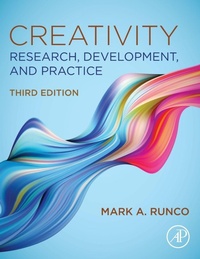
Creativity
Research, Development, and Practice
3rd Edition
Published on 10. March 2023
Book
Hardback
612 pages
978-0-08-102617-5 (ISBN)
Description
Creativity: Research, Development, and Practice, Third Edition, summarizes the research on the development, expression, and enhancement of creativity. It draws from the full range of disciplines studying creativity, including psychology, business, education, economics, philosophy, neuroscience, and more. This volume includes exploration of research on the nature/nurture debate, what influences creativity, how creativity is related to personality, how social context may affect creativity, mental health, and its relation to creativity, gender differences, and how creativity is related to and differs from, invention, innovation, imagination, and adaptability.
The third edition has been thoroughly updated, with a new chapter on psychometrics and substantial updates on the biology and neuroscience of creativity, politics, and creative cognition. It includes quotations, graphics, boxed controversial issues, and biographical examples from unambiguously creative individuals.
The third edition has been thoroughly updated, with a new chapter on psychometrics and substantial updates on the biology and neuroscience of creativity, politics, and creative cognition. It includes quotations, graphics, boxed controversial issues, and biographical examples from unambiguously creative individuals.
More details
Edition
3rd edition
Language
English
Place of publication
London
United Kingdom
Publishing group
Elsevier Science & Technology
Target group
College/higher education
Product notice
Laminated cover
Dimensions
Height: 240 mm
Width: 194 mm
Thickness: 35 mm
Weight
1386 gr
ISBN-13
978-0-08-102617-5 (9780081026175)
Copyright in bibliographic data and cover images is held by Nielsen Book Services Limited or by the publishers or by their respective licensors: all rights reserved.
Schweitzer Classification
Other editions
Additional editions
E-Book
03/2023
3rd Edition
Academic Press
€68.95
Available for download
Previous edition
Book
03/2014
2nd Edition
Academic Press
€68.08
Shipment within 15-20 days
Person
Mark Runco, Director of Creativity Research & Programming, Southern Oregon University, Ashland OR, USA
Mark Runco earned his Ph.D. in cognitive psychology from the Claremont Graduate School in California and has studied creativity ever since. He is currently a Director of Creativity Research & Programming, Southern Oregon University, Ashland OR, USA He began his teaching career as an assistant professor of psychology at the University of Hawaii, Hilo. He then taught at Cal State Fullerton for 22 years. He was also an adjunct professor at the Norwegian School of Economics and Business Administration for nearly 15 years and lectured regularly at Universidad de Cantabria in Spain and Shaanxi Normal University in Xi'an, China. He is a distinguished consulting faculty member at the Saybrook Graduate University in San Francisco and remains on the University of Georgia Graduate Faculty
Mark developed nine seminars on creativity, including "Creativity: What It Is and What It Is Not," "The Assessment of Creativity," "Creative Cognition," and "Social Contexts for Creativity." He is Fellow and past president of Division 10 (Psychology, Art, Creativity, and Aesthetics) of the American Psychological Association.
Mark also founded the Creativity Research Journal, which he still edits, along with two new journals: Business Creativity and the Creative Economy, and the Journal of Genius and Eminence. In 2010, Mark published the "rCAB" (Runco Creativity Assessment Battery), a comprehensive battery of tests for the assessment of creativity. He has published over 300 articles, chapters, and books on creativity, its measurement and enhancement. His textbook Creativity: Theories and Themes: Research, Development, and Practice has been translated into 10 languages. The 3rd edition will be published in 2020. He also was an Editor-in-Chief of the Encyclopedia of Creativity, which was published in 1999 and the second edition, which was published in 2011.
Mark Runco earned his Ph.D. in cognitive psychology from the Claremont Graduate School in California and has studied creativity ever since. He is currently a Director of Creativity Research & Programming, Southern Oregon University, Ashland OR, USA He began his teaching career as an assistant professor of psychology at the University of Hawaii, Hilo. He then taught at Cal State Fullerton for 22 years. He was also an adjunct professor at the Norwegian School of Economics and Business Administration for nearly 15 years and lectured regularly at Universidad de Cantabria in Spain and Shaanxi Normal University in Xi'an, China. He is a distinguished consulting faculty member at the Saybrook Graduate University in San Francisco and remains on the University of Georgia Graduate Faculty
Mark developed nine seminars on creativity, including "Creativity: What It Is and What It Is Not," "The Assessment of Creativity," "Creative Cognition," and "Social Contexts for Creativity." He is Fellow and past president of Division 10 (Psychology, Art, Creativity, and Aesthetics) of the American Psychological Association.
Mark also founded the Creativity Research Journal, which he still edits, along with two new journals: Business Creativity and the Creative Economy, and the Journal of Genius and Eminence. In 2010, Mark published the "rCAB" (Runco Creativity Assessment Battery), a comprehensive battery of tests for the assessment of creativity. He has published over 300 articles, chapters, and books on creativity, its measurement and enhancement. His textbook Creativity: Theories and Themes: Research, Development, and Practice has been translated into 10 languages. The 3rd edition will be published in 2020. He also was an Editor-in-Chief of the Encyclopedia of Creativity, which was published in 1999 and the second edition, which was published in 2011.
Content
1. Cognition and Creativity
2. Personality and Motivation
3. The Psychometrics of Creativity
4. Biological Perspectives on Creativity
5. Health and Clinical Perspectives
6. Social, Attributional, and Organizational Perspectives
7. Culture and Creativity
8. History and Historiometry
9. Creativity and Politics
10. Developmental Trends and Influences on Creativity
11. Educational Perspectives
12. Enhancement and the Fulfillment of Potential
13. Creativity and Philosophy
14. Conclusion: What Creativity is and What it is Not
2. Personality and Motivation
3. The Psychometrics of Creativity
4. Biological Perspectives on Creativity
5. Health and Clinical Perspectives
6. Social, Attributional, and Organizational Perspectives
7. Culture and Creativity
8. History and Historiometry
9. Creativity and Politics
10. Developmental Trends and Influences on Creativity
11. Educational Perspectives
12. Enhancement and the Fulfillment of Potential
13. Creativity and Philosophy
14. Conclusion: What Creativity is and What it is Not