

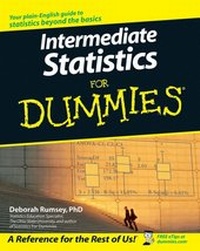
Intermediate Statistics For Dummies
1st Edition
Published on 9. March 2007
Book
Paperback/Softback
384 pages
978-0-470-04520-6 (ISBN)
Description
The statistics speak for themselves: enrollment in college statistics courses is up 45 percent over the last decade, the number of college-bound students taking the AP Statistics Exam nearly doubled from 2000 to 2003, and Statistics For Dummies has sold more than 65,000 copies in just over two years! This new guide takes statistics students to the next level, offering a refresher on statistics basics and covering concepts and topics typically encountered in second-semester statistics courses, including boxplots and scatterplots, Chebyshev's inequality, outliers, Z-scores, hypothesis tests, and Simpson's paradox.
Reviews / Votes
"style, language, layout,common sense, Minitab output, dire warnings,practicalities,examples,punchy headings and warmth of humour..." (MSOR Connections, Vol 8 No 1)More details
Edition
1., Auflage
Language
English
Place of publication
Chichester
United Kingdom
Publishing group
John Wiley and Sons Ltd
Target group
Professional and scholarly
Edition type
New edition
Dimensions
Height: 23.5 cm
Width: 18.8 cm
Weight
544 gr
ISBN-13
978-0-470-04520-6 (9780470045206)
Schweitzer Classification
Other editions
New editions
Deborah J. Rumsey
Statistics II for Dummies
Book
09/2009
Wiley
Unfortunately, price unknown
Article exhausted; check for reprint
Person
Deborah Rumsey has a PhD in Statistics from The Ohio State University (1993). She is a Statistics Education Specialist/Auxiliary Faculty Member for the Department of Statistics. Dr. Rumsey has been given the distinction of being named a Fellow of the American Statistical Association. She has also won the Presidential Teaching Award from Kansas State University. She is the author of Statistics For Dummies, Statistics Workbook For Dummies, and Probability For Dummies. She has published numerous papers and given many professional presentations on the subject of statistics education. Her passions include being with her family, bird watching, solving Sudoku puzzles, getting more seat time on her Kubota tractor, and cheering the Ohio State Buckeyes on to another National Championship.
Content
Introduction.
Part I: Data Analysis and Model-Building Basics.
Chapter 1: Beyond Number Crunching: The Art and Science of Data Analysis.
Chapter 2: Sorting through Statistical Techniques.
Chapter 3: Building Confidence and Testing Models.
Part II: Making Predictions by Using Regression.
Chapter 4: Getting in Line with Simple Linear Regression.
Chapter 5: When Two Variables Are Better than One: Multiple Regression.
Chapter 6: One Step Forward and Two Steps Back: Regression Model Selection.
Chapter 7: When Data Throws You a Curve: Using Nonlinear Regression.
Chapter 8: Yes, No, Maybe So: Making Predictions By Using Logistic Regression.
Part III: Comparing Many Means with ANOVA.
Chapter 9: Going One-Way with Analysis of Variance.
Chapter 10: Pairing Things Down with Multiple Comparisons.
Chapter 11: Getting a Little Interaction with Two-Way ANOVA.
Chapter 12: Rock My World: Relating Regression to ANOVA.
Part IV: Building Strong Connections with Chi-Square Tests.
Chapter 13: Forming Associations with Two-Way Tables.
Chapter 14: Being Independent Enough for the Chi-Square Test.
Chapter 15: Using Chi-Square Tests for Goodness-of-Fit (Your Data, Not Your Jeans).
Part V: Rebels without a Distribution.
Chapter 16: Going Nonparametric.
Chapter 17: The Sign Test and Signed Rank Test.
Chapter 18: Pulling Rank with the Rank Sum Test.
Chapter 19: Do the Kruskal-Wallis and Rank the Sums with Wilcox.
Chapter 20: Pointing Out Correlations with Spearman's Rank.
Part VI: The Part of Tens.
Chapter 21: Ten Errors in Statistical Conclusions.
Chapter 22: Ten Practice Problems.
Appendix: Tables for Your Reference.
Index.
Part I: Data Analysis and Model-Building Basics.
Chapter 1: Beyond Number Crunching: The Art and Science of Data Analysis.
Chapter 2: Sorting through Statistical Techniques.
Chapter 3: Building Confidence and Testing Models.
Part II: Making Predictions by Using Regression.
Chapter 4: Getting in Line with Simple Linear Regression.
Chapter 5: When Two Variables Are Better than One: Multiple Regression.
Chapter 6: One Step Forward and Two Steps Back: Regression Model Selection.
Chapter 7: When Data Throws You a Curve: Using Nonlinear Regression.
Chapter 8: Yes, No, Maybe So: Making Predictions By Using Logistic Regression.
Part III: Comparing Many Means with ANOVA.
Chapter 9: Going One-Way with Analysis of Variance.
Chapter 10: Pairing Things Down with Multiple Comparisons.
Chapter 11: Getting a Little Interaction with Two-Way ANOVA.
Chapter 12: Rock My World: Relating Regression to ANOVA.
Part IV: Building Strong Connections with Chi-Square Tests.
Chapter 13: Forming Associations with Two-Way Tables.
Chapter 14: Being Independent Enough for the Chi-Square Test.
Chapter 15: Using Chi-Square Tests for Goodness-of-Fit (Your Data, Not Your Jeans).
Part V: Rebels without a Distribution.
Chapter 16: Going Nonparametric.
Chapter 17: The Sign Test and Signed Rank Test.
Chapter 18: Pulling Rank with the Rank Sum Test.
Chapter 19: Do the Kruskal-Wallis and Rank the Sums with Wilcox.
Chapter 20: Pointing Out Correlations with Spearman's Rank.
Part VI: The Part of Tens.
Chapter 21: Ten Errors in Statistical Conclusions.
Chapter 22: Ten Practice Problems.
Appendix: Tables for Your Reference.
Index.