

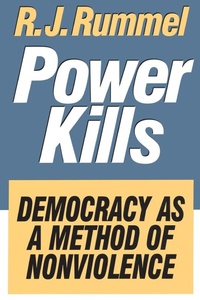
Power Kills
Democracy as a Method of Nonviolence
1st Edition
Published on 30. November 2002
Book
Paperback/Softback
256 pages
978-0-7658-0523-2 (ISBN)
Description
This volume, newly published in paperback, is part of a comprehensive effort by R. J. Rummel to understand and place in historical perspective the entire subject of genocide and mass murder, or what he calls democide. It is the fifth in a series of volumes in which he offers a detailed analysis of the 120,000,000 people killed as a result of government action or direct intervention.
In Power Kills, Rummel offers a realistic and practical solution to war, democide, and other collective violence. As he states it, "The solution...is to foster democratic freedom and to democratize coercive power and force. That is, mass killing and mass murder carried out by government is a result of indiscriminate, irresponsible Power at the center."
Rummel observes that well-established democracies do not make war on and rarely commit lesser violence against each other. The more democratic two nations are, the less likely is war or smaller-scale violence between them. The more democratic a nation is, the less severe its overall foreign violence, the less likely it will have domestic collective violence, and the less its democide. Rummel argues that the evidence supports overwhelmingly the most important fact of our time: democracy is a method of nonviolence.
In Power Kills, Rummel offers a realistic and practical solution to war, democide, and other collective violence. As he states it, "The solution...is to foster democratic freedom and to democratize coercive power and force. That is, mass killing and mass murder carried out by government is a result of indiscriminate, irresponsible Power at the center."
Rummel observes that well-established democracies do not make war on and rarely commit lesser violence against each other. The more democratic two nations are, the less likely is war or smaller-scale violence between them. The more democratic a nation is, the less severe its overall foreign violence, the less likely it will have domestic collective violence, and the less its democide. Rummel argues that the evidence supports overwhelmingly the most important fact of our time: democracy is a method of nonviolence.
Reviews / Votes
"The result of four decades of truly brilliant intellectual inquiry.... No scholar has done more in this century to promote understanding about the true causes of internal and external State violence...." - Robert F. Turner, Center for National Security Law, University of Virginia "Rummel mobilizes every resource (logical and empirical), tracks down virtually every related study, and defends his thesis with the energy of a knight of the round table and the hand of a master scholar." - Jack Vincent, Borah Professor of Political Science, University of IdahoMore details
Language
English
Place of publication
Somerset
United Kingdom
Publishing group
Taylor & Francis Inc
Target group
College/higher education
Professional and scholarly
Dimensions
Height: 229 mm
Width: 152 mm
Thickness: 14 mm
Weight
379 gr
ISBN-13
978-0-7658-0523-2 (9780765805232)
Copyright in bibliographic data and cover images is held by Nielsen Book Services Limited or by the publishers or by their respective licensors: all rights reserved.
Schweitzer Classification
Other editions
Additional editions
E-Book
07/2017
Routledge
€67.49
Available for download
E-Book
07/2017
Routledge
€67.49
Available for download
Book
03/1997
1st Edition
Routledge
€155.80
Shipment within 3-4 weeks
Person
R. J. Rummel is professor emeritus of political science at the University of Hawaii. He is also the author of Death by Government, Democide, and Lethal Politics, all published by Transaction. He was nominated for the 1996 Nobel Peace Prize in recognition of his work on this subject.
Content
1: Introduction; I: The Most Important Fact of Our Time; Introduction to Part I; 2: No War between Democracies; 3: Democracy Limits Bilateral Violence; 4: Democracies are Least Warlike; 5: Democracies are Most Internally Peaceful; 6: Democracies Don't Murder Their Citizens; II: Why are Democracies Nonviolent?; Introduction to Part II; 7: A New Fact?; 8: What is to be Explained?; 9: First-Level Explanation: The People's Will; 10: Second-Level Explanation: Cross-Pressures, Exchange Culture, and In-Group Perception; 11: Third-Level Explanation I: Social Field and Freedom; 12: Third-Level Explanation II: Antifield and Power; 13: Power Kills