

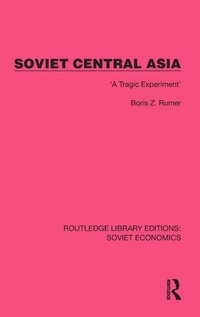
Soviet Central Asia
'A Tragic Experiment'
1st Edition
Published on 14. June 2023
Book
Hardback
204 pages
978-1-032-48486-0 (ISBN)
Description
Soviet Central Asia (1989) explores the economic development of the four republics of Central Asia that suffered under Moscow's economic policies - Uzbekistan, Tajikistan, Turkmenistan and Kirghizia. The Soviet literary weekly Literaturnaia gazeta described Soviet economic policies there as a 'tragic experiment', and this book argues that Central Asia serves as a prime example of the failure of Soviet regional development policies. It analyses the special role of the region in the Soviet economy and such key issues as industrial development, cotton production, water resources and labour. It also addresses the social ramifications of the underdevelopment of the region's economy and the impact of new policies under Gorbachev.
More details
Series
Language
English
Place of publication
London
United Kingdom
Publishing group
Taylor & Francis Ltd
Target group
Adult education
Adult education, General, Postgraduate, Undergraduate Advanced, and Undergraduate Core
Dimensions
Height: 240 mm
Width: 161 mm
Thickness: 17 mm
Weight
508 gr
ISBN-13
978-1-032-48486-0 (9781032484860)
Copyright in bibliographic data and cover images is held by Nielsen Book Services Limited or by the publishers or by their respective licensors: all rights reserved.
Schweitzer Classification
Other editions
Additional editions
Book
12/2024
1st Edition
Routledge
€44.90
Shipment within 10-20 days
E-Book
06/2023
1st Edition
Routledge
€39.49
Available for download
E-Book
06/2023
1st Edition
Routledge
€39.49
Available for download
Person
Boris Z. Rumer
Content
1. Introduction: Regional Economic Policy in the USSR 2. Central Asia's Role in the Soviet Economy and Its Economic Structure 3. Problems of Industrialization 4. Cotton 5. Water 6. Labour and Employment 7. The Standard of Living 8. The Shadow Economy and Organized Crime 9. The Impact of the Gorbachev Reforms on Central Asia 10. Conclusion