

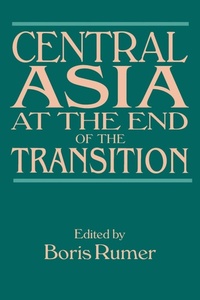
Central Asia at the End of the Transition
1st Edition
Published on 30. June 2005
Book
Paperback/Softback
464 pages
978-0-7656-1576-3 (ISBN)
Description
For better or worse, the former Soviet republics of Central Asia have largely completed their post-independence transitions. Over more than a decade, they have established themselves as independent states whose internal regimes and external relations have characteristic patterns and vulnerabilities both individually and as a group. The purpose of this volume is to assess both what has been accomplished and the trends of development in the region, especially its leading states. How sound are the foundations of this "bulwark against the spread of terrorism" in Eurasia?
More details
Language
English
Place of publication
London
United Kingdom
Publishing group
Taylor & Francis Ltd
Target group
College/higher education
Professional and scholarly
Illustrations
tables, map, bibliographic references, index
Dimensions
Height: 229 mm
Width: 152 mm
Thickness: 25 mm
Weight
670 gr
ISBN-13
978-0-7656-1576-3 (9780765615763)
Copyright in bibliographic data and cover images is held by Nielsen Book Services Limited or by the publishers or by their respective licensors: all rights reserved.
Schweitzer Classification
Other editions
Additional editions
Boris Z. Rumer
Central Asia at the End of the Transition
E-Book
07/2016
Routledge
€77.49
Available for download
Boris Z. Rumer
Central Asia at the End of the Transition
E-Book
07/2016
Routledge
€77.49
Available for download
Boris Z. Rumer
Central Asia at the End of the Transition
Book
05/2005
1st Edition
Routledge
€208.00
Shipment within 15-20 days
Person
Boris Rumer
Content
Part I Overview; Chapter 1 Central Asia at the End of the Transition, Boris Rumer; Part II The External Context; Chapter 2 Russia and Central Asia: Problems of Security, Irina Zviagel 'skaia; Chapter 3 Russia: On the Path to Empore?, Konstantin Syroezhkin; Chapter 4 China's Central Asia Policy: Making Sense of the Shanghai Cooperation Organization, Richard W. X. Hu; Chapter 5 Islamic Radicalism in Central Asia: The Influence of Pakistan and Afghanistan, Vyacheslav Belokrenitsky; Part III The Internal Social and Political Context; Chapter 6 The Regime in Kazakhstan, Dmitrii Furman; Chapter 7 Uzbekistan: Between Traditionalism and Westernization, Evgeniy Abdullaev; Part IV The Prospects for Economic Development; Chapter 8 Kyrgyzstan and Uzbekistan: Landlocked Agrarian Economies with an Unlimited Supply of Labor, Stanislav Zhukov; Chapter 9 Institutional Barriers to the Economic Development of Uzbekistan, Eshref Trushin, Eskender Trushin; Chapter 10 Kazakhstan: The Development of Small Raw-Material Exporters Under the Constraints of Globalization, Stanislav Zhukov; Chapter 11 Economic Ties Between Russia and Kazakhstan: Dynamics, Tendencies, and Prospects, Stanislav Zhukov, Oksana Reznikova;