

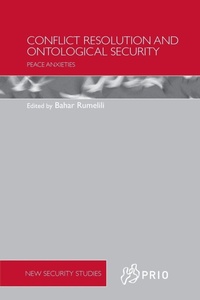
Conflict Resolution and Ontological Security
Peace Anxieties
1st Edition
Published on 24. April 2016
Book
Paperback/Softback
220 pages
978-1-138-20574-1 (ISBN)
Description
This volume highlights the ways in which the prospect of peace can generate anxieties and consequently set in motion social and political processes that reproduce and reactivate conflicts.
In analysing this issue, the volume builds on the notion of ontological security and its recent applications to international relations theory. Although conflicts threaten the physical security of the parties involved, they also help settle existential questions about basic parameters of life, being, and identity, and thus over time become sources of ontological security. The prospect of peace, through the resolution or transformation of conflict, threatens to unsettle the stability and consistency of self-narratives, and their associated routines and habits at the individual, group, and state levels.
The contributors argue two key points: 1) that ontological insecurity may set in motion political and social processes that reproduce and reactivate conflicts; 2) that coping with peace anxieties necessitates the formulation of alternative self-narratives at the individual, societal, and state levels that re-situate the Self in relation to Other and to the world at large. Consequently, the book analyses the ways in which, and the conditions under which, conflict resolution induces ontological insecurity, and the different ways in which ontological insecurity has prevented the successful culmination of peace processes in different conflict contexts, including Cyprus, Israel-Palestine and Northern Ireland.
This book will be of much interest to students of critical security studies, conflict resolution, peace and conflict studies, social theory and IR in general.
In analysing this issue, the volume builds on the notion of ontological security and its recent applications to international relations theory. Although conflicts threaten the physical security of the parties involved, they also help settle existential questions about basic parameters of life, being, and identity, and thus over time become sources of ontological security. The prospect of peace, through the resolution or transformation of conflict, threatens to unsettle the stability and consistency of self-narratives, and their associated routines and habits at the individual, group, and state levels.
The contributors argue two key points: 1) that ontological insecurity may set in motion political and social processes that reproduce and reactivate conflicts; 2) that coping with peace anxieties necessitates the formulation of alternative self-narratives at the individual, societal, and state levels that re-situate the Self in relation to Other and to the world at large. Consequently, the book analyses the ways in which, and the conditions under which, conflict resolution induces ontological insecurity, and the different ways in which ontological insecurity has prevented the successful culmination of peace processes in different conflict contexts, including Cyprus, Israel-Palestine and Northern Ireland.
This book will be of much interest to students of critical security studies, conflict resolution, peace and conflict studies, social theory and IR in general.
More details
Series
Language
English
Place of publication
London
United Kingdom
Publishing group
Taylor & Francis Ltd
Target group
College/higher education
Professional and scholarly
Illustrations
1 s/w Zeichnung, 2 s/w Tabellen
2 Tables, black and white; 1 Line drawings, black and white
Dimensions
Height: 234 mm
Width: 156 mm
Thickness: 12 mm
Weight
345 gr
ISBN-13
978-1-138-20574-1 (9781138205741)
Copyright in bibliographic data and cover images is held by Nielsen Book Services Limited or by the publishers or by their respective licensors: all rights reserved.
Schweitzer Classification
Other editions
Additional editions

Book
01/2015
1st Edition
Routledge
€231.50
Shipment within 15-20 days

E-Book
12/2014
1st Edition
Routledge
€61.99
Available for download

E-Book
12/2014
1st Edition
Routledge
€61.99
Available for download
Person
Bahar Rumelili is Associate Professor and Jean Monnet Chair in the Department of International Relations, Koc University, Turkey, and author of Constructing Regional Community and Order in Europe and Southeast Asia (2007).
Content
Introduction, Bahar Rumelili 1. Ontological (In)security and Peace Anxieties: A Framework for Conflict Resolution, Bahar Rumelili 2. Ontological Security and the Israeli-Palestinian Peace Process: Between Unstable Conflict and Conflict in Resolution, Amir Lupovici 3. Kurdish Issue and Levels of Ontological Security, Ayse Betuel Celik 4. Ethnic Nationalism and the Production of Ontological Security in Cyprus, Neophytos G. Loizides5. Ontological (In)security and Violent Peace in Northern Ireland, Audra Mitchell 6. Ontological (In)Security of 'Included' Citizens: The Case of Early Republican Turkey (1923-1946), Pinar Bilgin and Basak Ince 7. Ontological (In)Security After Peace: The Case of the Aland Islands, Pertti Joenniemi 8. The Ontological Significance of Karelia: Finland's Reconciliation with Losing the Promised Land, Christopher S. Browning & Pertti Joenniemi 9. Decolonising Security and Peace: Mono-Epistemology versus Peace Formation, Oliver P. Richmond Conclusion, Bahar Rumelili