

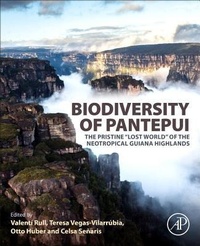
Biodiversity of Pantepui
The Pristine "Lost World" of the Neotropical Guiana Highlands
Published on 13. June 2019
Book
Paperback/Softback
470 pages
978-0-12-815591-2 (ISBN)
Description
Biodiversity of Pantepui: The Pristine "Lost World" of the Neotropical Guiana Highlands provides the most updated and comprehensive knowledge on the biota, origin, and evolution of the Pantepui biogeographical province. It synthesizes historical information and recent discoveries, covering the main biogeographic patterns, evolutionary trends, and conservational efforts.
Written by international experts on the biodiversity of this pristine land, this book explores what makes Pantepui a unique natural laboratory to study the origin and evolution of Neotropical biodiversity under the influence of only natural drivers. It discusses the organisms living in Pentepui, including algae, plants, several groups of invertebrates, birds, amphibians, reptiles, and mammals. The latter portion of the book delves into the effects of human activity and global warming on Pantepui, and current conservational efforts to combat these threats. Biodiversity of Pantepui is an important resource for researchers in ecology, biogeography, evolution, and conservation, who want to understand the biodiversity and natural history of this region, and how to help conserve and protect the Guiana Highlands from environmental and human damages.
Written by international experts on the biodiversity of this pristine land, this book explores what makes Pantepui a unique natural laboratory to study the origin and evolution of Neotropical biodiversity under the influence of only natural drivers. It discusses the organisms living in Pentepui, including algae, plants, several groups of invertebrates, birds, amphibians, reptiles, and mammals. The latter portion of the book delves into the effects of human activity and global warming on Pantepui, and current conservational efforts to combat these threats. Biodiversity of Pantepui is an important resource for researchers in ecology, biogeography, evolution, and conservation, who want to understand the biodiversity and natural history of this region, and how to help conserve and protect the Guiana Highlands from environmental and human damages.
More details
Language
English
Place of publication
San Diego
United States
Publishing group
Elsevier Science Publishing Co Inc
Target group
Professional and scholarly
Researchers and students in disciplines such as biodiversity, ecology, evolution, biogeography, earth sciences, or conservation
Product notice
Paperback (trade)
Unsewn / adhesive bound
Dimensions
Height: 234 mm
Width: 191 mm
Thickness: 25 mm
Weight
953 gr
ISBN-13
978-0-12-815591-2 (9780128155912)
Copyright in bibliographic data and cover images is held by Nielsen Book Services Limited or by the publishers or by their respective licensors: all rights reserved.
Schweitzer Classification
Other editions
Additional editions
Valentí Rull | Teresa Vegas-Vilarrúbia | Otto Huber
Biodiversity of Pantepui
The Pristine "Lost World" of the Neotropical Guiana Highlands
E-Book
06/2019
Academic Press
€105.00
Available for download
Persons
Valenti Rull is a biologist with a PhD in paleoecology (1990). He is a Tenured Scientist of the Spanish Council for Scientific Research (CSIC) at the Institute of Earth Sciences Jaume Almera, Barcelona. He uses paleocological evidence to study the type and characteristics of biotic responses to environmental shifts, the natural and anthropogenic drivers of ecological change and the role of tectonics and environmental change on the origin of biodiversity. He also works on the contribution of paleoecology to biodiversity conservation. Dr. Rull has conducted his research on several temperate (Pyrenees, Azores Islands), tropical (Andes, Orinoco delta, Maracaibo basin, Gran Sabana, Pantepui) and subtropical (Easter Island) regions. Teresa Vegas-Vilarrubia obtained her PhD at the Venezuelan Institute of Scientific Research (1989). She worked as Consultant assessing environmental impacts of the Venezuelan oil industry, and as Environmental Researcher and Education Manager of the National Parks System of Venezuela. Since 2002 she has served as faculty member at the University of Barcelona (Spain). Her main research lines are: Biotic responses to rapid climate changes, high-resolution Paleolimnology since the Lateglacial, long-term variations of lake hypoxia/anoxia and effects of global change on aquatic ecosystems. She teaches courses on Epicontinental Waters, Biogeochemistry and Paleoecology at the master level. Otto Huber, born Germany, 24.11.1944, resident in Merano (Italy). MSc in Biological Sciences, University of Rome (Italy) in 1971; Ph.D in Plant Ecology, University of Innsbruck (Austria) in 1976. Lived and worked in Venezuela 1973-2002, and part-time 2003-2010. Main research activities: plant ecology in savanna ecosystems of the Central Venezuelan Llanos; phenology of montane cloud forests of northern Venezuela; flora and vegetation of 56 different tepui summits of Pantepui, Venezuelan Guayana Shield. Professor for Plant Ecology at Universidad Simon Bolivar, Caracas (1999-2002); Director of Research (1994-98) and Research Associate (2002-10) of the Botanical Institute in Caracas. Celsa Senaris received her Ph.D. degree from the University of Santiago de Compostela in 2001. From 1991-2003 she was the Curator of the Herpetology collection of the La Salle Natural History Museum in Caracas, and she served as Director until 2012. Currently she is a Researcher in the Ecology and Genetics Laboratory at Instituto Venezolano de Investigaciones Cientificas. Her research focuses on the Guianan herpetofauna, studying the systematic and biogeography of the amphibians and reptiles in that region. Also, she has been a Professor in the Universidad Central de Venezuela. She is the Venezuelan Chair of the Amphibian Specialist Group-IUCN.
Editor
Senior Scientist, Spanish Council for Scientific Research (CSIC), Institute of Earth Sciences Jaume Almera, Barcelona, Spain
Associate Professor, Department of Evolutionary Biology, Ecology and Environmental Sciences, University of Barcelona - Barcelona, Spain
Scientific Advisor to the President of Fundacion Instituto Botanico de Venezuela - Caracas, Venezuela
Associate Researcher, Ecology and Population Genetics Laboratory, Instituto Venezolano de Investigaciones Cientificas - Altos de Pipe, Venezuela
Content
1. Physiographical and environmental diversity
2. Holocene climatic and ecological history
3. Protista: cyanobacteria, green algae, diatoms
4. Bryophyta
5. Vascular plant diversity and phytogeography
6. Elevational plant diversity patterns
7. Plant phylogeography and evolution
8. Vegetation and ecosystems
9. Invertebrates: insects, scorpions, crabs, snails, vertebrate parasites
10. Amphibians and reptiles
11. Birds
12. Mammals
13. Threats and conservation status
14. Potential effects of global warming
2. Holocene climatic and ecological history
3. Protista: cyanobacteria, green algae, diatoms
4. Bryophyta
5. Vascular plant diversity and phytogeography
6. Elevational plant diversity patterns
7. Plant phylogeography and evolution
8. Vegetation and ecosystems
9. Invertebrates: insects, scorpions, crabs, snails, vertebrate parasites
10. Amphibians and reptiles
11. Birds
12. Mammals
13. Threats and conservation status
14. Potential effects of global warming