

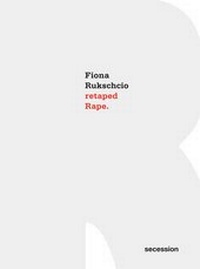
retaped Rape
1st Edition
Published in 2013
Book
48 pages
978-3-95763-066-7 (ISBN)
Description
vorherige ISBN 978-3-86895-273-5
In her films, collages and projects, Fiona Rukschcio deals with the roles assigned to women, with identity construction, and with extreme emotional experiences. At the Secession, she is has shown her film retaped Rape (2012) and a series of photographs documenting the making of the film. These new works take their cue and their structure from the film Rape made by Yoko Ono and John Lennon in 1969. Rukschcio re-filmed the work, in which the cameraman pursues a young woman through London back to her apartment, recreating the same shots at the original locations, but without the woman.
Rape is known as one of the works that brutally reveal the way the camera establishes its own powerful gaze, to which it subjects those filmed. This voyeuristic and exploitative (male) gaze, as described by Laura Mulvey in her essay "Visual Pleasure and Narrative Cinema" (1973), is exemplified by the film's experimental structure. The camera focuses in on, pursues, and encircles the woman, communicating with her in various ways.
In retaped Rape, the camera is thrown back on its own resources, following an invisible trace. This frees the viewer from the original perpetrator perspective, thus highlighting both the viewpoint of the victim and the duration of the aggression.
In her catalogue essay, Elisabeth Büttner writes: "The event has shifted; no longer visible, it first has to be created. [.] The ideology of 1969 is being decomposed. Neither a visible object nor a concrete occasion are required in order to reveal the work of the camera as powerful, intrusive, ceaselessly forming and transforming reality. [.] The primary transactional relation is no longer between the camera and the desired, hunted object but between camera and camerawoman, camera and audience."
"Fiona Rukschcio's camera proceeds ruthlessly," writes Doris Krumpl in her catalogue essay: "In many ways, her film retaped Rape resembles the original images by Yoko Ono and John Lennon, but it is anything but a rip-off, and the ugly face it reveals is far more cryptic than in 1969. Many things have now become totally normal, many others have retained their power to disturb. But the way people deal with these things has definitely changed, as retaped Rape shows." With this shift, Rukschcio opens up a series of questions concerning the connection between camera language, the gaze and, not least, violence. What changes, for example, when the person behind the camera is a woman, while the woman in front of the camera is missing?
Texts by Thomas Ballhausen, Elisabeth Büttner, Doris Krumpl
In her films, collages and projects, Fiona Rukschcio deals with the roles assigned to women, with identity construction, and with extreme emotional experiences. At the Secession, she is has shown her film retaped Rape (2012) and a series of photographs documenting the making of the film. These new works take their cue and their structure from the film Rape made by Yoko Ono and John Lennon in 1969. Rukschcio re-filmed the work, in which the cameraman pursues a young woman through London back to her apartment, recreating the same shots at the original locations, but without the woman.
Rape is known as one of the works that brutally reveal the way the camera establishes its own powerful gaze, to which it subjects those filmed. This voyeuristic and exploitative (male) gaze, as described by Laura Mulvey in her essay "Visual Pleasure and Narrative Cinema" (1973), is exemplified by the film's experimental structure. The camera focuses in on, pursues, and encircles the woman, communicating with her in various ways.
In retaped Rape, the camera is thrown back on its own resources, following an invisible trace. This frees the viewer from the original perpetrator perspective, thus highlighting both the viewpoint of the victim and the duration of the aggression.
In her catalogue essay, Elisabeth Büttner writes: "The event has shifted; no longer visible, it first has to be created. [.] The ideology of 1969 is being decomposed. Neither a visible object nor a concrete occasion are required in order to reveal the work of the camera as powerful, intrusive, ceaselessly forming and transforming reality. [.] The primary transactional relation is no longer between the camera and the desired, hunted object but between camera and camerawoman, camera and audience."
"Fiona Rukschcio's camera proceeds ruthlessly," writes Doris Krumpl in her catalogue essay: "In many ways, her film retaped Rape resembles the original images by Yoko Ono and John Lennon, but it is anything but a rip-off, and the ugly face it reveals is far more cryptic than in 1969. Many things have now become totally normal, many others have retained their power to disturb. But the way people deal with these things has definitely changed, as retaped Rape shows." With this shift, Rukschcio opens up a series of questions concerning the connection between camera language, the gaze and, not least, violence. What changes, for example, when the person behind the camera is a woman, while the woman in front of the camera is missing?
Texts by Thomas Ballhausen, Elisabeth Büttner, Doris Krumpl