

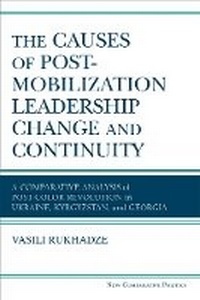
The Causes of Post-Mobilization Leadership Change and Continuity
A Comparative Analysis of Post-Color Revolution in Ukraine, Kyrgyzstan, and Georgia
Published on 24. August 2021
Book
Hardback
258 pages
978-0-472-13265-2 (ISBN)
Description
Vasili Rukhadze examines the factors that contributed to post-uprising leadership durability in the Ukraine, Kyrgyzstan, and Georgia in 2004-12, after these countries underwent their so-called "Color Revolutions." Using structured, focused comparison and process tracing, he argues that the key independent variable influencing post-mobilization leadership durability is ruling coalition size and cohesion. He demonstrates that if the ruling coalitions are large and fragmented, as in the Ukraine and Kyrgyzstan, the coalitions disintegrate, thus facilitating the downfall of the governments. Alternatively, if the ruling coalition is small and cohesive, as in Georgia, the coalition maintains unity, hence helping the government to stay in power.
This study advances the debate on regime changes. By drawing a clear distinction between political leaderships that come to power as a result of popular uprisings and governments that take power through normal democratic processes, military coup, or any other means, the research offers one of the first studies on post-mobilization leadership. Rukhadze helps scholars differentiate between the factors that affect durability of post-uprising leadership from those factors that impact durability of all other political leadership, in turn equipping researchers with new tools to study power politics.
This study advances the debate on regime changes. By drawing a clear distinction between political leaderships that come to power as a result of popular uprisings and governments that take power through normal democratic processes, military coup, or any other means, the research offers one of the first studies on post-mobilization leadership. Rukhadze helps scholars differentiate between the factors that affect durability of post-uprising leadership from those factors that impact durability of all other political leadership, in turn equipping researchers with new tools to study power politics.
More details
Series
Language
English
Place of publication
Ann Arbor
United States
Target group
Professional and scholarly
Illustrations
3 figures, 8 tables
Dimensions
Height: 229 mm
Width: 152 mm
ISBN-13
978-0-472-13265-2 (9780472132652)
Copyright in bibliographic data and cover images is held by Nielsen Book Services Limited or by the publishers or by their respective licensors: all rights reserved.
Schweitzer Classification
Person
Vasili Rukhadze is Visiting Lecturer of Political Science at the University of Pittsburgh
Content
TABLE OF CONTENTS
LIST OF TABLES AND FIGURES
AKNOWLEDGEMENTS
CHAPTERS
I. Introduction, Research Design, and Methodology, and Literature Review
II. Historical Background
III. The Case of Ukraine
IV. The Case of Kyrgyzstan
V. The Case of Georgia
VI. Conclusions
REFERENCES
LIST OF INTERVIEWEES
LIST OF TABLES AND FIGURES
AKNOWLEDGEMENTS
CHAPTERS
I. Introduction, Research Design, and Methodology, and Literature Review
II. Historical Background
III. The Case of Ukraine
IV. The Case of Kyrgyzstan
V. The Case of Georgia
VI. Conclusions
REFERENCES
LIST OF INTERVIEWEES