

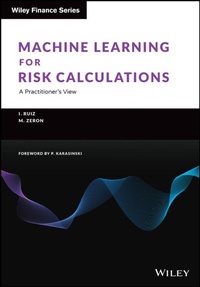
Machine Learning for Risk Calculations
A Practitioner's View
1st Edition
Published on 23. December 2021
Book
Hardback
464 pages
978-1-119-79138-6 (ISBN)
Description
State-of-the-art algorithmic deep learning and tensoring techniques for financial institutions
The computational demand of risk calculations in financial institutions has ballooned and shows no sign of stopping. It is no longer viable to simply add more computing power to deal with this increased demand. The solution? Algorithmic solutions based on deep learning and Chebyshev tensors represent a practical way to reduce costs while simultaneously increasing risk calculation capabilities. Deep Learning and Tensoring Risk Calculations: A Practitioner's View provides an in-depth review of a number of algorithmic solutions and demonstrates how they can be used to overcome the massive computational burden of risk calculations in financial institutions.
This book will get you started by reviewing fundamental techniques, including deep learning and Chebyshev tensors. You'll then discover algorithmic tools that, in combination with the fundamentals, deliver actual solutions to the real problems financial institutions encounter on a regular basis. Numerical tests and examples demonstrate how these solutions can be applied to practical problems, including XVA and Counterparty Credit Risk, IMM capital, PFE, VaR, FRTB, Dynamic Initial Margin, pricing function calibration, volatility surface parametrisation, portfolio optimisation and others. Finally, you'll uncover the
benefits these techniques provide, the practicalities of implementing them, and the software which can be used.
* Review the fundamentals of deep learning and Chebyshev tensors
* Discover pioneering algorithmic techniques that can create new opportunities in complex risk calculation
* Learn how to apply the solutions to a wide range of real-life risk calculations.
* Download sample code used in the book, so you can follow along and experiment with your own calculations
* Realize improved risk management whilst overcoming the burden of limited computational power
Quants, IT professionals, and financial risk managers will benefit from this practitioner-oriented approach to state-of-the-art risk calculation.
The computational demand of risk calculations in financial institutions has ballooned and shows no sign of stopping. It is no longer viable to simply add more computing power to deal with this increased demand. The solution? Algorithmic solutions based on deep learning and Chebyshev tensors represent a practical way to reduce costs while simultaneously increasing risk calculation capabilities. Deep Learning and Tensoring Risk Calculations: A Practitioner's View provides an in-depth review of a number of algorithmic solutions and demonstrates how they can be used to overcome the massive computational burden of risk calculations in financial institutions.
This book will get you started by reviewing fundamental techniques, including deep learning and Chebyshev tensors. You'll then discover algorithmic tools that, in combination with the fundamentals, deliver actual solutions to the real problems financial institutions encounter on a regular basis. Numerical tests and examples demonstrate how these solutions can be applied to practical problems, including XVA and Counterparty Credit Risk, IMM capital, PFE, VaR, FRTB, Dynamic Initial Margin, pricing function calibration, volatility surface parametrisation, portfolio optimisation and others. Finally, you'll uncover the
benefits these techniques provide, the practicalities of implementing them, and the software which can be used.
* Review the fundamentals of deep learning and Chebyshev tensors
* Discover pioneering algorithmic techniques that can create new opportunities in complex risk calculation
* Learn how to apply the solutions to a wide range of real-life risk calculations.
* Download sample code used in the book, so you can follow along and experiment with your own calculations
* Realize improved risk management whilst overcoming the burden of limited computational power
Quants, IT professionals, and financial risk managers will benefit from this practitioner-oriented approach to state-of-the-art risk calculation.
More details
Series
Language
English
Place of publication
New York
United States
Target group
Professional and scholarly
Dimensions
Height: 249 mm
Width: 172 mm
Thickness: 38 mm
Weight
828 gr
ISBN-13
978-1-119-79138-6 (9781119791386)
Copyright in bibliographic data and cover images is held by Nielsen Book Services Limited or by the publishers or by their respective licensors: all rights reserved.
Schweitzer Classification
Other editions
Additional editions
E-Book
12/2021
1st Edition
Wiley
€67.99
Available for download
E-Book
12/2021
1st Edition
Wiley
€67.99
Available for download
Content
I Fundamental Approximation Methods 31
1 Machine Learning 33
2 Deep Neural Nets 77
3 Chebyshev Tensors 109
II The toolkit plugging in approximation methods155
4 Introduction: why is a toolkit needed 157
5 Composition techniques 165
6 Tensors in TT format and Tensor Extension Algorithms 177
7 Sliding technique 197
8 The Jacobian projection technique 203
III Hybrid solutions approximation methods and the toolkit 215
9 Introduction 217
10 The Toolkit and Deep Neural Nets 221
11 The Toolkit and Chebyshev Tensors 225
12 Hybrid Deep Neural Nets and Chebyshev Tensors Frameworks 229
13 The Aim 247
14 When to use Chebyshev Tensors and when Deep Neural Nets253
15 Counterparty Credit Risk 271
16 Market Risk 323
17 Dynamic sensitivities 363
18 Pricing model calibration 385
19 Approximation of the implied volatility function 407
20 Optimisation Problems 435
21 Pricing Cloning 451
22 XVA sensitivities 461
23 Sensitivities of exotic derivatives 467
24 Software libraries relevant to the book 475
Appendix A Families of orthogonal polynomials 501
Appendices
Appendix B Exponential convergence of Chebyshev Tensors 503
Appendix C Chebyshev Splines on functions with no singularity
points 507
Appendix D Computational savings details for CCR 511
Appendix E computational savings details for dynamic sensitivi-ties 519
Appendix F Dynamic sensitivities on the market space 523
Appendix G Dynamic sensitivities and IM via Jacobian Projec-tion technique 53 Appendix H MVA optimisation further computational enhance-ment 537
1 Machine Learning 33
2 Deep Neural Nets 77
3 Chebyshev Tensors 109
II The toolkit plugging in approximation methods155
4 Introduction: why is a toolkit needed 157
5 Composition techniques 165
6 Tensors in TT format and Tensor Extension Algorithms 177
7 Sliding technique 197
8 The Jacobian projection technique 203
III Hybrid solutions approximation methods and the toolkit 215
9 Introduction 217
10 The Toolkit and Deep Neural Nets 221
11 The Toolkit and Chebyshev Tensors 225
12 Hybrid Deep Neural Nets and Chebyshev Tensors Frameworks 229
13 The Aim 247
14 When to use Chebyshev Tensors and when Deep Neural Nets253
15 Counterparty Credit Risk 271
16 Market Risk 323
17 Dynamic sensitivities 363
18 Pricing model calibration 385
19 Approximation of the implied volatility function 407
20 Optimisation Problems 435
21 Pricing Cloning 451
22 XVA sensitivities 461
23 Sensitivities of exotic derivatives 467
24 Software libraries relevant to the book 475
Appendix A Families of orthogonal polynomials 501
Appendices
Appendix B Exponential convergence of Chebyshev Tensors 503
Appendix C Chebyshev Splines on functions with no singularity
points 507
Appendix D Computational savings details for CCR 511
Appendix E computational savings details for dynamic sensitivi-ties 519
Appendix F Dynamic sensitivities on the market space 523
Appendix G Dynamic sensitivities and IM via Jacobian Projec-tion technique 53 Appendix H MVA optimisation further computational enhance-ment 537