

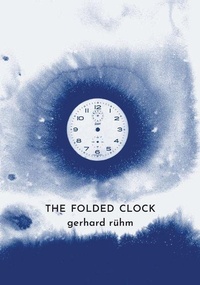
the folded clock
100 number poems
Published on 11. November 2025
Book
Paperback/Softback
173 pages
978-80-88628-11-8 (ISBN)
Description
Like Kurt Schwitters before him, Gerhard Ruhm has incorporated numerals and digits into his visual and aural poetry since the early days of Wiener Gruppe in the 1950s. The Folded Clock brings together these number poems, comprising typewriter ideograms, typed concrete poetry, collages of everyday paper ephemera and scraps, and a wide variety of literary forms where the visual pattern created on the page underpins the thematic meaning. Blurring the distinction between "counting" and "recounting," his "recitations" imaginatively translate arithmetic vocabulary into the mundane, the existential, or the cosmic, such as a history of the universe narrated as a solar year, from the Big Bang on January 1 to the moon landing in the last seconds of New Year's Eve. Ruhm's images and texts unleash the sensual qualities of numerals to subvert our digit-filled environment with its pervasive intensification of seamless control.
More details
Language
English
Place of publication
Prague
Czech Republic
Product notice
sewn/stitched
With flaps
Illustrations
52 black and white illustrations
Dimensions
Height: 199 mm
Width: 142 mm
Thickness: 14 mm
Weight
276 gr
ISBN-13
978-80-88628-11-8 (9788088628118)
Copyright in bibliographic data and cover images is held by Nielsen Book Services Limited or by the publishers or by their respective licensors: all rights reserved.
Schweitzer Classification
Persons
Born in Vienna, Austria, in 1930, author, composer, visual artist Gerhard Ruhm is one of the key figures in the postwar European (neo)avant-garde. He studied music in the 1950s and '60s and was a founding member of the legendary Vienna Group. His work is characterized by the intersections of music and language as well as text and image and thus encompasses poetry, prose, radio plays, drama scenarios, music compositions, visual compositions, collages, and graphic art, and reflects the techniques of concrete poetry and Dadaism, while also influenced by Surrealism and Dark Romanticism.