

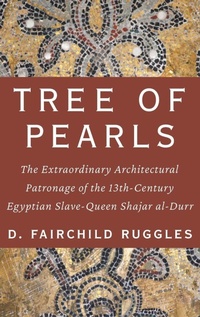
Tree of Pearls
The Extraordinary Architectural Patronage of the 13th-Century Egyptian Slave-Queen Shajar al-Durr
Published on 29. June 2020
Book
Hardback
204 pages
978-0-19-087320-2 (ISBN)
Description
Shajar al-Durr--known as "Tree of Pearls"--began her remarkable career as a child slave, given as property to the Ayyubid Sultan Salih of Egypt. She became his favorite concubine, was manumitted, became the sultan's wife, served as governing regent, and ultimately rose to become the legitimately appointed sultan of Egypt in 1250 after her husband's death. Shajar al-Durr used her wealth and power to add a tomb to his urban madrasa; with this innovation, madrasas and many other charitably endowed architectural complexes became commemorative monuments, a practice that remains widespread today. A highly unusual case of a Muslim woman authorized to rule in her own name, her reign ended after only three months when she was forced to share her governance with an army general from the ranks of the Mamluks (elite slave soldiers) and for political expediency to marry him.
Despite the fact that Shajar al-Durr's story ends tragically with her assassination and hasty burial, her deeds in her lifetime offer a stark alternative to the continued belief that women in the medieval period were unseen, anonymous, and inconsequential in a world that belonged to men. This biography--the first ever in English--will place the rise and fall of the sultan-queen in the wider context of the cultural and architectural development of Cairo, the city that still holds one of the largest and most important collections of Islamic monuments in the world. D. Fairchild Ruggles also situates the queen's extraordinary architectural patronage in relation to other women of her own time, such as Aleppo's Ayyubid regent. Tree of Pearls concludes with a lively discussion of what we can know about the material impact of women of both high and lesser social rank in this period, and why their impact matters in the writing of history.
Despite the fact that Shajar al-Durr's story ends tragically with her assassination and hasty burial, her deeds in her lifetime offer a stark alternative to the continued belief that women in the medieval period were unseen, anonymous, and inconsequential in a world that belonged to men. This biography--the first ever in English--will place the rise and fall of the sultan-queen in the wider context of the cultural and architectural development of Cairo, the city that still holds one of the largest and most important collections of Islamic monuments in the world. D. Fairchild Ruggles also situates the queen's extraordinary architectural patronage in relation to other women of her own time, such as Aleppo's Ayyubid regent. Tree of Pearls concludes with a lively discussion of what we can know about the material impact of women of both high and lesser social rank in this period, and why their impact matters in the writing of history.
Reviews / Votes
By the time I finished reading the chapters on Shajar al-Durr's patronage of two tomb complexes and the concept of Matronage, I had an enriched understanding of the impact of this specific woman's actions, particularly in light of the political, military, religious and cultural world in which she lived (and died). * Jere L. Bacharach, University of Washington * D. Fairchild Ruggles brings a different and refreshing sensibility to bear in this very interesting and rewarding book. Her exceptional scholarship and engaging style bring to life the most vivid character among the powerful women of the medieval Islamic world. * Stephen Humphreys, University of California, Santa Barbara * The book richly deserves the Nancy Lapp Popular Book Award that it received from the American Society of Overseas Research in 2020. * Tanisha C. Ford, American Historical Review *More details
Language
English
Place of publication
New York
United States
Target group
Professional and scholarly
Illustrations
104 illustrations, 50 in color
Dimensions
Height: 240 mm
Width: 161 mm
Thickness: 18 mm
Weight
621 gr
ISBN-13
978-0-19-087320-2 (9780190873202)
Copyright in bibliographic data and cover images is held by Nielsen Book Services Limited or by the publishers or by their respective licensors: all rights reserved.
Schweitzer Classification
Other editions
Additional editions
D. Fairchild Ruggles
Tree of Pearls
The Extraordinary Architectural Patronage of the 13th-Century Egyptian Slave-Queen Shajar al-Durr
E-Book
04/2020
1st Edition
OUP eBook
€16.99
Available for download
D. Fairchild Ruggles
Tree of Pearls
The Extraordinary Architectural Patronage of the 13th-Century Egyptian Slave-Queen Shajar al-Durr
E-Book
04/2020
1st Edition
OUP eBook
€16.99
Available for download
Person
D. Fairchild Ruggles is Professor and Debra L. Mitchell Chair in the Department of Landscape Architecture at the University of Illinois, Urbana-Champaign, where she also holds appointments in Art History, Architecture, Medieval Studies, Spanish and Portuguese, and Gender and Women's Studies. She is the author and presenter of short films on Islamic art for the Muslim Journeys Bookshelf, and she is current art and architecture field editor for The Encyclopaedia of Islam.
Content
List of Illustrations
Acknowledgements
Note on Dates and Transliterations
Chapter 1: Who Was "Tree of Pearls"
Chapter 2: Sultans and Slaves: Salih's Rise to Power
Chapter 3: The Streets of Cairo and the Salihiyya Madrasa
Chapter 4: Crisis in Cairo: From Sultan to Sultan-Queen
Chapter 5: Commemorative Architecture and Salih's "Blessed Mausoleum"
Chapter 6: "If You Lack Men": the Shajar al-Durr's Abdication and Tomb
Chapter 7: Matronage
Appendix: Recipe for Umm 'Ali
Bibliography
Index
Acknowledgements
Note on Dates and Transliterations
Chapter 1: Who Was "Tree of Pearls"
Chapter 2: Sultans and Slaves: Salih's Rise to Power
Chapter 3: The Streets of Cairo and the Salihiyya Madrasa
Chapter 4: Crisis in Cairo: From Sultan to Sultan-Queen
Chapter 5: Commemorative Architecture and Salih's "Blessed Mausoleum"
Chapter 6: "If You Lack Men": the Shajar al-Durr's Abdication and Tomb
Chapter 7: Matronage
Appendix: Recipe for Umm 'Ali
Bibliography
Index