

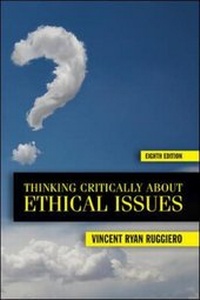
Thinking Critically About Ethical Issues
8th Edition
Published on 16. March 2011
Book
Paperback/Softback
224 pages
978-0-07-353590-6 (ISBN)
Description
This concise, accessible text emphasizes doing ethical analysis and thinking critically about ethical issues, rather than focusing on ethical theory or the history of ethics. Ruggiero's readers are invited to apply ethical principles to issues that exemplify the kinds of moral challenges encountered in everyday life. It engages students' minds, stimulates enthusiasm, and makes teaching more effective and rewarding.
More details
Edition
8th edition
Language
English
Place of publication
United States
Publishing group
McGraw-Hill Education - Europe
Dimensions
Height: 226 mm
Width: 152 mm
Thickness: 10 mm
Weight
261 gr
ISBN-13
978-0-07-353590-6 (9780073535906)
Copyright in bibliographic data and cover images is held by Nielsen Book Services Limited or by the publishers or by their respective licensors: all rights reserved.
Schweitzer Classification
Other editions
Previous edition

Vincent Ryan Ruggiero
Thinking Critically About Ethical Issues
Book
04/2007
7th Edition
McGraw-Hill Higher Education
€67.94
Article exhausted; check for reprint
Person
Vincent Ryan Ruggiero is internationally recognized as a pioneer in the movement to make creative and critical thinking central emphases in education and in society. The author of 22 books and over 500 essays, he is Professor of Humanities Emeritus at State University of New York, Delhi.
Content
Part I: THE CONTEXTCHAPTER 1 - THE NEED FOR ETHICSWhy do we need ethics? We have laws to protect people's rights. If the laws are enforced, what need have we of further rules?CHAPTER 2 - THE ROLE OF THE MAJORITY VIEWIs the basis for deciding moral values the majority view? In other words, if the majority of the citizens of our country should decide that a particular action is right, would that very decision make the action right?CHAPTER 3 - THE ROLE OF FEELINGSIf the majority view does not determine the rightness of an action, should each person decide on the basis of her or his own feelings, desires, preferences?CHAPTER 4 - THE ROLE OF CONSCIENCEIf feelings are no better a guide than the majority view, is the basis of morality each person's own conscience? How trustworthy is conscience?CHAPTER 5 - COMPARING CULTURESIf an action that is praised in one culture may be condemned in another, would it be correct to say that all moral values are relative to the culture they are found in? Isn't it a mark of ignorance to pass judgments on other cultures or to claim that one culture is better than another?Part II: A STRATEGYCHAPTER 6 - A FOUNDATION FOR JUDGMENTIf both individuals and cultures can be mistaken in their moral reasoning, we need a basis for evaluating their judgment. If the majority view, feelings, and conscience do not provide that basis, what does?CHAPTER 7 - THE BASIC CRITERIAWhat is really good for us? What criteria and approaches are most effective in examining moral issues? What pitfalls other than relativism and absolutism should we be aware of and strive to avoid?CHAPTER 8 - CONSIDERING OBLIGATIONSWhat do we do in situations where there is more than a single obligation? How can we reconcile conflicting obligations?CHAPTER 9 - CONSIDERING MORAL IDEALSHow can we reconcile conflicts between moral ideals or between a moral ideal and an obligation?CHAPTER 10 - CONSIDERING CONSEQUENCESHow do we deal with cases in which the consequences are not neatly separable into good and bad, but are mixed?CHAPTER 11 - DETERMINING MORAL RESPONSIBILITYHow do we determine whether a person is responsible for her or his immoral actions? Are there degrees of responsibility?Part III: THE TRADITIONCHAPTER 12 - A PERSPECTIVE ON HISTORYWhen did the study of ethics begin? Who were the great thinkers in the history of ethics? What contributions did they make?Part IV: CONTEMPORARY ETHICAL CONTROVERSIESEducation
Media and the arts
Sex
Government
Law
Business
Medicine
Science
WarAFTERWORD: A SUGGESTION FOR FURTHER STUDYAPPENDIX - WRITING ABOUT MORAL ISSUESNotesIndex
Media and the arts
Sex
Government
Law
Business
Medicine
Science
WarAFTERWORD: A SUGGESTION FOR FURTHER STUDYAPPENDIX - WRITING ABOUT MORAL ISSUESNotesIndex