

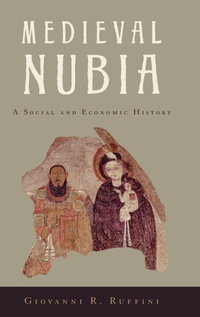
Medieval Nubia
A Social and Economic History
Published on 18. October 2012
Book
Hardback
320 pages
978-0-19-989163-4 (ISBN)
Description
Among the few surviving archaeological sites from the medieval Christian kingdom of Nubia--located in present day Sudan--Qasr Ibrim is unique in a number of ways. It is the only site in Lower Nubia that remained above water after the completion of the Aswan high dam. In addition, thanks to the aridity of the climate in the area the site is marked by extraordinary preservation of organic material, especially textual material written on papyrus, leather, and paper. Particularly rich is the textual material from the twelfth and thirteenth centuries CE, written in Old Nubian, the region's indigenous language. As a result, Qasr Ibrim is probably the best documented ancient and medieval site in Africa outside of Egypt and North Africa.
Medieval Nubia will be the first book to make available this remarkable material, much of which is still unpublished. The evidence discovered reveals a more complicated picture of this community than originally thought. Previously, scholars had thought medieval Nubia had existed in relative isolation from the rest of the world and had a primitive economy. Legal documents, accounts, and letters, however, reveal a complex, monetized economy with exchange rates connected to those of the wider world. Furthermore, they reveal public festive practices, in which lavish feasting and food gifts reinforced the social prestige of the participants. These documents show medieval Nubia to have been a society combining legal elements inherited from the Greco-Roman world with indigenous African social practices. In reconstructing the social and economic life of medieval Nubia based on the Old Nubian sources from the site, as well as other previously examined materials, Giovanni R. Ruffini will correct previous assumptions and produce a new picture of Nubia, one that connects it to the wider Mediterranean economy and society of its time.
Medieval Nubia will be the first book to make available this remarkable material, much of which is still unpublished. The evidence discovered reveals a more complicated picture of this community than originally thought. Previously, scholars had thought medieval Nubia had existed in relative isolation from the rest of the world and had a primitive economy. Legal documents, accounts, and letters, however, reveal a complex, monetized economy with exchange rates connected to those of the wider world. Furthermore, they reveal public festive practices, in which lavish feasting and food gifts reinforced the social prestige of the participants. These documents show medieval Nubia to have been a society combining legal elements inherited from the Greco-Roman world with indigenous African social practices. In reconstructing the social and economic life of medieval Nubia based on the Old Nubian sources from the site, as well as other previously examined materials, Giovanni R. Ruffini will correct previous assumptions and produce a new picture of Nubia, one that connects it to the wider Mediterranean economy and society of its time.
Reviews / Votes
This extraordinary volume adds a new dimension to our knowledge of medieval (Christian) Nubian economy and society, in particular to land tenure. ... The writing throughout the book is admirably clear. * William Y. Adams, Journal of African History *More details
Language
English
Place of publication
New York
United States
Target group
College/higher education
Professional and scholarly
Illustrations
8 illus., 1 map
Dimensions
Height: 240 mm
Width: 161 mm
Thickness: 23 mm
Weight
685 gr
ISBN-13
978-0-19-989163-4 (9780199891634)
Copyright in bibliographic data and cover images is held by Nielsen Book Services Limited or by the publishers or by their respective licensors: all rights reserved.
Schweitzer Classification
Other editions
Additional editions
E-Book
09/2012
1st Edition
OUP eBook
€70.99
Available for download
Person
Giovanni R. Ruffini is Assistant Professor of History and Classical Studies at Fairfield University.
Content
Acknowledgments ; Introduction: Qasr Ibrim and Christian Nubia ; Chapter One: Qasr Ibrim's Land Sales ; Chapter Two: Mashshouda and Archive 3 ; Chapter Three: The Historiography of Nubian Land Tenure ; Chapter Four: Nubian Land Sales as a Legal Genre ; Chapter Five: Nubian Land Sales as Ceremony ; Chapter Six: Nubia's Legal Tradition ; Chapter Seven: Money, Rent, Taxes and Investment ; Chapter Eight: Qasr Ibrim's Other Archives ; Conclusion ; Appendix 1: The Chronology of Archive 3 ; Bibliography ; Index