

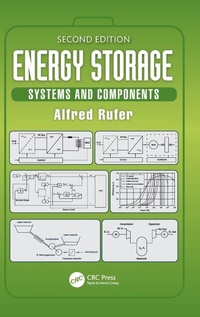
Energy Storage
Systems and Components
2nd Edition
Will be published approx. on 15. June 2026
Book
Hardback
326 pages
978-1-041-23319-0 (ISBN)
Description
This updated edition explores the critical field of energy storage technologies in today's evolving energy landscape. It serves as an essential reference describing various methods of storing energy in the context of renewable energy integration and efficient resource utilization.
Energy Storage: Systems and Components, Second Edition, provides a thorough examination of current storage technologies and analytical frameworks. The book explores systems using electrochemical transformations, classical battery storage elements, flow batteries, fuel cells and hydrogen storage while also investigating storage systems based on physical principles such as gravitational potential forces, air compression and rotational kinetic energy. The book begins with generalities on energy storage systems, establishing fundamental parameter sets for analyzing efficiency and performance characteristics, with special attention to usable energy density across different technologies. It then methodically reviews major storage technologies with detailed technical descriptions and models, covering everything from physics-based solutions like mechanical gravitational systems and pumped hydro to compressed air storage, various electrochemical solutions and chemical transformations. This new edition includes expanded sections on emerging topics like e-methanol production, synfuels for seasonal storage and dry gravitational technology. Readers will benefit from the inclusion of Ragone plot theory, which enables evaluation of real energy release potential relative to power dependency during discharge processes.
This book is ideally suited for practicing engineers and researchers in the energy domain who need comprehensive technical information on storage applications and design principles. It also serves engineering students studying energy systems, renewable integration and storage technologies, providing them with fundamental concepts and practical exercises to enhance understanding.
Energy Storage: Systems and Components, Second Edition, provides a thorough examination of current storage technologies and analytical frameworks. The book explores systems using electrochemical transformations, classical battery storage elements, flow batteries, fuel cells and hydrogen storage while also investigating storage systems based on physical principles such as gravitational potential forces, air compression and rotational kinetic energy. The book begins with generalities on energy storage systems, establishing fundamental parameter sets for analyzing efficiency and performance characteristics, with special attention to usable energy density across different technologies. It then methodically reviews major storage technologies with detailed technical descriptions and models, covering everything from physics-based solutions like mechanical gravitational systems and pumped hydro to compressed air storage, various electrochemical solutions and chemical transformations. This new edition includes expanded sections on emerging topics like e-methanol production, synfuels for seasonal storage and dry gravitational technology. Readers will benefit from the inclusion of Ragone plot theory, which enables evaluation of real energy release potential relative to power dependency during discharge processes.
This book is ideally suited for practicing engineers and researchers in the energy domain who need comprehensive technical information on storage applications and design principles. It also serves engineering students studying energy systems, renewable integration and storage technologies, providing them with fundamental concepts and practical exercises to enhance understanding.
More details
Edition
2nd edition
Language
English
Place of publication
London
United Kingdom
Publishing group
Taylor & Francis Ltd
Target group
College/higher education
Professional and scholarly
Postgraduate, Professional Reference, and Undergraduate Advanced
Illustrations
4 s/w Photographien bzw. Rasterbilder, 19 Farbfotos bzw. farbige Rasterbilder, 228 s/w Zeichnungen, 34 farbige Zeichnungen, 24 s/w Tabellen, 232 s/w Abbildungen, 53 farbige Abbildungen
24 Tables, black and white; 34 Line drawings, color; 228 Line drawings, black and white; 19 Halftones, color; 4 Halftones, black and white; 53 Illustrations, color; 232 Illustrations, black and white
Dimensions
Height: 234 mm
Width: 156 mm
Weight
790 gr
ISBN-13
978-1-041-23319-0 (9781041233190)
Copyright in bibliographic data and cover images is held by Nielsen Book Services Limited or by the publishers or by their respective licensors: all rights reserved.
Schweitzer Classification
Other editions
Additional editions
E-Book
approx. 06/2026
2nd Edition
CRC Press
€172.99
Available for download
E-Book
approx. 06/2026
2nd Edition
CRC Press
€172.99
Available for download
Previous edition
Book
11/2017
1st Edition
CRC Press
€245.12
Shipment within 10-20 days
Person
Alfred Rufer has been a full professor and head of the industrial Electronics Laboratory EPFL since 1996. He received the M.S. degree from the Swiss Federal Institute of Technology Lausanne (EPFL), Lausanne, Switzerland, in 1976. In 1978 he joined ABB where he was involved in the fields of high-power electronics and control. In 1993 he became an Assistant Professor at EPFL. He has authored or coauthored more than 200 publications on power electronics and applications, and he holds several patents. He was elected to the IEEE Fellow grade in 2006. Dr. Rufer's research activities focus on one hand on power converters as modular multilevel converters in asymmetric or hybrid technologies, and energy storage. Recently he has presented research for low aging, easy to recycle, hybrid energy storage device based on compressed air.
Content
Chapter 1 Generalities on Energy Storage Chapter 2 ENERGY STORAGE SYSTEMS Chapter 3 Comparative Ratings and Properties Chapter 4 Electrochemical Energy Storage Chapter 5 Energy Storage by Means of Supercapacitors Chapter 6 Energy Storage Systems Based on Compressed Air Chapter 7 Hydropower and Gravitational Storage Facilities Chapter 8 Flywheel Systems Chapter 9 Energy Storage Based on Hydrogen Chapter 10 System Arrangements and Applications Appendix A Power Electronics: Basic Circuits and Principles Appendix B Energy and the Integration of Power