

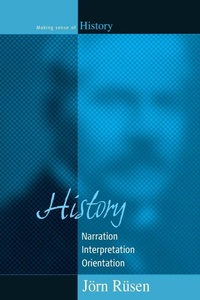
History
Narration, Interpretation, Orientation
1st Edition
Published on 1. January 2005
Book
Paperback/Softback
236 pages
978-1-84545-049-6 (ISBN)
Description
Without denying the importance of the postmodernist approach to the narrative form and rhetorical strategies of historiography, the author, one of Germany's most prominent cultural historians, argues here in favor of reason and methodical rationality in history. He presents a broad variety of aspects, factors and developments of historical thinking from the 18th century to the present, thus continuing, in exemplary fashion, the tradition of critical self-reflection in the humanities and looking at historical studies as an important factor of cultural orientation in practical life.
More details
Series
Language
English
Place of publication
Oxford
United Kingdom
Target group
College/higher education
Professional and scholarly
Product notice
Paperback (trade)
Illustrations
Bibliography; Index
Dimensions
Height: 229 mm
Width: 152 mm
Thickness: 13 mm
Weight
346 gr
ISBN-13
978-1-84545-049-6 (9781845450496)
DOI
10.3167/9781571816245
Copyright in bibliographic data and cover images is held by Nielsen Book Services Limited or by the publishers or by their respective licensors: all rights reserved.
Schweitzer Classification
Other editions
Additional editions
E-Book
01/2005
1st Edition
Berghahn Books
€27.49
Available for download
Person
Joern Ruesen was Professor of Modern History at Universities Bochum and Bielefeld for many years. From 1994 to 1997 he was Director of the Center for Interdisciplinary Research (ZiF) at Bielefeld. Since 1997 he has been President of the Institute for Advanced Study in the Humanities Essen (Kulturwissenschaftliches Institut). He specialises in theory and methodology of historical sciences, the history of historiography, intercultural aspects of historical thinking, theory of historical learning, and the history of human rights.
Content
List of Tables and Figures
Preface
Introduction: How to Understand Historical Thinking
PART I: NARRATION
Chapter 1. Historical Narration: Foundation, Types, Reason
Chapter 2. Narrative Competence: The Ontogeny of Historical and Moral Consciousness
Chapter 3. Rhetoric and Aesthetics of History: Leopold von Ranke
Chapter 4. Narrativity and Objectivity in Historical Studies
PART II: INTERPRETATION
Chapter 5. What is Historical Theory?
Chapter 6. New History: Paradigms of Interpretation
Chapter 7. Theoretical Approaches to an Intercultural Comparison of Historiography
Chapter 8. Loosening the Order of History: Modernity, Postmodernity, Memory
PART III: ORIENTATION
Chapter 9. Historical Thinking as Trauerarbeit: Burckhardt's Answer to a Question of our Time
Chapter 10. Historizing Nazi-Time: Metahistorical Reflections on the Debate Between Friedlaender and Broszat
Chapter 11. Holocaust-Memory and German Identity
Bibliography
Index
Preface
Introduction: How to Understand Historical Thinking
PART I: NARRATION
Chapter 1. Historical Narration: Foundation, Types, Reason
Chapter 2. Narrative Competence: The Ontogeny of Historical and Moral Consciousness
Chapter 3. Rhetoric and Aesthetics of History: Leopold von Ranke
Chapter 4. Narrativity and Objectivity in Historical Studies
PART II: INTERPRETATION
Chapter 5. What is Historical Theory?
Chapter 6. New History: Paradigms of Interpretation
Chapter 7. Theoretical Approaches to an Intercultural Comparison of Historiography
Chapter 8. Loosening the Order of History: Modernity, Postmodernity, Memory
PART III: ORIENTATION
Chapter 9. Historical Thinking as Trauerarbeit: Burckhardt's Answer to a Question of our Time
Chapter 10. Historizing Nazi-Time: Metahistorical Reflections on the Debate Between Friedlaender and Broszat
Chapter 11. Holocaust-Memory and German Identity
Bibliography
Index