

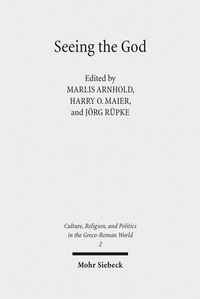
Seeing the God
Image, Space, Performance, and Vision in the Religion of the Roman Empire
1st Edition
Published on 13. August 2018
Book
Hardback
323 pages
978-3-16-155721-7 (ISBN)
Description
Als erste inter- und transdisziplinäre Arbeit richtet der vorliegende Band seinen Fokus auf die Bedeutung der visuellen Kultur in der Erforschung der klassischen, römischen und christlichen Antike. Er untersucht die Rolle des Bildlichen bei der Schaffung einer Vorstellung von den Göttern und wie die Festlegung auf eine Sichtbarkeit des Göttlichen die antiken religiösen Praktiken, Rituale und Überzeugungen beeinflusste. Die enthaltenen Aufsätze umfassen eine große Bandbreite von Fachgebieten wie Archäologie, Ikonologie, Kulturwissenschaften, visuelle Anthropologie, antike Rhetorik und Kognitionswissenschaft, um die visuellen Aspekte in den antiken Religionen von verschiedenen Blickwinkeln betrachten zu können. Dieses bahnbrechende Buch verspricht, die Diskussion um die Bedeutung und Rolle visueller Kultur für die Gestaltung der Religionen der Antike maßgeblich voranzubringen.
More details
Other editions
Additional editions
Jörg Rüpke | Harry O. Maier | Marlis Arnhold
Seeing the God
Image, Space, Performance, and Vision in the Religion of the Roman Empire
E-Book
08/2018
1st Edition
Mohr Siebeck
€144.00
Available for download
Persons
Editor
Born 1962; permanent fellow in Religious Studies at the Max Weber Centre for Advanced Cultural and Social Studies at the University of Erfurt and co-director of the International research group »Religion and Urbanity: Reciprocal Formations.«
is Professor of New Testament and Early Christian Studies at Vancouver School of Theology.
is Akademische Rätin at the Department of Classical Archaeology of the University of Bonn.
Content
Introduction
Section 1: Forms of Imagining Divine Presences and of Referring to Divine Agents
Steven J. Friesen: Material Conditions for Seeing the Divine: The Temple of the Sebastoi at Ephesos and the Vision of the Heavenly Throne in Revelation 4-5 - Katharina Rieger: Imagining the Absent and Perceiving the Present: An Interpretation of Material Remains of Divinities from the Rock Sanctuary at Caesarea Philippi (Gaulantis) - Kristine Iara: Seeing the Gods in Late Antique Rome - Jörg Rüpke: Not Gods Alone: on the Visibility of Religion and Religious Specialists in Ancient Rome
Section 2: Modes of Image Creation and Appropriation of Iconographies and Visual Cues
Richard L. Gordon: Getting it Right: Performative Images in Greco-Egyptian Magical Practice - Marlis Arnhold: Imagining Mithras in Light of Iconographic Standardization and Individual Accentuation - Robin Jensen: The Polymorphous Jesus in Early Christian Image and Text - David Balch: Founders of Rome, of Athens, and of the Church: Romulus, Theseus, and Jesus. Theseus and Ariadne with Athena Visually Represented in Rome, Pompeii and Herculaneum
Section 3: Evocation of Specific Images in People's Minds
Harry O. Maier: Seeing the Blood of God: The Triumphant Charade of Ignatius of Antioch the God-Bearer - Annette Weissenrieder: Space and Vision of the Divine: The Temple Imagery of the Epistle to the Ephesians - Brigitte Kahl: Citadel of the God(s) or Satan's Throne: The Image of the Divine at the Great Altar of Pergamon between Ruler Religion and Apocalyptic Counter-Vision - Vernon K. Robbins: Kinetic Divine Concepts, the Baptist, and the Enfleshed Logos in the Prologue and Precreation Storyline of the Fourth Gospel
Section 1: Forms of Imagining Divine Presences and of Referring to Divine Agents
Steven J. Friesen: Material Conditions for Seeing the Divine: The Temple of the Sebastoi at Ephesos and the Vision of the Heavenly Throne in Revelation 4-5 - Katharina Rieger: Imagining the Absent and Perceiving the Present: An Interpretation of Material Remains of Divinities from the Rock Sanctuary at Caesarea Philippi (Gaulantis) - Kristine Iara: Seeing the Gods in Late Antique Rome - Jörg Rüpke: Not Gods Alone: on the Visibility of Religion and Religious Specialists in Ancient Rome
Section 2: Modes of Image Creation and Appropriation of Iconographies and Visual Cues
Richard L. Gordon: Getting it Right: Performative Images in Greco-Egyptian Magical Practice - Marlis Arnhold: Imagining Mithras in Light of Iconographic Standardization and Individual Accentuation - Robin Jensen: The Polymorphous Jesus in Early Christian Image and Text - David Balch: Founders of Rome, of Athens, and of the Church: Romulus, Theseus, and Jesus. Theseus and Ariadne with Athena Visually Represented in Rome, Pompeii and Herculaneum
Section 3: Evocation of Specific Images in People's Minds
Harry O. Maier: Seeing the Blood of God: The Triumphant Charade of Ignatius of Antioch the God-Bearer - Annette Weissenrieder: Space and Vision of the Divine: The Temple Imagery of the Epistle to the Ephesians - Brigitte Kahl: Citadel of the God(s) or Satan's Throne: The Image of the Divine at the Great Altar of Pergamon between Ruler Religion and Apocalyptic Counter-Vision - Vernon K. Robbins: Kinetic Divine Concepts, the Baptist, and the Enfleshed Logos in the Prologue and Precreation Storyline of the Fourth Gospel