

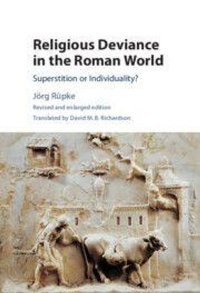
Religious Deviance in the Roman World
Superstition or Individuality?
Published on 16. May 2016
Book
Hardback
159 pages
978-1-107-09052-1 (ISBN)
Description
Religious individuality is not restricted to modernity. This book offers a new reading of the ancient sources in order to find indications for the spectrum of religious practices and intensified forms of such practices only occasionally denounced as 'superstition'. Authors from Cicero in the first century BC to the law codes of the fourth century AD share the assumption that authentic and binding communication between individuals and gods is possible and widespread, even if problematic in the case of divination or the confrontation with images of the divine. A change in practices and assumptions throughout the imperial period becomes visible. It might be characterised as 'individualisation' and informed the Roman law of religions. The basic constellation - to give freedom of religion and to regulate religion at the same time - resonates even into modern bodies of law and is important for juridical conflicts today.
More details
Language
English
Place of publication
Cambridge
United Kingdom
Target group
Professional and scholarly
Product notice
sewn/stitched
Cloth over boards
Dimensions
Height: 239 mm
Width: 155 mm
Thickness: 14 mm
Weight
354 gr
ISBN-13
978-1-107-09052-1 (9781107090521)
Copyright in bibliographic data and cover images is held by Nielsen Book Services Limited or by the publishers or by their respective licensors: all rights reserved.
Schweitzer Classification
Other editions
Additional editions
E-Book
05/2016
Cambridge University Press
€84.49
Available for download
E-Book
05/2016
Cambridge University Press
€71.49
Available for download
Persons
Joerg Ruepke was Chair of Comparative Religion at the University of Erfurt from 1999 to 2015, and is now permanent Fellow for Religious Studies at the Max Weber Center for Advanced Cultural and Social Studies. He is also co-director of the Research Group 'Religious Individualisation in Historical Perspective' and director of the ERC research project 'Lived Ancient Religion'. Since 2012, he has been a member of the German Council of Science and Humanities ('Wissenschaftsrat') and since 2013, Vice-Director of the Max Weber Center. His authored books include Rituals in Ink (2004), The Religions of the Romans (2007), Fasti sacerdotum (2008), The Roman Calendar from Numa to Constantine: Time, History, and the Fasti (2011), Religion in Republican Rome: Rationalization and Ritual Change (2012), Ancients and Moderns: Religion (2013) and From Jupiter to Christ (2014). He has also edited Religion and Law in Classical and Christian Rome (co-edited with Clifford Ando, 2006), A Companion to Roman Religion (2007), Reflections on Religious Individuality (2013) and A Companion to the Archaeology of Religion in the Ancient Mediterranean (co-edited with Rubina Raja, 2015).
Content
1. Superstitio: conceptions of religious deviance in Roman antiquity; 2. Creation of religious norms in the Late Republic; 3. The role of ethos and knowledge in controlling religious deviance: a Tiberian view of priestly deviance; 4. De superstitione: religious experiences best not had in temples; 5. The normative discourse in Late Antiquity; 6. The individual in a world of competing religious norms; 7. Deviance and individuation: from Cicero to Theodosius.