

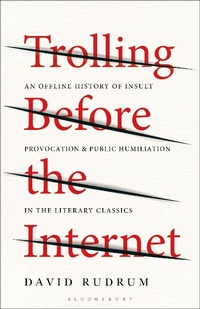
Trolling Before the Internet
An Offline History of Insult, Provocation, and Public Humiliation in the Literary Classics
Published on 14. November 2024
Book
Paperback/Softback
320 pages
978-1-5013-9153-8 (ISBN)
Description
Trolling began long before the internet. This accessible history traces the ancestry of its textual and rhetorical strategies, by looking at literature from ancient Greece to the 1980s.
Trolling is the most controversial genre of writing to have risen to prominence in the 21st century, with far-reaching consequences for its writers and readers alike. But it is too often regarded as a technological problem, confined to the internet. This book takes a very different approach: it regards trolling as a cultural problem with a long and venerable literary history.
Taking in the contrarianism of Lord Byron, the wit of Oscar Wilde, insult trading in Shakespeare, Jonathan Swift's disaster trolling, Martin Luther's dissemination of heresy through a public discussion forum, the grotesquely misogynistic abuse hurled in Archilochus's poetry, the taunting provocations of avant-garde manifestos, and not forgetting public humiliations in Beowulf, David Rudrum demonstrates that trolls' rhetorical shenanigans are neither new nor unvanquishable.
Trolling is the most controversial genre of writing to have risen to prominence in the 21st century, with far-reaching consequences for its writers and readers alike. But it is too often regarded as a technological problem, confined to the internet. This book takes a very different approach: it regards trolling as a cultural problem with a long and venerable literary history.
Taking in the contrarianism of Lord Byron, the wit of Oscar Wilde, insult trading in Shakespeare, Jonathan Swift's disaster trolling, Martin Luther's dissemination of heresy through a public discussion forum, the grotesquely misogynistic abuse hurled in Archilochus's poetry, the taunting provocations of avant-garde manifestos, and not forgetting public humiliations in Beowulf, David Rudrum demonstrates that trolls' rhetorical shenanigans are neither new nor unvanquishable.
Reviews / Votes
[Rudrum's] findings serve as an important first step toward legitimizing the study of trolling as a genre of writing. * Journal of the Midwest Modern Language Association *More details
Language
English
Place of publication
New York
United States
Publishing group
Bloomsbury Publishing Plc
Target group
Professional and scholarly
Dimensions
Height: 153 mm
Width: 228 mm
Thickness: 26 mm
Weight
466 gr
ISBN-13
978-1-5013-9153-8 (9781501391538)
Copyright in bibliographic data and cover images is held by Nielsen Book Services Limited or by the publishers or by their respective licensors: all rights reserved.
Schweitzer Classification
Other editions
Additional editions
David Rudrum
Trolling Before the Internet
An Offline History of Insult, Provocation, and Public Humiliation in the Literary Classics
E-Book
11/2024
1st Edition
Bloomsbury Academic
€22.49
Available for download
David Rudrum
Trolling Before the Internet
An Offline History of Insult, Provocation, and Public Humiliation in the Literary Classics
E-Book
11/2024
1st Edition
Bloomsbury Academic
€22.49
Available for download
Person
David Rudrum is Senior Lecturer in English Literature at the University of Huddersfield, UK. He is the author or editor of four previous publications, including Supplanting the Postmodern (co-edited with Nicholas Stavris, Bloomsbury, 2015) and Stanley Cavell and the Claim of Literature (2013).
Content
Acknowledgements
Prefatory note on content
Introduction:
Trolling in/and/as Literature
Chapter One: Trolling is ...
Trolling and its definitions: What we (don't) know so far
Chapter Two: ...to defame, insult, or humiliate an opponent in public...
From flyting to flaming; from Beowulf to Shakespeare
Chapter Three: ...or to make a public statement...
Trolling the Pope: Martin Luther Goes Viral
Chapter Four: ...of views that are not sincerely held...
U Can Has Babeez! - Jonathan Swift's A Modest Proposal
Chapter Five: ...but instead aim to court controversy...
Oscar Wilde as a contrarian troll, or, How to put the 'wit' into 'Twitter'
Chapter Six: ...or to be provocative or vexatious...
'A Slap in the Face of Public Taste': some avant-garde trolls
Chapter Seven: ...sometimes with legal consequences.
Social justice trolling: Emile Zola's J'Accuse...!
Conclusions
Index
Prefatory note on content
Introduction:
Trolling in/and/as Literature
Chapter One: Trolling is ...
Trolling and its definitions: What we (don't) know so far
Chapter Two: ...to defame, insult, or humiliate an opponent in public...
From flyting to flaming; from Beowulf to Shakespeare
Chapter Three: ...or to make a public statement...
Trolling the Pope: Martin Luther Goes Viral
Chapter Four: ...of views that are not sincerely held...
U Can Has Babeez! - Jonathan Swift's A Modest Proposal
Chapter Five: ...but instead aim to court controversy...
Oscar Wilde as a contrarian troll, or, How to put the 'wit' into 'Twitter'
Chapter Six: ...or to be provocative or vexatious...
'A Slap in the Face of Public Taste': some avant-garde trolls
Chapter Seven: ...sometimes with legal consequences.
Social justice trolling: Emile Zola's J'Accuse...!
Conclusions
Index