

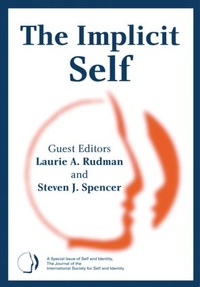
The Implicit Self
A Special Issue of Self and Identity
1st Edition
Published on 3. May 2007
Book
Hardback
184 pages
978-1-84169-826-7 (ISBN)
Description
The ten papers in this special issue of Self and Identity use a variety of cutting-edge empirical approaches to advance social psychological theory and extend the applications of the implicit self to under-investigated domains, including the clinical consequences of the implicit self, the developmental trajectory of implicit associations, and the impact of being a minority member on implicit self-constructs. Principal questions guiding the special issue include: How does the implicit self regulate emotion and defend against ego-threats? When and how does it adapt to changes in social identity and social comparison? What are the consequences of discrepancies between explicit and implicit self-evaluations? When and how do implicit self-identities develop?
More details
Series
Language
English
Place of publication
Hove
United Kingdom
Publishing group
Taylor & Francis Ltd
Target group
College/higher education
Dimensions
Height: 234 mm
Width: 156 mm
Weight
521 gr
ISBN-13
978-1-84169-826-7 (9781841698267)
Copyright in bibliographic data and cover images is held by Nielsen Book Services Limited or by the publishers or by their respective licensors: all rights reserved.
Schweitzer Classification
Other editions
Additional editions
Book
06/2015
1st Edition
Psychology Press Ltd
€47.22
Shipment within 10-20 days
Persons
Professor Laurie A. Rudman, Department of Psychology, Tillett Hall Rutgers, the State University of New Jersey.
Professor Steven J. Spencer, University of Waterloo, ON, Canada
Professor Steven J. Spencer, University of Waterloo, ON, Canada
Content
L. A. Rudman, S. J. Spencer, The Implicit Self. J. A. Steinberg, A. Karpinski, L. B. Alloy, The Exploration of Implicit Aspects of Self-esteem in Vulnerability-stress Models of Depression. S. L. Koole, L. H. M. Coenen, Implicit Self and Affect Regulation: Effects of Action Orientation and Subliminal Self Priming in an Affective Priming Task. V. Zeigler-Hill, C. Terry, Perfectionism and Explicit Self-esteem: The Moderating Role of Implicit Self-esteem. A. K. Sanchez, C. Zogmaister, L. Arcuri, When "They" Becomes "We": Multiple Contrasting Identities in Mixed Status Groups. C. McCall, N. Dasgupta, The Malleability of Men's Gender Self-concept. H. S. Hodgins, A. B. Brown, B. Carver, Autonomy and Control Motivation and Self-esteem. J. Eaton, C. Ward Struthers, A. Shomrony, A. G. Santelli, When Apologies Fail: The Moderating Effect of Implicit and Explicit Self-esteem on Apology and Forgiveness. I. McGregor, C. H. Jordan, The Mask of Zeal: Low Implicit Self-esteem and Defensive Extremism after Self-threat. Y. Dunham, A. S. Barrow, M. R. Banaji, Children and Social Groups: A Developmental Analysis of Implicit Consistency in Hispanic Americans. T. Devos, P. Diaz, E. Viera, R. Dunn, College Education and Motherhood as Components of Self-concept: Discrepancies Between Implicit and Explicit Assessments.