

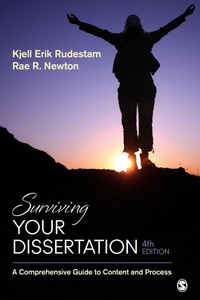
Surviving Your Dissertation
A Comprehensive Guide to Content and Process
4th Edition
Published on 13. August 2014
Book
Paperback/Softback
376 pages
978-1-4522-6097-6 (ISBN)
Description
Perfect for graduate students as well as behavioral and social scientists who supervise and conduct research!
In the fully updated Fourth Edition of their best-selling guide, Surviving Your Dissertation, Kjell Erik Rudestam and Rae R. Newton answer questions concerning every stage of the dissertation process, including
selecting a suitable topic,
conducting a literature review,
developing a research question,
understanding the role of theory,
selecting an appropriate methodology and research design,
analyzing data, and
interpreting and presenting results.
In addition, this must-have guide covers topics that other dissertation guides often miss, such as the many types of quantitative and qualitative research models available, the principles of good scholarly writing, how to work with committees, how to meet IRB and ethical standards, and how to overcome task and emotional blocks. With plenty of current examples, the new edition features an expanded discussion of online research, data collection and analysis, and the use of data archives, as well as expanded coverage of qualitative methods and added information on mixed methods.
In the fully updated Fourth Edition of their best-selling guide, Surviving Your Dissertation, Kjell Erik Rudestam and Rae R. Newton answer questions concerning every stage of the dissertation process, including
selecting a suitable topic,
conducting a literature review,
developing a research question,
understanding the role of theory,
selecting an appropriate methodology and research design,
analyzing data, and
interpreting and presenting results.
In addition, this must-have guide covers topics that other dissertation guides often miss, such as the many types of quantitative and qualitative research models available, the principles of good scholarly writing, how to work with committees, how to meet IRB and ethical standards, and how to overcome task and emotional blocks. With plenty of current examples, the new edition features an expanded discussion of online research, data collection and analysis, and the use of data archives, as well as expanded coverage of qualitative methods and added information on mixed methods.
Reviews / Votes
"This text provides a broad coverage, focused approach for dissertation, balanced approach between quantitative and qualitative designs, and excellent examples." -- Udaya R. Wagle, Western Michigan University "I wish this text was available when I was working on my dissertation as it would have demystified the process greatly!" -- Anne J. Hacker, Walden University "The title is wonderful and attention getting. It's practical and consistent with the title in terms of compliance with requirements while seeking the path of least resistance toward completion of a quality product." -- Bernie Kerr, Central Michigan University "[S]traightforward, well-written, concise and not too cumbersome....gets to the root of what students need to know. I like the detailed explanations and examples for writing each section of the dissertation....The text explains and gives examples of how to write the methodology and the results. I also think the student suggestions are very helpful." -- Kaye Pepper, University of Mississippi "The text is well organized....It includes chapters on the presentation of both quantitative and qualitative results which are particularly welcome in PhD programs that value paradigmatic diversity and do not expect students to conform to the assumptions of a single paradigm such as positivism." -- Karin Klenke, Leadership Development Institute (LDI) InternationalMore details
Edition
4th Revised edition
Language
English
Place of publication
Thousand Oaks
United States
Target group
College/higher education
Edition type
Revised edition
Dimensions
Height: 229 mm
Width: 152 mm
Thickness: 20 mm
Weight
544 gr
ISBN-13
978-1-4522-6097-6 (9781452260976)
Copyright in bibliographic data and cover images is held by Nielsen Book Services Limited or by the publishers or by their respective licensors: all rights reserved.
Schweitzer Classification
Other editions
Previous edition
Kjell Erik Rudestam | Rae R. Newton
Surviving Your Dissertation
A Comprehensive Guide to Content and Process
Book
05/2007
3rd Edition
SAGE Publications Inc
€70.83
Article exhausted; check for reprint
Persons
Kjell Erik Rudestam is Professor of Psychology at Fielding Graduate University, Santa Barbara, California, where he served as Associate Dean of Academic Affairs for many years. He was previously a psychology professor at York University, Toronto, and Miami University, Oxford, Ohio, after receiving his PhD in Psychology (Clinical) from the University of Oregon. He is the author of Your Statistical Consultant: Answers to Your Data Analysis Questions, 2nd edition (also with Rae R. Newton), Handbook of Online Learning, 2nd edition (with Judith Schoenholtz-Read), and eight other books, as well as numerous articles in professional journals on topics including suicide, psychotherapy, and family and organizational systems. He is a Fellow of the American Psychological Association (Division 12), a Diplomate of the American Board of Examiners in Professional
Psychology (Clinical), a Diplomate of the American Academy of Experts in Traumatic Stress, and holds an Honorary Doctorate of Science from The Professional School of Psychology.
Rae R. Newton is Professor of Sociology Emeritus at California State University, Fullerton. He recently joined the faculty of the School of Psychology at Fielding Graduate University where he serves as a research consultant and statistical advisor to doctoral students and faculty. He received his PhD in sociology from the University of California, Santa Barbara, and completed postdoctoral training in mental health measurement at Indiana University. His primary interests include longitudinal modeling of outcomes for high risk youth and foster care populations, family violence and statistics education. He is author, with Kjell Erik Rudestam, of Your Statistical Consultant: Answers to Your Data Analysis Questions, now in its second edition and numerous articles in professional journals on topics including family violence, child maltreatment, and measurement. In semi-retirement he enjoys traveling with his wife in their RV and surfing throughout Mexico and Central America.
Psychology (Clinical), a Diplomate of the American Academy of Experts in Traumatic Stress, and holds an Honorary Doctorate of Science from The Professional School of Psychology.
Rae R. Newton is Professor of Sociology Emeritus at California State University, Fullerton. He recently joined the faculty of the School of Psychology at Fielding Graduate University where he serves as a research consultant and statistical advisor to doctoral students and faculty. He received his PhD in sociology from the University of California, Santa Barbara, and completed postdoctoral training in mental health measurement at Indiana University. His primary interests include longitudinal modeling of outcomes for high risk youth and foster care populations, family violence and statistics education. He is author, with Kjell Erik Rudestam, of Your Statistical Consultant: Answers to Your Data Analysis Questions, now in its second edition and numerous articles in professional journals on topics including family violence, child maltreatment, and measurement. In semi-retirement he enjoys traveling with his wife in their RV and surfing throughout Mexico and Central America.
Content
Part I: Getting Started
Chapter 1: The Research Process
Chapter 2: Selecting a Suitable Topic
Chapter 3: Methods of Inquiry: Quantitative and Qualitative Approaches
PART II: Working with the Content: The Dissertation Chapters
Chapter 4: Literature Review and Statement of the Problem
Chapter 5: The Method Chapter: Describing Your Research Plan
Chapter 6: Presenting the Results of Quantitative Studies
Chapter 7: Presenting the Results of Qualitative Research
Chapter 8: Discussion
PART III: Working with Process: What You Need to Know to Make the Dissertation Easier
Chapter 9: Overcoming Barriers: Becoming an Expert While Controlling Your Own Destiny
Chapter 10: Writing
Chapter 11: How to Complete Your Dissertation Using Online Data Access and Collection
Chapter 12: Guidelines for the Presentation of Numbers in the Dissertation
Chapter 13: Informed Consent and Other Ethical Concerns
Chapter 1: The Research Process
Chapter 2: Selecting a Suitable Topic
Chapter 3: Methods of Inquiry: Quantitative and Qualitative Approaches
PART II: Working with the Content: The Dissertation Chapters
Chapter 4: Literature Review and Statement of the Problem
Chapter 5: The Method Chapter: Describing Your Research Plan
Chapter 6: Presenting the Results of Quantitative Studies
Chapter 7: Presenting the Results of Qualitative Research
Chapter 8: Discussion
PART III: Working with Process: What You Need to Know to Make the Dissertation Easier
Chapter 9: Overcoming Barriers: Becoming an Expert While Controlling Your Own Destiny
Chapter 10: Writing
Chapter 11: How to Complete Your Dissertation Using Online Data Access and Collection
Chapter 12: Guidelines for the Presentation of Numbers in the Dissertation
Chapter 13: Informed Consent and Other Ethical Concerns