

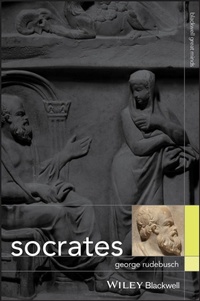
Socrates
1st Edition
Published on 11. September 2009
Book
Paperback/Softback
240 pages
978-1-4051-5086-6 (ISBN)
Description
Socrates presents a compelling case for some life-changing conclusions that follow from a close reading of Socrates' arguments.
Offers a highly original study of Socrates and his thought, accessible to contemporary readers
Argues that through studying Socrates we can learn practical wisdom to apply to our lives
Lovingly crafted with humour, thought-experiments and literary references (from the Iliad to Harry Potter), and with close reading sof key Socratic arguments
Aids readers with diagrams to make clear complex arguments
Offers a highly original study of Socrates and his thought, accessible to contemporary readers
Argues that through studying Socrates we can learn practical wisdom to apply to our lives
Lovingly crafted with humour, thought-experiments and literary references (from the Iliad to Harry Potter), and with close reading sof key Socratic arguments
Aids readers with diagrams to make clear complex arguments
Reviews / Votes
"The book is well and lucidly written, with plentiful tables and diagrams and excerpts . . ..She will have to be a bright student, because some of Rudebusch's arguments are quite subtle; but I, for one, would have no hesitation in recommending the book to such a student." (The Heythrop Journal, 4 September 2013)"This relatively short volume serves as an excellent introduction to Socratic philosophy. Readers who are new to the enigmatic philosopher will learn much about who he was, what his principal doctrines were and why he held them. Remarkably comprehensive in its scope, it is throughout lucid, engaging and provocative. But this is also a book that will benefit even the most seasoned scholars regardless of how they view the author's basic interpretative stance. [The author's] reconstructions of Socrates' arguments for his 'wild ideas' are invariably rigorous, plausible, faithful to the text and well informed by current scholarly debates. It is a rare book that so well serves such different readerships." (Thomas Brickhouse, The Classical Review, 2011) "A lucid and engaging account of the philosophy of Socrates. ... The experience of this book will be joyous for many readers, as it was for me. Rudebusch's advocacy of Socrates as a thinker who has much to tell us about the good human life is carried off with passion and grace, as well as an enviable succinctness and clarity. It is a treatment that I expect will succeed, deservedly, in winning over new advocates." (Notre Dame Philosophical Reviews, April 2010)
More details
Series
Language
English
Place of publication
Hoboken
United Kingdom
Publishing group
John Wiley and Sons Ltd
Product notice
Paperback (trade)
Unsewn / adhesive bound
Dimensions
Height: 230 mm
Width: 152 mm
Thickness: 23 mm
Weight
360 gr
ISBN-13
978-1-4051-5086-6 (9781405150866)
Copyright in bibliographic data and cover images is held by Nielsen Book Services Limited or by the publishers or by their respective licensors: all rights reserved.
Schweitzer Classification
Other editions
Additional editions
Person
George Rudebusch is Professor of Philosophy at Northern Arizona University. He is the author of Socrates, Pleasure, and Value (1999).
Content
Acknowledgments.
Translations Used.
Introduction. The Ion:
1. Interpreting Socrates
The Apology:
2. Mission From God
3. Puzzling Notoriety
The Protagoras:
4. Bravery
5. Knowledge Rules
The Laches:
6. Bravery Again
7. Puzzling Pedagogy
The Lysis:
8. Love
The Euthydemus:
9. Luck
The Meno:
10. Desire
Book 1 of the Republic:
11. Benevolence
12. Happiness
13. Freedom
The Euthyphro:
14. Reverence
The Crito:
15. World Religion
The Phaedo:
16. Last Words
Epilogue: Socrates or Plato?
Index of Passages Cited.
General Index.
Translations Used.
Introduction. The Ion:
1. Interpreting Socrates
The Apology:
2. Mission From God
3. Puzzling Notoriety
The Protagoras:
4. Bravery
5. Knowledge Rules
The Laches:
6. Bravery Again
7. Puzzling Pedagogy
The Lysis:
8. Love
The Euthydemus:
9. Luck
The Meno:
10. Desire
Book 1 of the Republic:
11. Benevolence
12. Happiness
13. Freedom
The Euthyphro:
14. Reverence
The Crito:
15. World Religion
The Phaedo:
16. Last Words
Epilogue: Socrates or Plato?
Index of Passages Cited.
General Index.