

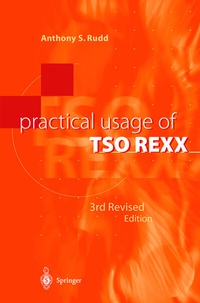
Practical Usage of TSO REXX
3rd Edition
Published on 29. March 2000
Book
Paperback/Softback
XV, 342 pages
978-1-85233-261-7 (ISBN)
Description
REXX is a general purpose language which is easy to learn. It contains an extensive library of powerful functions which greatly reduces the amount of coding necessary to write applications. The use of REXX in a wide range of environments simplifies the writing of applications to run under different hardware and operating systems, and its expansibility allows other components to make sure of REXX facilities and vice versa.
Practical Usage of TSO REXX provides a concise source of information for the development and implication of applications using the REXX language. The author adopts a practical approach, using lists and diagrams to illustrate relevant points.
This third edition, (previously titled Practical Usage of MVS REXX), has been revised to include the new REXX features introduced for the OS/390 TSO/E environment.
Practical Usage of TSO REXX provides a concise source of information for the development and implication of applications using the REXX language. The author adopts a practical approach, using lists and diagrams to illustrate relevant points.
This third edition, (previously titled Practical Usage of MVS REXX), has been revised to include the new REXX features introduced for the OS/390 TSO/E environment.
More details
Edition
Third Edition 2000
Language
English
Place of publication
London
United Kingdom
Target group
Professional and scholarly
Research
Illustrations
XV, 342 p.
Dimensions
Height: 235 mm
Width: 155 mm
Thickness: 20 mm
Weight
546 gr
ISBN-13
978-1-85233-261-7 (9781852332617)
DOI
10.1007/978-1-4471-0755-2
Schweitzer Classification
Other editions
Additional editions
Anthony S. Rudd
Practical Usage of TSO REXX
E-Book
12/2012
3rd Edition
Springer
€53.49
Available for download
Previous edition
Anthony S. Rudd
Practical Usage of MVS REXX
Book
09/1996
2nd Edition
Springer
€85.55
Article exhausted; check for reprint
Content
1. Introduction.- 1.1 REXX background.- 1.2 REXX characteristics.- 1.3 REXX applications.- 1.4 REXX's future.- 2. REXX Facilities.- 2.1 Introduction.- 2.2 REXX structure.- 2.3 REXX expressions.- 2.4 Statements.- 2.5 Invocation of a REXX exec.- 2.6 Comparison with CLISTs.- 3. REXX Processing Elements.- 3.1 Introduction.- 3.2 Statements.- 3.3 Routines.- 3.4 Types of instruction.- 3.5 Control processing flow.- 3.6 Assignment.- 3.7 Stack (queue) processing.- 3.8 Parsing.- 3.9 Debugging.- 3.10 Miscellaneous instructions.- 3.11 Commands.- 3.12 Special variables.- 4. REXX Instructions.- 4.1 Introduction.- 4.2 Instruction descriptions.- 4.3 Examples.- 5. Exception Handling.- 5.1 Introduction.- 5.2 Condition traps.- 5.3 Explicit invocation.- 6. String Processing.- 6.1 Introduction.- 6.2 Word parsing.- 6.3 Delimiter parsing.- 6.4 Positional parsing.- 6.5 Dynamic parsing.- 6.6 Argument parsing.- 6.7 Worked examples.- 7. Numbers and Arithmetic.- 7.1 Introduction.- 7.2 Number.- 7.3 Arithmetic operators.- 7.4 Precision and representation.- 7.5 Sequence of operations.- 7.6 Numeric formatting.- 8. Input/Output.- 8.1 Introduction.- 8.2 Data buffering.- 8.3 Opening and closing the data files.- 8.4 Terminal operations.- 8.5 File-mode operations.- 9. Debugging.- 9.1 Introduction.- 9.2 Exception conditions.- 9.3 Tracing options.- 9.4 Trace output.- 9.5 Interactive debug.- 9.6 Parametric debug.- 9.7 Errors with host commands and functions.- 10. REXX Built-in Functions.- 10.1 Introduction.- 10.2 Function definitions.- 10.3 Examples.- 11. Host REXX Commands.- 11.1 Introduction.- 11.2 Host REXX command definitions.- 11.3 Example.- 12. MVS Command Functions.- 12.1 Introduction.- 12.2 MVS command function calls.- 12.3 Invocation of other TSO commands.- 12.4 Example.- 13. REXX Invocation.- 13.1Introduction.- 13.2 Invocation from TSO/ISPF.- 13.3 Invocation from batch TSO.- 13.4 Invocation from batch.- 13.5 Linkage to the host environment.- 13.6 Linkage to programs.- 13.7 Interface with ISPEXEC (ISPF Dialog Manager).- 13.8 Interface with ISREDIT (ISPF/PDF Edit macro).- 13.9 Interface with DB2 (Database2).- 13.10 Interface with QMF (Query Management Facility).- 13.11 Interface from programs with REXX.- 14. System Interfaces.- 14.1 Introduction.- 14.2 General conditions.- 14.3 Invocation of a REXX exec.- 14.4 Interface from programs to REXX processor (IRXEXEC).- 14.5 Program access to REXX variables (IRXEXCOM service).- 14.6 Stack processing (IRXSTK service).- 14.7 Command interface.- 14.8 Function interface.- 14.9 Function package.- 14.10 Load routine (IRXLOAD service).- 14.11 Initialisation routine (IRXINIT service).- 14.12 Get result (IRXRLT service).- 14.13 Control blocks.- 14.14 Examples.- 15. Worked Examples.- 15.1 Introduction.- 15.2 Worked example.- 15.3 Worked example.- 15.4 Worked example.- 15.5 Worked example.- 15.6 Worked example.- 16. REXX Compiler.- 16.1 Introduction.- 16.2 JCL procedures.- 16.3 Compiler options.- 16.4 Combining compiled objects.- 16.5 Stubs.- 16.6 Performance.- 16.7 Compatibilty.- 17. Other Environments.- 17.1 Introduction.- 17.2 REXX for CICS.- 17.3 REXX for UNIX Services.- 18. Program Development.- 18.1 Introduction.- 18.2 Reusability.- 18.3 Readability.- 18.4 Reliability.- 18.5 Maintainability.- 18.6 Compatibility.- 18.7 Performance.- 18.8 Expansibility.- 18.9 Stepwise refinement.- 18.10 Portability.- 18.11 Testing.- 18.12 Run-time debugging.- 18.13 Development with the REXX compiler.- Appendix A. Syntax Notation.- Appendix B. Glossary.