

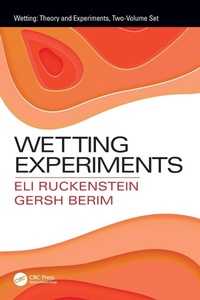
Wetting Experiments
1st Edition
Published on 6. December 2018
Book
Hardback
375 pages
978-1-138-39333-2 (ISBN)
Description
Wetting Experiments contains experimental wetting studies related to biological problems, polymers, and catalysts. An understanding of wetting is important for numerous practical applications, such as preparing self-cleaning surfaces, manufacturing artificial blood vessels, and developing new lubricants and nonadhesive dishes. As part of Wetting: Theory and Experiments, Two-Volume Set, thisvolume provides new insights into wetting experiments and fills a need not addressed by other books. Biology-related studies are devoted to the problem synthetic materials selection for use in biological media. Polymers are examined to estimate various surface characteristics, such as the ability of polymeric solids to alter their surface structures between different environments to minimize their interfacial free energy.
Aimed at engineers, physical scientists, and materials scientists, this volume addresses the key areas of wetting, providing insights valuable to the field.
Aimed at engineers, physical scientists, and materials scientists, this volume addresses the key areas of wetting, providing insights valuable to the field.
More details
Series
Language
English
Place of publication
London
United Kingdom
Publishing group
Taylor & Francis Ltd
Target group
College/higher education
Illustrations
129 s/w Abbildungen
129 Illustrations, black and white
Dimensions
Height: 260 mm
Width: 183 mm
Thickness: 25 mm
Weight
919 gr
ISBN-13
978-1-138-39333-2 (9781138393332)
Copyright in bibliographic data and cover images is held by Nielsen Book Services Limited or by the publishers or by their respective licensors: all rights reserved.
Schweitzer Classification
Other editions
Additional editions
Eli Ruckenstein | Gersh Berim
Wetting Experiments
E-Book
11/2018
1st Edition
CRC Press
€73.49
Available for download
Eli Ruckenstein | Gersh Berim
Wetting Experiments
E-Book
11/2018
1st Edition
CRC Press
€73.99
Available for download
Persons
Eli Ruckenstein is a State University of New York (SUNY) Distinguished Professor at the SUNY at Buffalo. He has published more than 1000 papers in numerous areas of engineering science and has received a large number of awards from the American Chemical Society and the American Institute of Chemical Engineers. Dr. Ruckenstein has also received the Founders Gold Medal Award from the National Academy of Engineering and the National Medal of Science from President Clinton. He is a member of the National Academy of Engineering and of the American Academy of Art and Sciences.
Gersh Berim earned his PhD in Theoretical and Mathematical Physics from Kazan State University in Russia in 1978. He has authored or coauthored 70+ papers. His research interests include statics, kinetics, and dynamics of low-dimensional spin systems, kinetic theory of nucleation, and wetting at the nanoscale. Since 2001, he has been working in the group of Dr. Ruckenstein at SUNY at Buffalo. Previously, he was a visiting research scholar at the Institute of Physics "Gleb Wataghin" of the University of Campinas, Brazil (1995-1996), and at the Institute of Theoretical Physics I of the University of Erlangen, Germany (1998-2000).
Gersh Berim earned his PhD in Theoretical and Mathematical Physics from Kazan State University in Russia in 1978. He has authored or coauthored 70+ papers. His research interests include statics, kinetics, and dynamics of low-dimensional spin systems, kinetic theory of nucleation, and wetting at the nanoscale. Since 2001, he has been working in the group of Dr. Ruckenstein at SUNY at Buffalo. Previously, he was a visiting research scholar at the Institute of Physics "Gleb Wataghin" of the University of Campinas, Brazil (1995-1996), and at the Institute of Theoretical Physics I of the University of Erlangen, Germany (1998-2000).
Content
1. Biology Related Experiments 2. Experiments on Wetting of Polymers 3. Experiments on Wetting by Catalysts