

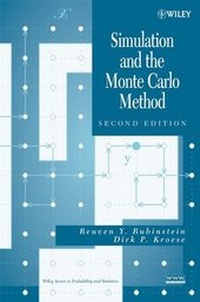
Simulation and the Monte Carlo Method
2nd Edition
Published on 19. December 2007
Book
Hardback
372 pages
978-0-470-17794-5 (ISBN)
Description
This accessible new edition explores the major topics in Monte Carlo simulation
Simulation and the Monte Carlo Method, Second Edition reflects the latest developments in the field and presents a fully updated and comprehensive account of the major topics that have emerged in Monte Carlo simulation since the publication of the classic First Edition over twenty-five years ago. While maintaining its accessible and intuitive approach, this revised edition features a wealth of up-to-date information that facilitates a deeper understanding of problem solving across a wide array of subject areas, such as engineering, statistics, computer science, mathematics, and the physical and life sciences.
The book begins with a modernized introduction that addresses the basic concepts of probability, Markov processes, and convex optimization. Subsequent chapters discuss the dramatic changes that have occurred in the field of the Monte Carlo method, with coverage of many modern topics including:
Markov Chain Monte Carlo
Variance reduction techniques such as the transform likelihood ratio method and the screening method
The score function method for sensitivity analysis
The stochastic approximation method and the stochastic counter-part method for Monte Carlo optimization
The cross-entropy method to rare events estimation and combinatorial optimization
Application of Monte Carlo techniques for counting problems, with an emphasis on the parametric minimum cross-entropy method
An extensive range of exercises is provided at the end of each chapter, with more difficult sections and exercises marked accordingly for advanced readers. A generous sampling of applied examples is positioned throughout the book, emphasizing various areas of application, and a detailed appendix presents an introduction to exponential families, a discussion of the computational complexity of stochastic programming problems, and sample MATLAB(r) programs.
Requiring only a basic, introductory knowledge of probability and statistics, Simulation and the Monte Carlo Method, Second Edition is an excellent text for upper-undergraduate and beginning graduate courses in simulation and Monte Carlo techniques. The book also serves as a valuable reference for professionals who would like to achieve a more formal understanding of the Monte Carlo method.
Reviews / Votes
"The book is clearly written and easy to read for people with mathematical background.... The material of the book is useful in most areas of the nowadays research work." (International Statistical Review, April 2009) "I enjoyed reading the book, and found the individual examples quite interesting." (Biometrics, December 2008) "I enjoyed reading the book, and found the individual examples quite interesting." (Biometrics, December 2008) "..if you need to learn how to use Monte Carlo in your simulations, this is probably the best single document I have ever read. "(Computing Reviews, September 2008) "Rubinstein and Kroese did an exemplary job of addressing major issues and providing much needed updated information in this area." (CHOICE, June 2008) "the book is nicely written and the additional to the book from the 1st edition certainly make it more attractive to a wider audience. I would recommend it to students and practioners with appropriate background." (MAA Review March 2008)More details
Series
Edition
2. Auflage
Language
English
Place of publication
Hoboken
United States
Publishing group
John Wiley and Sons Ltd
Target group
Professional and scholarly
Edition type
New edition
Dimensions
Height: 23.8 cm
Width: 16.3 cm
Thickness: 2.3 cm
Weight
653 gr
ISBN-13
978-0-470-17794-5 (9780470177945)
Schweitzer Classification
Other editions
New editions
Reuven Y. Rubinstein | Dirk P. Kroese
Simulation and the Monte Carlo Method
Book
12/2016
3rd Edition
Wiley
€135.00
Shipment within 15-20 days
Additional editions
Reuven Y. Rubinstein | Dirk P. Kroese
Simulation and the Monte Carlo Method
E-Book
09/2011
2nd Edition
Wiley
€108.99
Available for download
Reuven Y. Rubinstein | Dirk P. Kroese
Simulation and the Monte Carlo Method
E-Book
02/2008
2nd Edition
Wiley
€108.99
Available for download
Persons
Reuven Y. Rubinstein, DSc, is Professor Emeritus in the Faculty of Industrial Engineering and Management at Technion-Israel Institute of Technology. He has served as a consultant at numerous large-scale organizations, such as IBM, Motorola, and NEC. The author of over 100 articles and six books, Dr. Rubinstein is also the inventor of the popular score-function method in simulation analysis and generic cross-entropy methods for combinatorial optimization and counting.
Dirk P. Kroese, PhD, is Senior Lecturer in Statistics in the Department of Mathematics at The University of Queensland, Australia. He has published over fifty articles in a wide range of areas in applied probability and statistics, including Monte Carlo methods, cross-entropy, randomized algorithms, tele-traffic theory, reliability, computational statistics, applied probability, and stochastic modeling.
Content
Preface.
Acknowledgments.
1. Preliminaries 1.
1.1 Random Experiments.
1.2 Conditional Probability and Independence.
1.3 Random Variables and Probability Distributions.
1.4 Some Important Distributions.
1.5 Expectation.
1.6 Joint Distributions.
1.7 Functions of Random Variables.
1.8 Transforms.
1.9 Jointly Normal Random Variables.
1.10 Limit Theorems.
1.11 Poisson Processes.
1.12 Markov Processes.
1.13 Efficiency of Estimators.
1.14 Information.
1.15 Convex Optimization and Duality.
Problems.
References.
2. Random Number, Random Variable and Stochastic Process Generation.
2.1 Introduction.
2.2 Random Number Generation.
2.3 Random Variable Generation.
2.4 Generating From Commonly Used Distributions.
2.5 Random Vector Generation.
2.6 Generating Poisson Processes.
2.7 Generating Markov Chains and Markov Jump Processes.
2.8 Generating Random Permutations.
Problems.
References.
3. Simulation of Discrete Event Systems.
3.1 Simulation Models.
3.2 Simulation Clock and Event List for DEDS.
3.3 Discrete Event Simulation.
Problems.
References.
4. Statistical Analysis of Discrete Event Systems.
4.1 Introduction.
4.2 Static Simulation Models.
4.3 Dynamic Simulation Models.
4.4 The Bootstrap Method.
Problems.
References.
5. Controlling the Variance.
5.1 Introduction.
5.2 Common and Antithetic Random Variables.
5.3 Control Variables.
5.4 Conditional Monte Carlo.
5.5 Stratified Sampling.
5.6 Importance Sampling.
5.7 Sequential Importance Sampling.
5.8 The Transform Likelihood Ratio Method.
5.9 Preventing the Degeneracy of Importance Sampling.
Problems.
References.
6. Markov Chain Monte Carlo.
6.1 Introduction.
6.2 The Metropolis-Hastings Algorithm.
6.3 The Hit-and-Run Sampler.
6.4 The Gibbs Sampler.
6.5 Ising and Potts Models.
6.6 Bayesian Statistics.
6.7 Other Markov Samplers.
6.8 Simulated Annealing.
6.9 Perfect Sampling.
Problems.
References.
7. Sensitivity Analysis and Monte Carlo Optimization.
7.1 Introduction.
7.2 The Score Function Method for Sensitivity Analysis of DESS.
7.3 Simulation-Based Optimization of DESS.
7.4 Sensitivity Analysis of DEDS.
Problems.
References.
8. The Cross-Entropy Method.
8.1 Introduction.
8.2 Estimation of Rare Event Probabilities.
8.3 The CE-Method for Optimization.
8.4 The Max-cut Problem.
8.5 The Partition Problem.
8.6 The Travelling Salesman Problem.
8.7 Continuous Optimization.
8.8 Noisy Optimization.
Problems.
References.
9. Counting via Monte Carlo.
9.1 Counting Problems.
9.2 Satisfiability Problem.
9.3 The Rare-Event Framework for Counting.
9.4 Other Randomized Algorithms for Counting.
9.5 MinxEnt and Parametric MinxEnt.
9.6 PME for COPs and Decision Making.
9.7 Numerical Results.
Problems.
References.
Appendix A.
A.1 Cholesky Square Root Method.
A.2 Exact Sampling from a Conditional Bernoulli Distribution.
A.3 Exponential Families.
A.4 Sensitivity Analysis.
A.5 A simple implementation of the CE algorithm for optimizing the 'peaks' function.
A.6 Discrete-time Kalman Filter.
A.7 Bernoulli Disruption Problem.
A.8 Complexity of Stochastic Programming Problems.
Problems.
References.
Acronyms.
List of Symbols.
Index.